
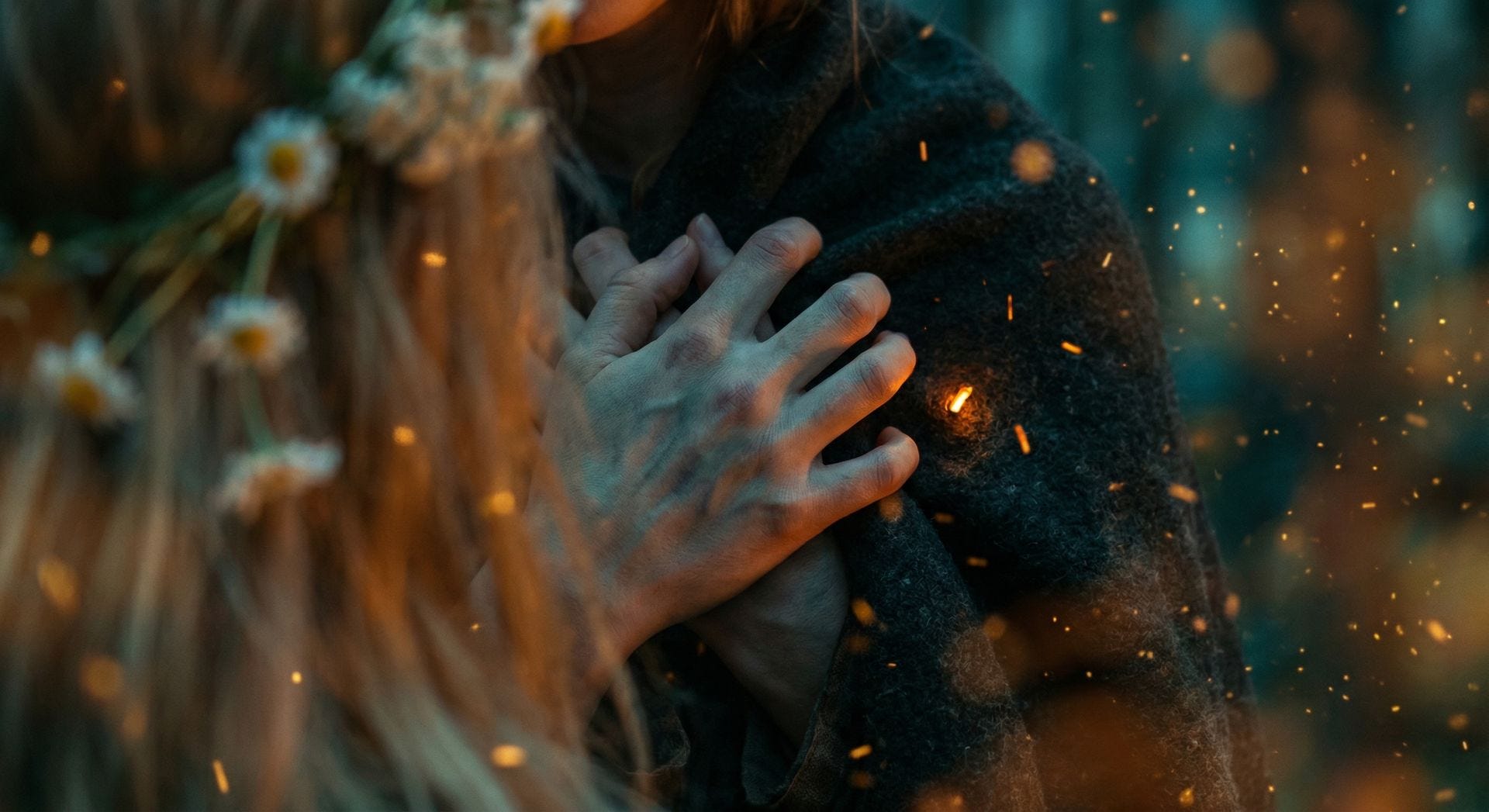
The fire was built low and wide, breathing rather than roaring, fed with birch and resin so it glowed steady and alive. Sparks lifted slowly into the night, rising like thoughts released and not called back.
The women gathered barefoot around it, skirts lifted just enough to move freely, linen pale against the darkening grass. No men crossed the boundary of stones. They never had. This night belonged to women alone. They called it Dew Night, though the elders named it more formally, as they did all old things: the Kupolė Circle. Linde had always preferred the simpler name. Dew clung to the earth. Dew cooled heated skin. Dew gathered quietly, without asking permission.
Linde stepped into the circle with her friends, her bare feet sinking into ground still warm from the day. She wore no jewels beyond the flower crown she had woven herself: chamomile for calm, fern for protection, yarrow tucked at the back for courage. The choices mattered. Everyone knew that.
If anyone mistook her for a maid instead of a king’s daughter, she did not correct them.
She did not care.
Laila caught Linde’s eye across the fire and lifted the cup slightly in salute. Laila was taller, a few years older, fuller, a gorgeous woman entirely unashamed of the space she occupied, Laila stood with the easy confidence of someone who had already learned that the world would try to limit her, and had decided not to cooperate. Her golden hair was unbound, her smile sharp with affection and mischief in equal measure.
“Gather ‘round, little birds,” Laila called out, her voice a sultry hum that silenced the giggles. She gestured to the grass, and the girls sat in a tight, expectant circle. “Before I hand you this cup and leave you to the spirits so I can go home to my hungry children, you need to know what you’re actually looking for in that fire.”
“We’re looking for husbands, Laila!” Vasja chirped, making the others laugh.
“A husband is a contract, darling,” Laila countered with a wink, leaning in until the firelight turned her eyes into amber. “A husband is a figure on a ledger. You are looking for a partner. You are looking for the man who sees the person beneath the facade.”
She paused, letting the crackle of the birch logs fill the silence. “Look at me and Andrej. You all know him as the king’s son, the brave warrior who looks like he could crush a boulder with his bare hands. When I met him in Queen Velena’s chambers, I was just a village girl, her midwife apprentice. I was covered in herb dust and smelled of vinegar and valerian. I was a scholar, girls! I had a mind like a steel trap and no time for a man, not even the Queen’s own son. I thought, ‘Laila, don’t you dare slip. This training is the only thing that belongs to you.’“
“Did he chase you?” Nastja whispered, wide-eyed.
“He didn’t have to chase me; he simply became unavoidable,” Laila laughed, a rich, earthy sound. “He spent so much time in his mother’s chambers ‘checking on her’ that Velena started asking if he’d developed a sudden interest in midwifery. I mentioned once, just once, mind you, that I needed a rare mountain lichen that only grows on the northern face of the jagged peaks for a healing potion.”
Laila leaned closer, her voice dropping to a conspiratorial whisper. “The next day, it appeared on my worktable. Perfectly cleaned. No note. The day after that, it was fresh mint. Then a rare root from the deep marshes. He did that for months, bringing me rare ingredients like a silent, oversized cat bringing gifts to its mistress. He never spoke; he just watched me from the doorway, his eyes following my hands as I worked. He didn’t want a maid to serve him; he wanted to be the soil that my roots grew in.”
“But when did you know?” Linde asked softly.
Laila’s expression softened. “When he had to join your father, King Artemij, to fight in the border wars. For weeks, the table was empty. No lichen. No roots. The silence of that room was louder than a drum. I realized then that I wasn’t just missing ingredients; I was missing my shadow. I was terrified he had been killed... that some Pecheneg blade had silenced that steady heart. That’s when the truth hit me like a falling tree. Missing him was harder than breathing. It wasn’t a want, Linde. It was a requirement.”
She gestured toward the flickering flames. “When he finally returned, he didn’t even wash the road-dust from his face before finding me. We bumped into each other in the corridor, and we didn’t wait for permission or a formal contract. Our lips met, and well... let’s just say I wasn’t a virgin on my wedding night. Tradition is a cold bedfellow, girls. Queen Velena knew, of course, she saw everything,but she protected us. She saw that our love was the real rite of passage, older than any tradition and stronger than any law.”
Linde listened, smiling, half-amused and half-analytical.
She liked stories that pretended to be about romance but were actually about pattern recognition. Andrej had not conquered Laila. He had studied her. Watched. Adjusted. Learned where not to push.
An excellent survival strategy, she thought. Rare among men.
Laila lifted the cup again, the steam rising like a veil. “So, drink. Don’t look for a man who wants to guard you like a prisoner in a tower. Look for the man who brings you the lichen you need to do your work. Look for the one who makes you feel like you’ve finally stopped holding your breath. Drink. And hope for a man who breaks the rules for you.”
“Drink,” she said softly when the cup reached Linde’s hands. “And don’t overthink it. I mixed it myself.”
“That is precisely why I’m overthinking it,” Linde murmured under her breath as the cup touched her lips. The draught was warm and dark, honeyed at first, bitter beneath. Linde knew its temperament by scent alone. Mugwort to loosen the dreaming mind. Sweet herbs to soften fear. Something sharper, measured carefully, never enough to cloud, only to open.
Half medicine. Half permission.
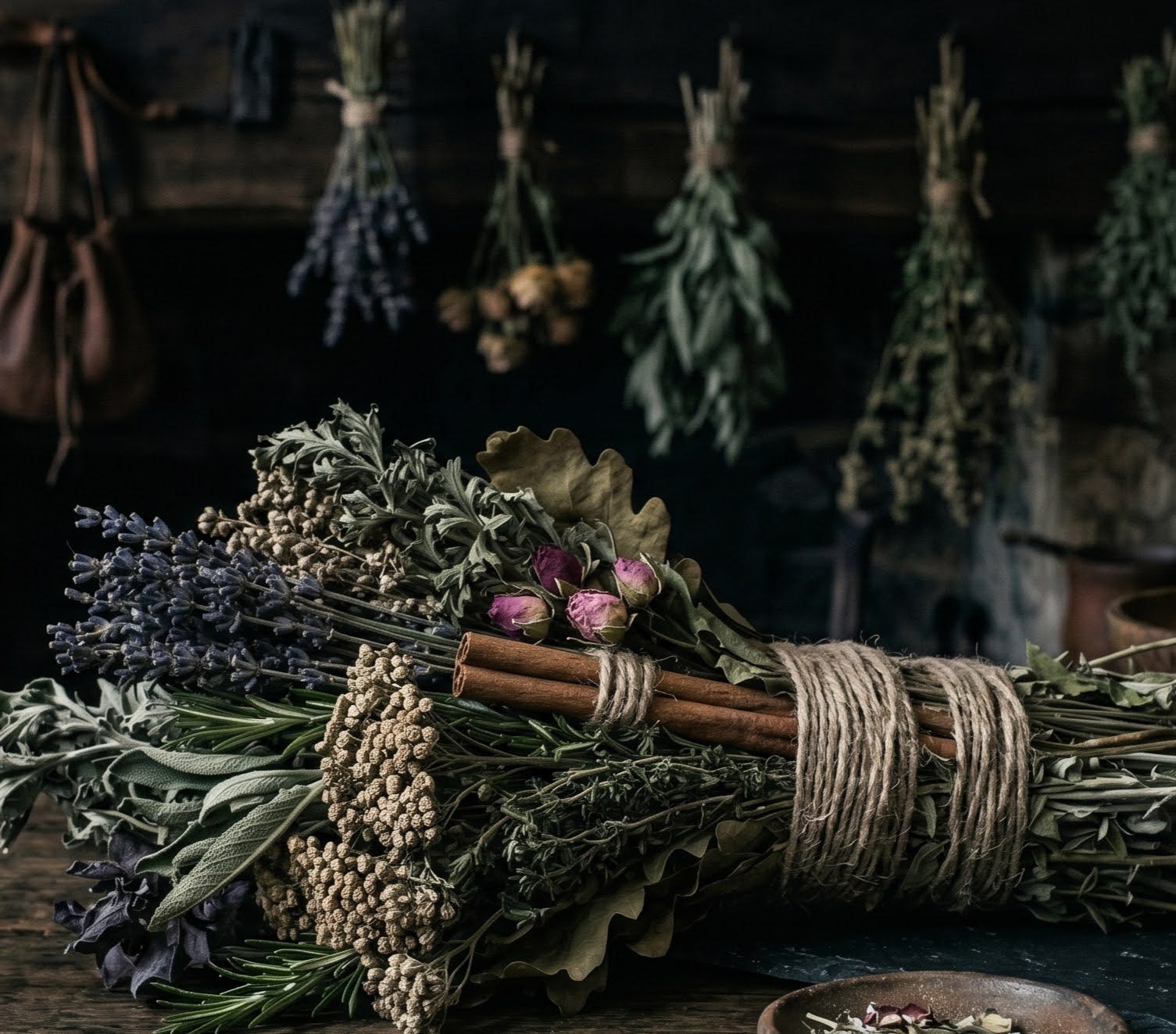
The draught was not taken for pleasure alone. On Dew Night, it was said to thin the veil between what was hoped for and what would come, to sharpen the dreaming mind so a woman might glimpse the shape of the one meant to walk beside her.
She had seen what love could look like: her beloved oldest brother Andrej, ten years her senior, a a brave, kind hearted warrior, and his wife Laila, Linde’s best friend, devotion worn openly, desire unashamed, a man steady enough to worship a woman without needing to own her. Linde wanted nothing less.
Warmth spread through her chest, then her limbs, easing a tension she hadn’t realized she carried. Laughter came more easily after that. The night felt closer, as if the dark itself leaned in to listen.
The rhythm began without command, hands clapping, feet stamping, breath syncing. The circle widened. Hair came loose. Firelight painted gold along arms and throats, along the soft hollows at the base of women’s necks. Linde danced. Not to be seen. Not to impress.
She danced because her body remembered what her mind did not need to command.
Loose strands of honey-pale hair slipped free of her braid almost immediately, catching the firelight in a way that annoyed her. She pushed them back with a quiet huff and kept moving. Her hair had never respected order, no matter how often she tried to impose it.
The song rose, low, repeating, shaped by generations rather than invention. It spoke of blood and moonlight, of women who bled and birthed and buried and endured, and still sang.
Linde joined when the melody reached her, her voice slipping easily into place. Not loud. Just clear.
The draught sharpened her awareness. She noticed breath, balance, the subtle sway of posture in the girls around her. She always noticed such things. Her mother used to say the body spoke long before the mouth did, and people had crossed rivers and borders to watch her listen.
Her mother. The thought came with a familiar ache, braided tightly with pride.
They still spoke of her in reverent tones. The great healer. As if the word might keep her close. Linde felt her absence most sharply on nights like this, when women gathered in knowledge and fire and belonging, when joy pressed so close it almost hurt.
She was eighteen. Of age. No longer a child. Joy rose in her chest, bright and unfamiliar, and grief rose with it, steady as breath. Her mother had loved children fiercely. Had loved life. Had wanted one more. Linde danced for both of them.
When the circle spun wide, she slipped away quietly, unnoticed in the whirl of movement, and walked toward the edge of the clearing. Dew cooled her soles. The forest waited, dense and dark, listening. “I’m here,” she thought, not aloud, but inward, the way she had learned to speak when words felt too small.
The fire blurred at the edges. Sparks lifted like living things.
Linde closed her eyes.
The dream did not arrive as a vision, but as a feeling. The dream came in layers. At first, it was stillness. Linde stood barefoot on damp earth, the night breathing around her. There was no fire she could see, yet a low warmth pulsed at the edges of things, as if flame had passed through once and left its memory behind.
Mother, she thought, not as a plea, but as a reaching. The presence answered without form or voice. Calm. Steady. The way her mother had always been, a hand at her back rather than a word in her ear. Understanding came first, settling gently into her mind.
She sensed a person not as a body, but as a way of standing in the world. A steadiness that did not waver under pressure. A courage that did not seek notice. Someone who stepped forward when others pulled away, not to conquer, but to hold the line. Her thoughts quieted. Her questions softened. Respect came before longing. Safety before desire. The warmth behind her ribs deepened, a quiet glow spreading through her chest. Breathing felt easier. Being felt easier. Then Linde leaned into the dream, curiosity stirring.
But how will I know? she asked, with the boldness of wanting more. Show me. The night shifted. The dream deepened.
The warmth behind Linde’s ribs no longer waited. It spread with quiet intention, unfurling through her chest until her breasts felt heavy and achingly full, the peaks tightening beneath the thin linen as if they had been touched by flame. She gasped softly, startled by the sudden intimacy of her own body. Her mouth went dry.
Awareness sharpened everywhere at once, her skin, her breath, the slow arch of her back as the heat drifted lower, settling deep in her belly. The sensation was unfamiliar and powerful, a pull she had never known before, gathering between her thighs with a steady insistence that made her shift instinctively. She flushed, overwhelmed by how much she felt.
The fire did not rush her. It did not command. It surrounded her.
When she stopped bracing against it and let herself open to the sensation instead of fearing it, the warmth surged, rolling through her in slow, luminous waves. Her breath broke apart. Her body answered in ways she did not yet have language for, hips tipping slightly as the feeling crested higher and higher. Pleasure bloomed, sudden, blinding, spreading outward until she was nothing but sensation: heat and breath and release, her body trembling as the fire swept through her completely. And within that moment, that exquisite undoing, she understood.
This was not hunger. This was love. A love that filled rather than consumed. A love that felt steady even as it overwhelmed her, that held her while it opened her, that left her whole rather than spent.
The fire flared, then softened, easing its grip as the intensity ebbed, leaving her flushed and breathless, her body humming with a warmth that lingered like embers banked carefully against the night.
When the dream released her, Linde woke with a sharp inhale, heart racing, skin warm beneath her furs. The air smelled of smoke and dew and women’s breath. She lay very still, one hand resting over her belly as if to anchor herself. She did not feel shame. She felt awe.
She felt love: faceless, nameless, but utterly real, still glowing quietly within her.
She sunk into a peaceful sleep. And she did not yet know how swiftly the world would tear her from it.
🧠 Behind the Saga: The Anthropology of the Kupolė Circle
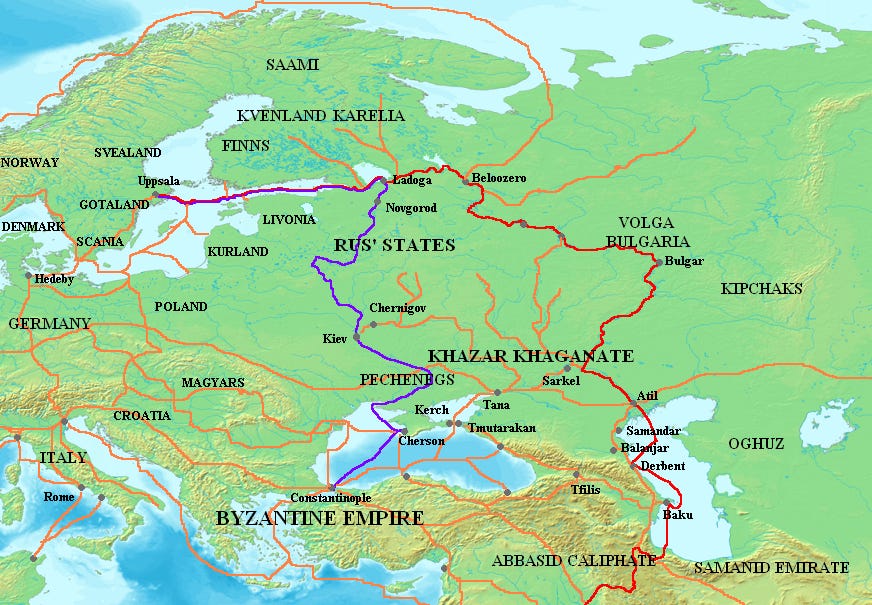
Image: Map showing the major Varangian trade routes: the Volga trade route and the trade route from the Varangians to the Greeks. Source.
You might have noticed that Linde views the mystical Kupolė night not through a lens of modern romance, but through a framework of pattern recognition and somatic safety.
Historically, this is grounded in the deep, resilient traditions of northeastern Europe, specifically the borderlands of modern-day Belarus and the Baltic region. In the 10th century, this area was a vibrant cultural melting pot where indigenous Baltic, East Slavic, and Norse-Rus currents constantly intersected and influenced one another. Because the impenetrable, dense forests of this region acted as a natural shield, this territory resisted Christianization longer than almost anywhere else in Europe, preserving authentic, earth-centered pagan rituals for centuries.
Mainstream historical analyses frequently make the mistake of reducing events like Kupolė to simple, decorative folklore. But these ancient pre-Christian rituals were far more than simple folklore. They represented a distinct, autonomous parallel world managed entirely by women. Conventional histories often undermine or dismiss the immense female agency that existed within these ancient communal rites because it didn’t mirror the loud, overt political structures of men.
But this female authority, expressed through complex botanical knowledge, sacred music, and somatic ritual, was a massive cultural powerhouse carefully woven into the fabric of society. Across these intersecting pre-Christian cultures, women held highly revered positions as keepers of sacred and spiritual domains. They were practitioners of Spá: the ancient art of discerning fate, alignment, and truth through pure intuition and internal bodily awareness. It was about recognizing a steadiness and a willingness to protect a woman’s individual autonomy. As Linde explores later in the saga, “you’re not supposed to see his face, but you’re supposed to recognize the feeling.”
💭 Let’s Discuss in the Comments: Ancient communities relied heavily on these intense, non-verbal rituals to process transitions and find communal support. In our hyper-connected, text-heavy modern world, what structures (if any) do you think we have left that serve that same deep, somatic purpose for women?