
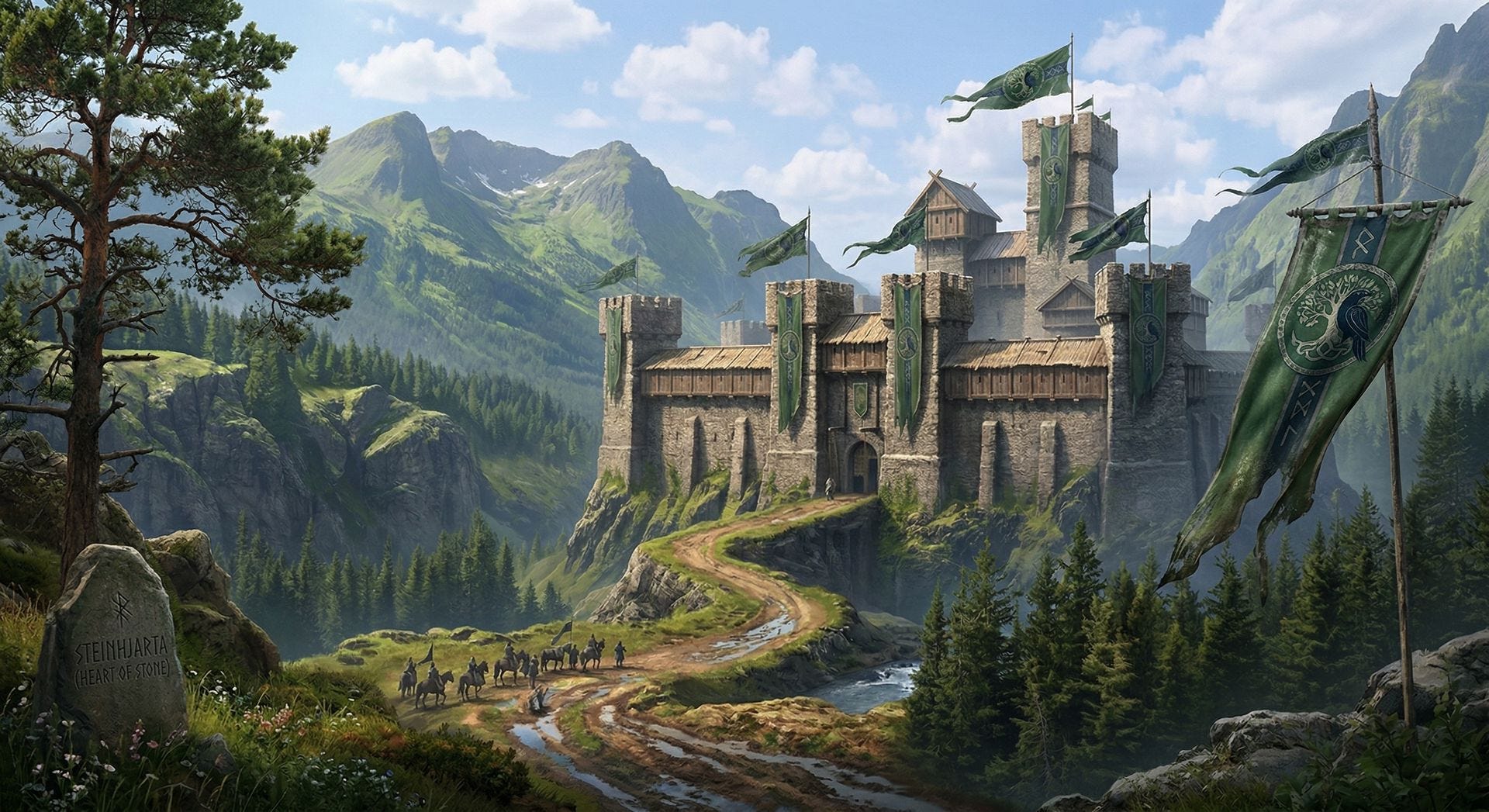
The iron-shod hooves of the horses rang hollow against the ancient, weather-beaten stone of the North Castle’s outer ward. High above, the banners of the Oak and the Raven snapped in a cool mountain wind that smelled of pine resin and woodsmoke.
As they dismounted, the silence was broken not by command, but by the heavy rhythmic thud of spears hitting shields, the warrior’s greeting for a Prince returned from the dead.
King Erik descended the stone steps. He stopped before Gustav, gripping his shoulders with hands like stone vices. He searched his son’s face, his eyes shining with a fierce pride. “The Norns are fickle, my son,” Erik rumbled. “I had begun to sharpen the stones for your cairn.”
“Then you can use them for the hearth, Father,” Gustav replied.
Erik’s gaze shifted to Linde. He froze. His breath hitched as he saw the Freya-Lock encircling her wrist, the silver glinting against the rich silks Laila had chosen for her. Recognition flared in his eyes, not surprise, but a deep, staggering memory. The silver of my house. He looked from the bracelet to Gustav, his expression unreadable to the crowd, but his grip on Gustav’s shoulder tightened in a silent acknowledgment. He said nothing of the jewelry, turning instead to the guest of honor with a deep, respectful nod.
“Daughter of Velena,” Erik said, his voice thick. “You have your mother’s eyes. She once saved my wife from a fever that would have taken her before Gustav was even born. You are welcome in my hall.”
“Thank you, my King” - she nodded.
King Artemij moved then, crossing the space with a sudden, genuine warmth. He pulled Gustav into a brief, crushing embrace, clapping his back. “My son’s brother-in-arms,” Artemij said firmly. “You bled for my people seven years ago, and now you bring me my heart. There is no gold in the East that can pay this debt. You are as much a son of my hall as Andrej.”
He turned to Linde, his sharp features softening into a smile. “And you,” he teased, brushing a thumb against her cheek, “you look far too regal. I expected a bedraggled forest cat, and I find a Queen of the Alfar. Laila has clearly been busy.”
Linde’s eyes sparked with the familiar fire. “And you, Father, look as if you’ve spent the last month arguing with the wind and losing.”
Artemij’s lip twitched. He reached out, his hand trembling as he touched her cheek. “The palace was a tomb without your noise. Do not ever get lost again. It is bad for my digestion.”
“We shall have a feast tonight that the skalds will sing of for a decade.” - he added, loudly.
The heavy weight of the reunion lingered in the air like the mist rolling off the mountains. As the Kings turned to lead the retinue toward the Great Hall, Gustav stepped to Linde’s side. The courtyard began to churn with activity - servants rushing to tend the horses and guards hauling chests of Eastern trade goods.
Gustav leaned in, his voice a low anchor amidst the rising cacophony. “The feast will be loud and the questions will be many. You need a moment of peace first.”
His hand touched the small of her back: brief, grounding, private in the most careful way.
Linde did not argue. Her father’s attention was a net right now, loving, suffocating.
Gustav guided her through a side entrance. Wind vanished. Warmth replaced it. The castle swallowed them into narrow corridors lit by pitch-pine torches, shadows jumping along ancient timbers.
As they climbed a spiraling staircase, the air grew sweeter, dried herbs replacing the metallic tang of armory stone.
They stopped before a heavy door of polished rowan carved with interlocking suns.
Gustav’s hand hovered at the latch, as if even touching the iron was a vow.
“These were my mother’s chambers,” he said softly. “Nowhere else in this fortress is safe enough, or honorable enough, for the woman who wears that silver.”
He opened the door.
The room breathed amber light. A pre-lit hearth. Sheepskins like snow made warm. Lavender and yarrow hanging from rafters. A loom still threaded with unfinished wool as if time itself had paused mid-sentence.
Linde stepped in, her feet stepping on soft furs.
Her gaze found the silver basins, the abandoned work, the intimacy of a life that had once been lived here.
Her fingers lifted toward the Freya-Lock on her wrist.
A single, hot tear traced down her cheek.
“The night you gave me this,” she whispered, voice trembling, “I didn’t think I would ever stand in her private places.” She swallowed. “I feel her here, Gustav. The weight of who she was.”
Gustav stood in the doorway, restrained as a man holding back a storm. His hands twitched, aching to wipe that tear away, aching to pull her close and forget kings and halls and permission.
But the corridor outside still held footsteps. Politics still had ears.
“I know,” he rasped. “But here you are the Lady of the Solar. “You are home, Linde. Rest. The world starts again at sundown.”
Linde moved deeper, fingers trailing over the smooth wood of an embroidery frame.
Then she turned back to him. “You said your father kept this room locked,” she said quietly.
Gustav closed the rowan door. The bustle cut off like a severed thread. Silence rushed in, thick and heavy.
“My father hasn’t let anyone sleep here since she passed,” Gustav said. “By putting you here... he is telling the castle, and your father, that you are not merely a guest.”
He nodded at her wrist.
“You are protected by the spirit of this house.”
He sat on a low carved stool near the hearth, prosthetic leg stretched toward the heat.
“This castle, Steinhjarta (Heart of Stone), was built by refugees,” he said. “Not conquerors. Men who fled blood-feuds to find a place where they could breathe. They built walls thick not to hoard gold, but to hold the line against winter...and against kings who think the North is empty land for the taking.”
His voice softened when he spoke of Freya.
“My mother was the heart of that philosophy. She used to tell me a king is not the man who sits on the throne to be served. He is the man who stands at the door when the threat is coming.”
He looked up at the herb bundles swaying gently.
“He is the last to eat. The first to bleed.”
Linde listened, and the shape of him, of why he was the way he was, settled into her bones.
“She sounds like Velena,” Linde said.
“They were mirrors, like sisters,” Gustav agreed. Then his gaze dimmed.
“I had two sisters,” he said quietly. “Anna and Signy.” The names landed like stones in water. “They had hair like moonlight and eyes like summer sea. And when the sweating sickness came, it didn’t care for stone walls.”
He paused, swallowed.
“My mother fought for them. Ground every herb in this room. Stayed awake seven nights. Whispered songs to the gods.” His jaw tightened. “But the Norns had already spun their thread. They died within hours of each other.”
Linde reached out, fingers brushing his arm, not pulling him close, just anchoring him to now.
“My mother survived,” Gustav whispered. “But the light left her. She lived one more year. Long enough to make sure I understood the law of the hall.” He glanced at the bed. “She died in this very place. Hand in my father’s. Because she had no more reason to stay.”
Linde looked at the Freya-Lock. “He saw it,” she murmured. “In the yard.”
“He didn’t have to speak,” Gustav said. “He saw that I had finally chosen.”
His eyes lifted to hers, raw, restrained, desperate with meaning.
“And tonight,” he added, voice dropping, “play the Princess. Be the daughter Artemij expects.”
“Let me handle the kings.”
Linde’s mouth curved, warmth and challenge intertwined.
“And who will handle you, Gustav?”
He exhaled a laugh that sounded like a man trying not to beg.
“The mead, likely.”
But his gaze stayed serious.
“Sleep for an hour,” he said. “If you go into that hall tired, your father will devour every weakness like meat.”
Then he stepped close, hands framing her face.
“Artemij sees you as his crown jewel,” he whispered. “My father sees you as the return of our heart.” He pressed his forehead to hers. “But I...” The restraint cracked. “I see the only light that doesn’t cast a shadow. You didn’t just mend my flesh, Linde. You made me want to live again.”
For a heartbeat, the world narrowed: lavender, firelight, breath. Then he forced himself back.
“The feast will begin soon,” he murmured, lips brushing her brow. “I have to leave now...or I won’t be able to leave at all.”
“Go,” she whispered, not letting go of his wrists. “I will be ready.”
And when he left, the silence he took with him felt like a vow hanging in the air, unfinished.
The armory of the North Castle was a place of iron and sweat, far removed from the forced civility of the Great Hall. It was lit by sputtering pitch-pine torches that cast long, jagged shadows against racks of bearded axes and heavy chainmail. The air was thick with the scent of oil and cold stone.
Gustav found his father sitting on a low oaken bench, rhythmically running a whetstone over the edge of a seax. Erik didn’t look up immediately. “She has her mother’s stillness,” he said, his voice a low rumble. “Velena could sit in a room for an hour and you’d think she was a statue until she spoke. But that girl... she has a fire beneath the ice that her mother never showed.”
“Linde is not her mother,” Gustav said, leaning his weight against a stone pillar. “She is the strongest person I have ever known.” - he added.
“No. She is a Princess of the East, and I saw the Freya Lock on her wrist. I said nothing in the yard because I did not want to hand Artemij a reason to start a war before we had even shared salt. But do not think for a moment I missed it.”
Erik finally looked up, his eyes hard. “I loved Freya with a desperation that nearly cost me this crown, Gustav. I recognize that look in you. It is a beautiful thing for a man, but it is a dangerous thing for a King. You haven’t looked at a woman like that, not even Helga. With her, you were a Prince doing his duty. “
Gustav tightened his jaw. “Father. I did what was expected of me because I didn’t know there was anything else.”
“And now?” Erik stepped closer. Now Gustav looked like a man who would burn the world to keep one woman warm. “My heart wants this for you,” he admitted. “To see Velena’s daughter in Freya’s chambers...it feels like the Norns mending a broken thread.”
He clapped a heavy hand on Gustav’s shoulder, his expression turning solemn. “But listen to me. If you marry her, you aren’t just taking a wife. You are taking on the ambitions of her father.”
“Artemij is our ally,” Gustav countered. “He trusts me. I bled for his people.”
Erik’s voice dropped to a warning whisper. “Artemij is a ‘King of Sorrows.’ He loves you as a soldier because you bled for his sons. But he wants the Silk Road. He wants his blood in the veins of Emperors in the East. To him, you are a hero but you are also the ruler on the edge of the world. He will not believe the halls of Hjarta Steinn are worthy of his only daughter. Not for her mind. Not for her ambition.”
He held Gustav’s gaze.
“And perhaps...” Erik said quietly, “not for her happiness.”
Gustav met his father’s gaze, his eyes burning with a raw, possessive iron. “Then he does not know his daughter. She was never a bird to be kept in a gilded cage. She is the wind, Father. And I am the only one who has learned how to breathe when she blows. Let him test the cage. He will find the iron of the North is harder than he remembers.”
Erik stared at him for a long moment, then let out a short, gruff laugh that held more pride than worry. “Then prepare yourself. Tonight, we drink. Tomorrow... tomorrow you face the King of the East.”
The Great Hall was a cavern of orange light and roaring noise. The central fire-pit crackled, sending sparks dancing toward the smoke-hole high above. Long trestle tables groaned under the weight of the feast: platters of roasted boar glazed with wild apples, mounds of smoked salmon, dark rye bread, and bowls of thick barley porridge sweetened with forest honey. The air was a thick soup of woodsmoke, roasted meat, and the pungent, greasy scent of tallow lamps.
Gustav sat to the right of his father at the High Seat, his eyes constantly drifting to the guest table where Linde sat. She was flanked by Andrej and Laila, her shimmering silks catching the firelight. She was laughing at something Andrej said, her face animated and bright.
King Erik looked at Gustav, then at Linde. “We are the last of our line, Gustav. We need the roots she brings. But look at Artemij.”
Across the fire, King Artemij was watching his daughter. He was drinking deeply of the mead, but his eyes were sharp, scanning the room. He seemed satisfied, his laughter loud as he bantered with Linde.
Artemij watched his daughter laugh, his heart a strange mixture of lead and light. To most, he was the ambitious King of the East, calculating trade routes and border security. But as he looked at Linde, he didn’t see a political asset; he saw Velena. He saw the same tilt of the head, the same stubborn set of the jaw that had once brought him to his knees. He had been terrified. For weeks, the world had felt hollow, a nightmare of silence where her voice should be. Now she was back, yet a new fear gnawed at him. He felt a distance he couldn’t name. Something had forged between her and the Northman in the dark of their journey, a bond that hadn’t been shared with him. It stung. To be the father of a woman who no longer needed his protection was a grief he hadn’t prepared for.
Artemij leaned toward Linde as the roasted boar was served. “The Northman hasn’t looked at his meat once, Linde,” he whispered with a sharp, testing playfulness.
“You laugh,” he murmured, tone teasing. “But you haven’t told me the best part.”
Linde blinked. “The best part of what?”
Artemij’s eyes flicked, subtly, toward the high seat. “The part where you explain why the Northman looks at you as if you’re the last living thing in winter.”
Linde’s breath caught, just slightly. And Artemij saw it. A father’s heart sank with the precision of an arrow.
Linde lifted her chin, trying to keep her face neutral. “He saved me,” she said, voice careful.
Artemij’s gaze held hers. “That is not what I asked.”
Linde didn’t blush; she simply smiled, a soft, steady expression that made Artemij’s stomach drop. “He is the best heart I have ever met, Father. He didn’t just save me; he carried the weight of the world so I didn’t have to.”
Artemij felt the air leave him. So it is true. His ambition screamed of Eastern alliances, of silk and gold, but his heart saw the truth. Linde wouldn’t be led; she had already chosen her path. Velena would have laughed at me for this fear, he thought bitterly. Velena would have said: “If you try to hold a river in your hands, you will only drown.”
Suddenly, the drums began, a low, rhythmic thudding of stretched hide. The four rescued girls, led by Laila, stepped into the center of the hall. They began a Baltic serpent dance, their bodies weaving in a long, hypnotic chain. It was a dance of the East, fluid, sensual, and ancient.
The hall clapped. Men shouted approval. Even Erik’s mouth twitched.
Artemij stood, a bit unsteady from the mead, and gestured to Linde. “Go!” he commanded loudly, hiding his sinking heart with a gesture toward the center of the hall. “Show them how the daughters of the East move!”
Linde laughed, a bright, clear sound that cut through the tavern noise. She rose and joined the chain, her silks flaring like a peacock’s tail. As she danced, she began to sing a flirty Baltic song, her voice clear and sweet.
“The bee seeks the clover, white and tall, But the clover hides a secret from them all. The falcon circles, his wings are wide, But he knows not where the honey-drops hide.”
She spun, her eyes locking onto Gustav’s with a bold, unmistakable heat. The subtext wasn’t lost on anyone in the hall, it was a song of courtship and desire.
Gustav sat perfectly still, his hands gripped tight around his drinking horn. He was enchanted, his breath hitching every time she spun past him.
The room was full of clapping and cheering, but as the dance reached its peak, King Artemij’s smile slowly vanished. He stopped clapping. He looked at the way his daughter looked at the Viking Prince. He saw the Freya Lock glinting on her wrist as she raised her hands in the dance. He saw the raw, possessive hunger in Gustav’s eyes, a mirror of the way he had once looked at Velena.
The warmth in the room didn’t just fade; it died. Artemij’s face hardened into a mask of iron. Not because he was furious she wanted a man.
But because he suddenly understood: his only daughter had found something she would follow. Even into a fortress of stone, and away from him... And no king could compete with love chosen freely. Not even a father.
As the dance ended and Linde collapsed into laughter with her friends, Gustav stood. He walked toward the High Seat, the room falling silent as the Prince approached the guest King.
“King Artemij,” Gustav said, his voice ringing through the hall. “I would speak with you. Privately.”
Artemij took a slow, deliberate sip of his mead.
He didn’t look at Gustav; he looked at the fire. “Tomorrow,” he said, his voice as cold as the Siberian wind. “At dusk. In my chambers. I find the night air has become... chilly.”
Then Artemij stood and walked away without looking back, leaving Gustav standing alone in the dying light, and leaving the hall to realize, slowly, that the real battle had not happened on the steppe.
It was about to happen in a father’s private room.
And everyone could feel it.
🧠 Behind the Saga: Deconstructing the Viking Myth
Chapter 15 brings our protagonists out of the chaotic, trauma-bonded wilderness and slams them directly into the architectural reality of 10th-century northern power. By examining the foundations of Steinhjarta and the performative nature of the Great Hall, we can unearth the sophisticated structural mechanisms of early medieval kinship, settlement geography, and ritualized courtship.
When Gustav explains the history of his home fortress to Linde, noting that “Steinhjarta was built by refugees. Not conquerors,” he is echoing a profound historical truth that modern pop culture entirely ignores.
The colloquial term “Viking” was a job description—an occasional maritime raiding activity—not an ethnic identity. In reality, the vast majority of Scandinavian and northern settlers were pastoralists, farmers, traders, and, crucially, refugees fleeing structural violence. The expansion of early medieval Norse territory was heavily driven by the violent consolidation of kingship (such as Harald Fairhair’s unification of Norway). This political centralization triggered massive internal displacement. Entire kin-groups fled blood-feuds, heavy taxation, and tyrannical land-grabs to establish decentralized, fortified spaces where they could literally just breathe. Steinhjarta’s thick walls were engineered not to hoard stolen imperial gold, but as a communal defensive shield to hold the line against harsh winter environments and expansionist kings who viewed the North as empty land ripe for the taking.
Gustav’s decision to place Linde in his late mother’s locked chambers (the Solar) is a high-stakes act of diplomatic signaling. In early medieval fortress architecture, the private chambers of the matriarch were sacred, highly restricted spaces.
By bypassing the standard guest quarters and unlocking this specific room, King Erik and Gustav are utilizing material space to establish a legal and spiritual precedent. When Gustav tells Linde, “By putting you here... [my father] is telling the castle, and your father, that you are not merely a guest,” he is utilizing the ancestral authority of the dead to enforce a protective boundary around her. Linde is instantly transformed from a political asset of the East into a figure protected by the literal spirit and lineage of the house.
The Baltic serpent dance led by Laila and the rescued girls is not merely entertainment; it is a highly ritualized, somatic tool of communication. In decentralized pagan courts, public feasting halls operated as arenas of immense social and political surveillance, where overt declarations could cause immediate warfare. Therefore, women utilized song and dance as a localized tool of absolute personal agency.
Linde’s choice of a flirty Baltic song, metaphorically painting Gustav as the falcon searching for hidden honey-drops, is a masterstroke of courtly defiance. By locking her eyes onto Gustav’s during the spin, the subtext is instantly decoded by every sentient mind in the room. She is publicly executing a courtship ritual. As she raises her hands in the dance, the flashing of the ancestral Freya-Lock on her wrist transforms the performance into a geopolitical declaration.
This performance completely shatters King Artemij’s internal world. As an ambitious ruler, he views his only daughter through a lens of macroeconomic statecraft, a valuable diplomatic bridge to the Silk Road and Eastern empires. But watching her dance, he experiences a profound paternal and political realization: Linde is demonstrating absolute psychological autonomy. She isn’t a passive prize to be maneuvered on a map; she has chosen her own destination, using an ancient, performative ritual to signal her sovereignty.
Finally, King Erik’s shock upon recognizing his late wife’s silver bracelet on Linde’s wrist anchors the narrative in the profound, cross-cultural alliances of historical women. Erik notes that Linde’s mother, Velena, once saved his own wife from a fatal fever before Gustav was even born.
This detail emphasizes that long before these two kings ever shared mead or negotiated border security, their families were already woven together by a matriarchal network of medical reciprocity. To Erik, seeing Velena’s daughter inhabiting Freya’s private rooms and wearing her silver feels like the Norns systematically mending a broken thread, proving that true structural continuity in the ancient world was maintained by the memory of the women who healed, rather than the men who fought.
🌱 Room for Thought:
King Artemij’s sudden, icy withdrawal at the end of the feast sets up an agonizing psychological truth: it is often far easier for a powerful father to face an invading army than to accept that his child no longer requires his protection or his plans.
Today, we look back at ancestral history and see nothing but arranged marriages, treatying kings, and women bartered like currency for territory. Yet, Chapter 15 shows a woman weaponizing her own culture, using a traditional song and a piece of family silver to claim her own destiny in front of an entire warrior court.
When you look at the absolute, chilling silence that settles over the Great Hall as Artemij delays the meeting until dusk, it forces an unblinking question:
In our modern world, we celebrate total romantic freedom, but do we lack the terrifying, magnificent bravery it takes to look an king in the eye and choose a home in the stone?
The lines have been drawn, and the feast has gone cold. Tomorrow at dusk, Gustav enters the King of East’s private chambers alone. Will Artemij break his son’s brother-in-arms to preserve his dreams of the Silk Road, or will the iron of the North force the Eastern King to rewrite his entire board?
If the escalating standoff between the Oak and the Raven has you gripped, you can jump straight into the deeper history right now. The first two complete volumes of the Firebound saga: Emerald to Steel and Salt and Gold, are available for immediate reading on Kindle.