
The North Castle did not boast; it endured. Its power lived in weight, in the thickness of stone walls that had seen centuries of frost, and in the silence of men who had nothing left to prove. The air smelled of pine resin, cold iron, and the ghosts of old smoke.
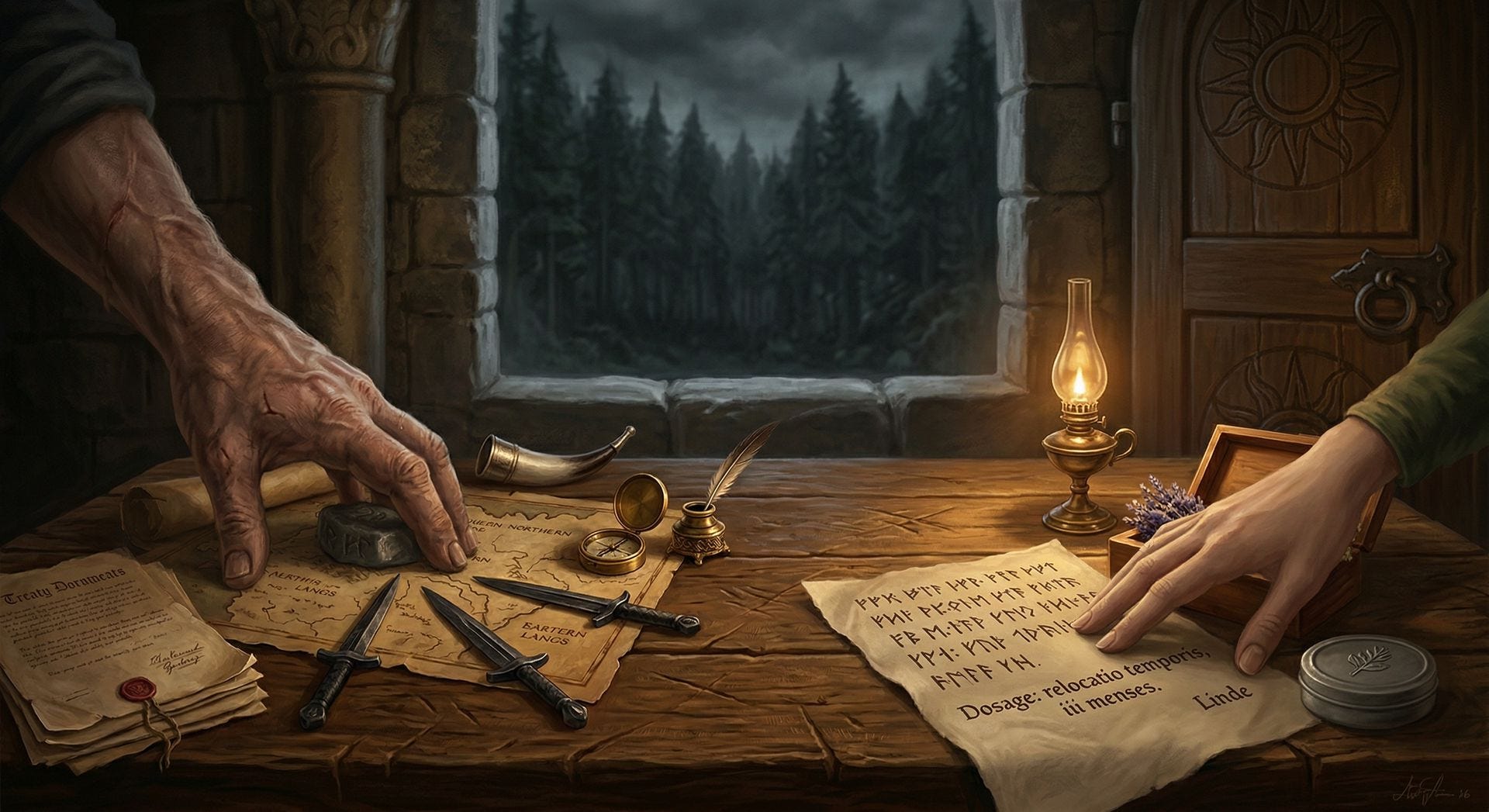
While Linde was ushered to a side chamber, the two Kings retreated to a room where maps were laid across a table scarred by blades. King Artemij watched Gustav with the precision of a jeweler looking for a flaw in a gem.
The room smelled of old parchment, cold iron, and the sharp, acidic tang of wine. King Artemij sat behind a table scarred by the map-weights of a dozen failed treaties. He looked at Gustav, this time not as a hero who had saved his daughter, but as a man who was trying to steal the sun from his sky.
Gustav stood opposite him, unarmed by etiquette, hands visible at his sides. The scars on his face caught the lamp glow like pale seams in stone. He did not perform. He simply waited, the way a bear waits at a river, stillness hiding an entire storm.
Artemij didn’t begin with praise. He began with Velena.
“I watched her fade,” Artemij said, voice dry as winter reeds. He kept his eyes on the map as if the ink could bear what he could not. “Velena. The greatest healer of our age. The woman who spoke to sickness like it was a stubborn child and made it obey.”
His throat moved once, a hard swallow that did not soften him.
“I watched her lose her own battle...” A pause. Then, quieter, more dangerous: “When she died, I did not only lose a wife. I lost the compass of my soul.”
At that, his fingers, those sharp, capable fingers that signed treaties and broke enemies, tightened on the lip of his cup until the metal creaked faintly.
“Now you stand there,” Artemij continued, finally lifting his gaze, “smelling of salt and Northern pine, asking me to give you the only thing I have left that carries her likeness.”
Gustav’s breath stayed steady. But something in his eyes shifted. He understood this kind of pain. Loss that turned a man into stone and then demanded he keep ruling as if stone could bleed.
“I cannot replace what you lost,” Gustav said. His voice was low, even, careful without being timid. “And I would never insult Velena by pretending I could.”
Artemij’s mouth twitched, almost a smile, then vanished.
“And yet you ask for my daughter.”
Gustav took a single step forward. “I ask,” he said, “because she is not a jewel to be locked away, even in a father’s love.”
Artemij’s eyes flashed. “Careful.”
“I am careful,” Gustav replied. “That is why I’m here. That is why I’m speaking to you and not simply taking what I want. That is why I will ask your permission even if she could twist your arm with three sentences and a look.”
That last line landed, because it was true, and Artemij knew it.
He leaned back slightly, studying Gustav as if searching for the crack.
“You believe you understand her?” Artemij asked. “A girl who speaks tongues like breath. Who reads stars like other girls read faces. Who carries Velena’s blood in her hands and makes men twice her age feel foolish without lifting her voice.”
His gaze hardened, sharpened to a king’s blade.
“What will you do,” Artemij asked softly, “when she grows bored of your snow and your silence? When your hall begins to feel to her like a locked chest? When she wants more than defending borders and counting winter stores?”
Gustav didn’t flinch. “I will open the chest,” he said simply.
Artemij scoffed, but it wasn’t dismissive. It was... pained. Like a man remembering the way he once spoke to Velena and how the world punished him for loving her.
“You cannot open a hall built of stone, Northman.”
Gustav’s voice dropped into something older, something that belonged to oath-stones and sacred fires. “Then I will not ask her to live as stone.” He held Artemij’s gaze, unblinking. “I have seen Linde face the dark without bowing to it,” Gustav said. “I have seen her mend what the world broke and refuse to let death have the final word. She does not look at the stars to wish. She looks to calculate. She does not carry herbs because she is gentle. She carries them because she is relentless.”
His hand lifted, not to touch, but to vow. “I do not ask for a prize to sit in my hall. I ask for the privilege of standing at the door when the wind comes.”
Artemij’s eyes narrowed. “A shield,” he murmured. “That is what you offer. Steel and silence. How touching.”
Gustav let the barb pass without bleeding. “Not silence,” he corrected. “Presence.” Then, with a steadiness that did not beg, he added: “You fear losing her because you lost Velena.”
The words struck like a thrown knife. Artemij’s posture stiffened.
Gustav did not apologize for saying the truth. He only continued, voice quiet, lethal with empathy. “You do not fear I will hurt her,” Gustav said. “You fear I will survive her. You fear you will have to watch her leave your hall while you stand here, still breathing, unable to bargain with the gods.”
For a heartbeat the lamp flame seemed to shrink. Artemij looked away.
“I cannot promise you she will never be in danger,” Gustav said. “Only a liar would promise that. But I swear this, by the roots beneath these stones and the ravens that watch above them: if she stays with me, I will not make her smaller to fit my hall. I will not bury her fire to calm my fear. I will build my life around the truth of her.”
His voice dipped lower, almost reverent: “And if I ever forget that she belongs to herself, may the sea take what I have left.”
Artemij stared at him for a long time, too long for politics, too intimate for kings.
Then Artemij spoke again, and it was the final lash.
“Three. Winters.” The words fell heavy as a tombstone. “You will not wed her,” Artemij said, voice steady now, cruel in its control, “until three winters have passed. If you claim her, you will claim her with my curse on your roof. Let the Northman prove he can survive longing without becoming a beast.”
Gustav’s chest went tight. Three winters. Not a season. Not a negotiation. A stretch of time long enough for fate to sharpen its teeth. But he did not bargain. He did not threaten. He did not plead.
He simply bowed his head, once, as if accepting a wound with dignity.
“If that is your will,” Gustav said, and something in his voice broke, in the way ice breaks in deep water, “then I will wait.”
He lifted his gaze.
“I would wait until my hair turned as white as your mountains,” he said.
Artemij’s mouth twitched. Pain and admiration warring so hard it almost showed as tenderness.
But he gave Gustav nothing.: no approval, no mercy. Only a small gesture toward the door.
“Go,” Artemij whispered, shielding his eyes as if light hurt. “I find I have a headache brewing.”
Gustav left with his heart in his throat, feeling like he had just been sentenced.
Behind him, Artemij stayed seated, staring at the map as if the ink could bring Velena back.
And alone, with no one to see, the King of the East closed his eyes.
As if fighting tears. As if fighting time.
Gustav did not seek Linde immediately. Not because he did not want to. Because he could not trust his face. He sent a message instead, short, spare, written in a hand that looked carved rather than inked.
Three winters. Your father has spoken. I will obey. Forgive me.
He sealed it like a death notice.
And when it reached Linde, it reached her in the worst possible place: surrounded by warmth, softened by laughter, with her friends close enough to see her unguarded.
Linde was with Laila and her Dew Night friends: Galina, Nastja, Vasja, and Katrina. They had taken over a chamber by the solar with the comfortable anarchy of people who had survived something together and refused to pretend otherwise. Herbs drying overhead, berry wine warmed near the brazier.
Galina sat on the floor with a length of wool across her knees, mending a tear with careful, almost reverent precision.
She had rolled the wool carefully across her knees, smoothing it as if it were something living. The tunic she worked on was unmistakably a man’s, broad in the shoulders, patched with care rather than haste. Every few stitches, she paused, checking the seam as though it mattered deeply that it hold. It did.
Rolf would be riding east again soon.
Galina tied off the thread and held up the finished tunic. “Rolf asked my consent yesterday,” she said quietly. Linde turned to her.
“And?”
Galina smiled: “I said yes. His family has already cleared a room. His mother cried. His sister brought me bread like I was already theirs.”
The room went still: not heavy or sad, but hopeful.
Linde crossed the space and hugged her fiercely.
“Good,” she said. “That is exactly how it should be.”
Linde’s throat tightened in a way she did not let show. If Mother were here, this would already be done. She thought.
Velena would have listened once. She would have looked at Gustav the way she looked at men, not weighing crowns or borders, but balance. She would have seen the devotion in the Freya-lock, the steadiness beneath his ferocity, the way Linde’s body leaned toward him without thought.
Laila, sensing the shift the way she always did, broke it deliberately. Her voice cut through the stillness, low and unapologetic. “I’m telling you, Northmen don’t flirt. They issue strategic declarations and hope you find them romantic.”
Katrina laughed into her cup. Vasja nearly spilled berry wine. Nastja shook her head, smiling.
“And yet,” Linde said dryly, “you married one.”
“I trained him,” Laila replied. “With great patience. And threats.”
The room was warm. Herb bundles dried overhead. There was laughter in the walls, life, unguarded.
That was when the messenger arrived.
He hovered awkwardly at the threshold, young, clearly regretting his timing. Laila waved him in with the air of a woman who had survived worse interruptions.
Linde unfolded the note. Read. Went perfectly still.
Three winters. Your father has spoken. I will obey. Forgive me.
Then the storm arrived.
“Oh,” she said, very calmly at first, which was how everyone knew it was going to be catastrophic. “Oh. Good. Wonderful.”
Laila blinked. “What is it?”
Linde lifted the note like it was evidence at trial.
“Three winters,” she announced, voice bright with disbelief. “THREE.”
One of the girls squeaked. Someone dropped a comb.
Linde began pacing like a woman about to lecture a room full of grown men on the mathematical impossibility of their arrogance.
“Do we understand what a winter is in the North?” she asked the ceiling, as if the ceiling were complicit. “It is not a season. It is an event. It has opinions. It lasts longer than some marriages.”
Laila pressed a hand to her mouth, already failing not to laugh.
“Three winters means my joints will start negotiating without my consent. Three winters means Gustav will grow a beard so dense birds attempt to nest in it. Three winters means I will have completed at least two new medical treatises, mastered another language, and lost my patience entirely.”
“This,” Linde continued, gesturing with the letter like a surgical instrument, “is what happens when men confuse endurance with wisdom.”
“Three winters implies,” Linde continued, waving the note, “that my father believes the gods have agreed to pause the world. It implies he believes fate is polite. It implies...” she turned sharply, eyes bright with fury and humor, “ that after surviving chains, mountains, and the slave market, the most dangerous thing I could possibly do is love a man too efficiently.”
She slapped the note lightly against her palm, as if it were an unruly apprentice.
“I would like to remind everyone,” she continued, voice going sweeter, “that I am the daughter of Velena. The gods have already tried to kill me ... multiple times. If they try again, I will have the courtesy to die faster than three winters.”
Laila made a strangled sound. “Linde...”
“And Gustav,” Linde added suddenly, as if remembering him with affectionate outrage, “has apparently decided he is going to sit quietly in a corner for three winters like a good, obedient bear.”
She mimed a bear, solemnly waiting. Then she stopped, hands on hips, eyes flashing.
“I love him,” she announced, as if this was a scientific conclusion reached after rigorous experiment. “But if he thinks patience is a virtue when it becomes stupidity, I will personally drag him to the altar by his fur.”
The girls were laughing now, hushed, delighted, half-shocked.
Laila leaned in, openly grinning. “Careful. Northmen enjoy being dragged.”
Linde shot her a look sharp enough to cauterize. “Not helping.”
Linde paused. “I will have to correct this, as soon as possible.”
Katrina tilted her head. “Like a dosage?”
“Exactly like a dosage,” Linde replied. “Too much patience becomes poison.”
Linde folded Gustav’s letter with decisive care. “I’ll speak to my father,” she said. “Immediately.”
Galina smiled at her. “Of course you will.”
“And when you do,” Nastja added, grinning, “try not to burn the keep down.”
Linde’s mouth curved, sharp and affectionate.
“No promises.”
Across the hall, near a column half in shadow, Gustav had just entered the corridor mouth.
He couldn’t hear her exact words. But he saw the pacing. The lifted note. The flash of her hands. The way Laila’s shoulders shook with laughter. The way Linde’s face was alive, incandescent with will. He felt heartbreak and relief crash together so hard it nearly dropped him.
Three winters.
And yet... There she was. Furious. Unbroken. And somehow, absurdly... comforting him without knowing she was doing it. He had feared silence. Feared compliance. Feared he would look up and see her dimmed by duty. Instead, he saw fire.
Gustav’s mouth twitched once, a ghost of a smile that hurt like a bruise.
Then he turned away, because if he stayed one moment longer he would cross a line.
And he did not know what lines were allowed anymore.
Linde did not confront her father like a rebel. She confronted him like a daughter who had learned that love did not require obedience to be true.
She found Artemij in a torch-lit corridor off the main hall, standing alone except for a guard who understood silence well enough not to hear. The king held a horn of mead loosely at his side. His shoulders were bare of ceremony here, bowed not by age, but by the long labor of remembering.
He looked older in this light. Tired in the way a man becomes tired when he has carried the same grief for too many years without setting it down.
“Father,” Linde said softly.
He turned at once, eyes searching her face with a reflex that had never dulled. He reached for humor the way some men reached for armor.
“Well?” he said. “Did the Northman’s message offend you? I hear their script looks as if it was wrestled onto the page by an axe.”
“It was very tidy,” she said. “Which is how I knew something was wrong.”
A breath left him. Half a laugh, half a sigh that had been waiting all evening.
“He accepted it,” Artemij said. “Three winters. Without a protest or bargaining.” His voice roughened, unwilling admiration breaking through. “Either he is the most patient man I have ever met... or the most foolish.”
Linde stepped closer. “He is neither,” she said. “He is simply Gustav.”
Artemij’s jaw tightened. “And what does that mean?”
“It means,” Linde replied, “that he will choose honor even when it costs him joy. It means he will obey you even if you are wrong.”
He looked at her sharply. “You are telling me that I am wrong?”
She did not answer with words. She answered by taking his hands.
They were colder than she expected, from the way sorrow cools a man from the inside out.
“You are afraid. You are worried.” she said gently.
“I am a king,” Artemij said automatically.
“You are my father,” Linde answered.
The corridor fell silent. Somewhere far away, laughter rolled through the great hall: life continuing without regard for private reckonings.
Artemij did not deny it. His throat worked once.
Linde held his hands and spoke slowly, as if laying stones across deep water.
“You think if I go North,” she said, “you will lose me and the stone will swallow me. That the world will take me from you piece by piece.”
His eyes burned. “You do not belong in a place like that.”
Linde tightened her fingers around his.
“Look at me,” she said.
He did.
“I am not being carried into a cage,” she continued. “I am choosing.”
“And you believe he can make you happy?” Artemij asked, the question sharp with love. “A boy shaped by war. By duty.”
“He can,” Linde said. “Because he does not try to diminish me. And because he understands what it costs to love and still stand.”
She lifted his hand and pressed it to her cheek.
“If I go to the North, we do not grow apart,” she said. “We grow outward. I will not vanish from you. I will be your voice here. Your eyes among the stone.”
For one suspended breath, Artemij did not see his daughter.
He saw Velena. Not just a memory of her, but her presence.
Something in him yielded, not broke, but gave way, like a door finally opened after years of being held shut against the weather.
He pulled Linde into his arms, holding her with a ferocity that had nothing to do with crowns and everything to do with love long practiced and rarely spoken aloud.
His breath shuddered once. Then again. When he drew back, his eyes were wet, his face unguarded, and his voice steadier for having allowed the truth through.
“Three months,” he said.
Linde stilled. “What?”
“Three months,” Artemij repeated. “Not winters. Not years.” The relief was immediate, dizzying.
“And there is a price,” he said.
Linde nodded. “War.”
“Yes.” His voice hardened, not cruelly, but with purpose. “The slave-roads will burn. The men who touched you will not see another season. Gustav rides with your brothers. After we show this castle what it means to celebrate the living.”
His gaze held hers, fierce and certain.
“I will not give you in marriage while your captors still breathe.”
Linde swallowed, pride and sorrow entwining.
“Three months,” she said quietly.
“This world does not pause for love,” Artemij replied. “It only grants it shelter between storms.”
The map lay open across the table, its edges pinned with iron daggers. Rivers and roads cut the parchment into clean, merciless lines, veins and scars in equal measure.
Andrej traced a route with his finger, already thinking ahead, already counting days and dead men.
“If we move fast after the engagement,” he said, “we can clear the eastern roads before the thaw.”
Vlad leaned over the table, nodding once. “Gives the men something to look forward to besides blood.”
Gustav stood opposite them, both hands braced against the wood.
He hadn’t spoken. His gaze rested on the map, but it wasn’t roads he was seeing. It was distance. Time. Winters stacking like stone.
“If,” he said quietly, the word slipping out before he could catch it “she still wants me.”
The room went still. Andrej looked up at once. It was the look of a man who had learned, long ago, how to spot quiet bleeding.
Vlad noticed too, his expression tightening, but he stayed silent. This was not his moment to speak. This was his brother’s work.
Andrej stepped closer, lowering his voice so it wouldn’t turn into something performative.
“You’re acting like silence is a verdict,” he said.
Gustav’s jaw flexed. “He gave me three winters.”
Andrej didn’t hide the flash of fierce pride that crossed his face.
“And you took them,” he said. “You stood in front of the most ambitious king in the East and didn’t bargain for yourself. Do you know how few men would do that?”
“That doesn’t mean I passed,” Gustav replied. His eyes burned now. “It just means I didn’t flinch.”
Andrej bumped his shoulder, as a battlefield language.
“You passed the moment you chose her dignity over your relief,” he said.
“Kings don’t test men they plan to refuse. They test the ones they’re afraid might actually deserve her.”
Gustav swallowed, the truth landing hard.
Andrej’s voice softened. “My sister isn’t something that gets decided about,” he added. “If she didn’t want you, you wouldn’t be standing here wondering. You’d already be gone, and you wouldn’t even know what ended you.”
That earned it. A sharp breath from Gustav, something dangerously close to a laugh.
Vlad finally spoke, his voice low and blunt as a hammer strike. “You saved her life,” he said. “She’s not the kind of woman who takes that lightly.”
Gustav looked back down at the map. For a moment longer, he said nothing. Then he reached out, took one of the iron daggers, and drove it cleanly into the parchment, pinning the route with decisive force.
“Then we clear the roads,” he said, his voice steady again, iron back in place. “And we do it fast.”
Andrej grinned, tired and sharp. “That’s more like it,” he said. “We’ll give you your three months.”
Gustav’s head snapped up. “Three - ?”
Andrej waved a hand, already turning back to the map, the grin widening despite himself.
“Trust me. If Father actually thinks three winters will stand...” He shook his head, smiling to himself. “Linde will reduce this keep to ash with a lecture.”
Gustav climbed the stone stairs to his private quarters, his boots feeling heavier than the iron plate in the armory. The castle was quiet now, the frantic energy of the day settling into a low, thrumming dread. Every step he took echoed with the finality of Artemij’s voice: Three winters.
The number was a cage. He could already feel the phantom cold of three years spent watching her from across a hall, forbidden from touching the curve of her jaw or feeling the heat of her breath against his neck. He had spent weeks in the wild, survival his only thought, and now that they were home, the restraint required of him felt more violent than any battle.
He pushed open the heavy oak door to his chamber and stopped.
The room was dark, save for the dying embers in the hearth. The scent of her lingered there, lavender and something sharp, like crushed mint. In the middle of his bed sat a single piece of vellum.
He picked it up, his large, calloused fingers trembling slightly. He expected a goodbye, or perhaps a lament to match his own. Instead, as he began to read, the tension in his shoulders didn’t just break, it shattered.
My heart,
I received your note and immediately diagnosed it as excessive patience.
Do not make plans for my life without consulting me. Also, do not grow old and tragic.
There will be war before the wedding. I do not like this, but I accept it.
Come back whole.
The correct measure is three months. I have spoken to my father. He argued. I explained. He yielded.
Linde
Gustav let out a breath he felt he had been holding since they crossed the threshold of the castle. A low, ragged sound, half-laugh, half-sob, escaped his throat. He sank onto the edge of the furs, the letter clutched so tightly in his fist that the vellum creaked.
Three months.
It was still an eternity, still a season of blood and ice, but it was a bridge he could see the end of. He could almost feel her fire in the words, the clinical, stubborn brilliance that refused to let the world be tragic. She hadn’t waited for him to save her; she had walked into the King’s shadow and demanded the light back.
He closed his eyes, pressing the letter to his forehead. The ache in his chest was still there, but it had changed. It was no longer the dull weight of a tombstone; it was the sharp, agonizing thrum of a bowstring pulled taut. His hand drifted to the space beside him on the bed, feeling the cold furs where she should be. He could almost hear her voice, lecturing him on the inefficiency of his grief.
“Three months,” he rasped into the empty room, the words a vow to the shadows.
He folded the note with obsessive care and tucked it into the tunic against his skin, right over the steady, heavy beat of his heart. He would ride. He would burn the roads. He would turn the world to ash if he had to. But he would come back.
Because she had spoken. And in the entire world there was no god or king more certain than the woman who refused to let him grow old alone.
🧠 Behind the Saga: Surviving the Legal and Military Architecture of Kings
Chapter 16 brings our protagonists face-to-face with the ultimate structural test of the early medieval world: the absolute authority of the sovereign father balanced against the unyielding personal sovereignty of the daughter. By looking past the surface-level romance, we can dissect the deep historical mechanisms of kinship strategy, immediate martial mobilization, and the counter-intuitive truths of Northern campaign logic.
When King Artemij issues his ultimate condition for the marriage: “The slave-roads will burn... I will not give you in marriage while your captors still breathe”, the narrative shifts from a private alliance to an active, coordinated military campaign. Historically, this immediate, aggressive mobilization against human traffickers is incredibly accurate to the 10th-century geopolitical landscape. In early medieval Europe the slave trade was an incredibly lucrative, highly organized international network often backed by powerful local warlords or deep-pocketed foreign syndicates. However, abducting a high-status woman, especially the daughter of an Eastern sovereign, crossed a lethal legal boundary.
In decentralized tribal societies, a sovereign’s primary currency was protection. If a king allowed foreign raiders to infiltrate his borders, abduct his family, his political authority would instantly collapse.
A retaliatory strike wasn’t just about family vengeance; it was an existential necessity to re-establish border security and deter future incursions. Warlords routinely maintained small, elite standing units (druths or comitatus) specifically engineered for rapid, off-season deployment. By driving an iron dagger into the map parchment alongside Andrej and Vlad, Gustav is engaging in a highly authentic 10th-century joint task force: combining Norse infantry tactics with Eastern scouts to systematically dismantle a criminal infrastructure before the spring thaw renders the roads impassable.
When King Artemij initially decrees a waiting period of “Three winters,” he is utilizing time as a deliberate political weapon. In early medieval and pagan diplomacy, long intervals of time were systematically calculated to test the structural resilience of an alliance: A dynamic, ambitious ruler like Artemij, whose eyes are fixed on Eastern trade wealth and the Silk Road, views three years as a diagnostic window. If Gustav is merely driven by the immediate, trauma-bonded rush of a spectacular wilderness rescue, three grueling Northern winters will freeze the passion out of his court.
Gustav’s stoic acceptance of this agonizing sentence “accepting a wound with dignity” proves his adherence to the ultimate code of the North: honor is a multi-generational contract. By accepting the timeline without threats or bargaining, Gustav demonstrates that his devotion isn’t an impulsive capture; it is a permanent, calculated vow.
The true anthropological turning point occurs when Linde receives Gustav’s letter and diagnoses his compliance as “excessive patience.” Her subsequent pacing and sharp monologue to her friends highlight her constructed, non-neurotypical processing style. Where the men see a grand, tragic tragedy of duty and endurance, Linde’s empirical mind sees an entirely inefficient use of time and human life.
When Linde corners her father in the torch-lit corridor, she executes a masterclass in personal sovereignty. She does not approach him as a rebellious subject defying a king, but as a sovereign daughter anchoring a grieving father. By physically taking his cold hands and asserting her autonomous choice: “I am not being carried into a cage. I am choosing”, she forces Artemij to confront his own psychological projection. As she presses his hand to her cheek, Artemij does not see a bartered piece of a Silk Road alliance; he sees the unyielding presence of Velena. In decentralized pagan kinship, a daughter who inherited her mother’s distinct spiritual and intellectual “fire” possessed massive moral authority.
By treating her father’s grand decree like an incorrect medical dosage that requires immediate adjustment, Linde single-handedly forces an empire-building sovereign to slash his sentence from three winters to three months.
🌱 Room for Thought:
Linde’s warning to Gustav “Do not make plans for my life without consulting me. Also, do not grow old and tragic” stands as a rejection of the over-dramatized, long-suffering romance trope.
Today, we look back at ancient history and assume women were merely passive pawns shifted across map tables by powerful fathers and stoic kings. Yet, Linde proves that a woman who possesses empirical clarity can rewrite a king’s entire military timeline with a single conversation.
If the escalating war path and the razor-sharp wit of the High Forest have you gripped, you can jump straight into the deeper history right now. The first two complete volumes of the Firebound saga: Emerald to Steel and Salt and Gold are available for immediate reading on Kindle.