
The engagement celebration began at dusk, as if the day itself had been waiting for permission to become beautiful. Torches were planted in wide circles across the lower courtyard, their flames steady despite the wind rolling in from the lake. Pine boughs and juniper were woven along the railings; birch poles stood upright like pale sentinels, carved with spirals and suns and softened runes that looked older than the stone they guarded. The air smelled of resin, smoke, and honeyed drink: mead warmed with herbs, poured generously into wooden cups.
People gathered not as spectators, but as participants. This was not a feast for kings alone. It was for women who had held households together through winters, for men who had returned from raids with scars instead of songs, for children who needed to believe the world could still be safe. Even the soldiers moved differently here, as if the courtyard, ringed in firelight, demanded reverence.
Drums sounded first: low and steady, like a heartbeat remembering itself. A frame drum stretched with hide answered a deeper skin struck with open palms. Then came the voices: women first, calling out in layered harmony, voices rising and folding over one another in ancient patterns meant not to impress, but to summon memory.
The girls stepped forward barefoot. They wore linen dresses belted high beneath the chest, skirts loose and flowing, dyed in quiet earth colors: amber, ash-blue, moss green, berry-dark. Their hair was braided with narrow ribbons and fresh flowers; some wore wreaths threaded with yarrow, wild thyme, and mugwort, the scent sharp and grounding. They formed a circle. Then another. The dance began slowly, measured steps, heels lifting, toes brushing the stone. Arms rose and fell like wings learning their span. Hands clasped, released, clasped again. The movements echoed the old Baltic circle dances that bound villages together in spring and midsummer, communal, patient, woven with sharper Nordic accents: heel taps that woke the ankles, controlled stamps that answered the drum. The rhythm quickened.
Skirts flared. Ankles flashed. The girls turned inward, then outward, their bodies moving as one living thing, spinning, bending, stamping, laughing. Older women joined at the edges, clapping and calling refrains. Men stepped back, watching with a quiet respect that had nothing to do with permission and everything to do with awe. This was not performance. It was inheritance.
Yet beneath the joy was the sharp, jagged edge of the coming dawn. Laila danced with her jaw set, her eyes finding Andrej in the shadows, her movements a silent plea for his return. Galina’s steps were frantic, her hands gripping her neighbor’s as if she could anchor the men to the earth.
Gustav stood near the outer ring of torchlight with Andrej, Vlad, and a handful of his commanders. His hands were clasped behind his back, posture steady, commander’s discipline in a place that asked for softness. He watched the circles tighten and widen. He watched the way the girls’ feet marked time, the way their laughter rang against stone and disappeared into the trees. He watched for danger out of habit. But the danger was not outside the walls. It was inside him. He could not stop looking for Linde.
When she finally stepped forward, the courtyard shifted, not louder, but quieter, as if even the fire leaned in. She wore white. Not bridal white, not the bright ceremonial white of new beginnings, but winter-white: the pale linen of mourning and promise braided together. A soft fur mantle rested on her shoulders, bright as moonlight. Her hair was unbound, falling in long waves down her back, pale gold threaded with shadow. She did not smile. She did not look at the crowd. Her feet found the stone with quiet certainty. The dance she chose was not taught. It was remembered. Her feet began first, bare soles pressing firmly into the ground, anchoring her weight. She marked the beat with a slow heel tap, then a soft pivot, the movement small but deliberate. Each step landed cleanly, as if she were stitching herself to the earth. She moved forward and back along an invisible line, then turned on the ball of her foot, skirts flaring briefly before settling again.
Her arms followed, rising not outward but upward, elbows bent, wrists loose. Her hands traced spirals in the air, gestures once used to call protection, passage, blessing. She bent at the waist, lowering herself toward the ground, palms brushing her thighs, then rose again, taller, steadier, an echo of death and return. Her shoulders rolled back, her chest lifted with breath, the curve of her spine fluid as water finding its path. The drums softened, following her pace.
The courtyard did not watch her like a prize. They watched her like a flame.
Gustav felt something in his chest tighten so sharply he nearly shifted his stance. He had seen warriors prepare for death with less composure than the way she moved now. Each step she took seemed to draw a line he could not cross, and yet bound him to her all the same. He realized, with a jolt that unsettled him, that he had never truly seen her power before, not in chains, not in fear, not even in love, but here, where she chose every movement herself. When she finally stilled, one hand pressed lightly to her heart, the other open to the sky, the silence felt earned.
Then the tempo shifted. The drums grew frantic, a thrumming demand. Linde began to spin, and the princess vanished. In her place was a witch, possessed by a desperate, fiery longing. She moved with a fluid, swaying heat that made the air in Gustav’s lungs vanish. She was not just dancing; she was reaching for him through the distance of the ritual. Her hips rolled with a slow, heavy grace; her spine arched like a bow being drawn. She bent low to the ground, palms grazing her thighs, then rose with a sharp, visible shudder that sent her hair cascading like a curtain of gold.
The tension was a physical weight. She was terrified. Ever since her rescue journey, they had been one heartbeat. To have him drift away into the smoke of a campaign felt like death. Her dance was a manifestation of that crushing fear: sensual, raw, and bleeding with the need to be held by him.
Gustav felt it in his bones. Seeing her move this way, seeing the raw vulnerability in the curve of her throat and the rhythmic stamp of her bare feet, drove him to his limits. He was a man of iron, but she was melting him where he stood. When she finally began to sing, the primal purity of it nearly broke him.
Her voice rose alone at first: low, clear, unadorned. It followed the shape of old women’s songs, short looping verses heavy with metaphor. She sang of thresholds. Of daughters leaving hearths. Of mothers whose hands still guide from beyond the veil. Of love found in the wrong season, and kept anyway. The melody was Baltic in its bone, spare and intimate. As it unfolded, Nordic harmonics crept in, open vowels held long, tones stretched like horizon lines. The song wove sorrow and resolve together until they were inseparable.
People listened without moving.
Linde’s voice did not break, but her eyes darkened. She sang of survival not as triumph, but as cost. Of the body as a vessel that remembers. Of fire that warms and burns at once. Gustav stood utterly still, but his blood did not. He reminded himself that she stood under the gaze of kings and brothers and a world that demanded restraint. And yet the sound of her, steady and unguarded, made his discipline feel like a living thing clawing at his ribs.
He knew he would soon ride toward the men who had dared touch her life. He knew he would bring war to them. And the thought of leaving her now, after this, carved a hollow behind his breastbone.
When her gaze lifted, it did not search the crowd. It found him. Emerald met steel. For a moment, the courtyard vanished, the torches collapsing into a blur of gold and smoke. It felt as though she had reached across the fire and placed her palm directly over his heart. He should have looked away, but he couldn’t.
A tear slipped down Linde’s cheek.
She did not wipe it away. She let it fall like truth. Gustav’s throat tightened painfully. The final note lingered, trembling in the air like something alive.
Silence followed, not emptiness, but reverence. Then, gently, the drums returned, coaxing the body back from stillness. The circles closed. The communal dances resumed, laughter rising again like proof that joy could survive.
But Gustav remained where he was, the song still lodged inside him.
Later, the celebration moved indoors.
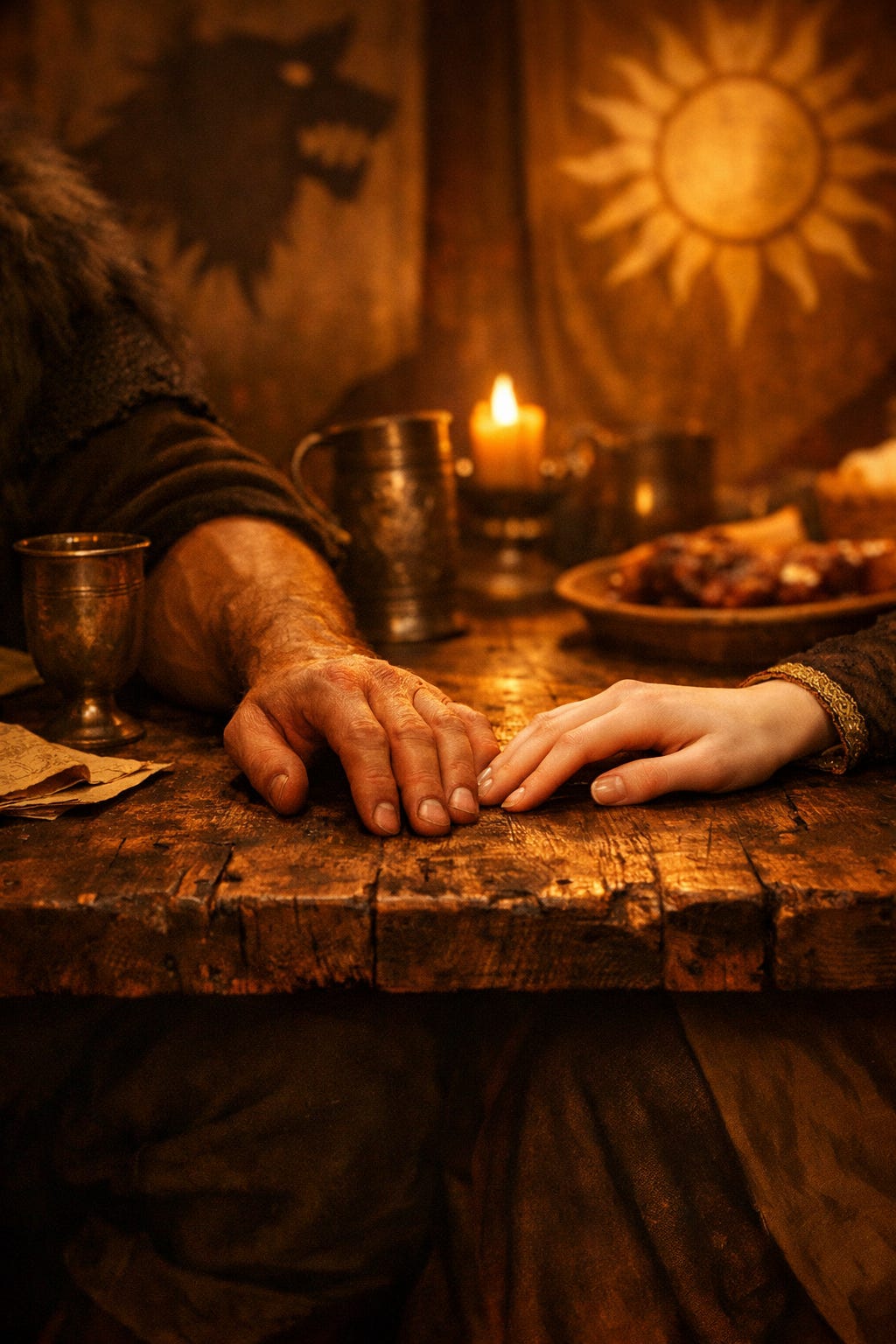
The great hall glowed with firelight and voices. More than a hundred guests filled the long tables, leaders of the northlands, forest chiefs, seasoned warriors, river merchants, envoys from neighboring realms. Banners hung heavy above them: wolves, suns, ships, ancient signs of lineage and promise. The tables bowed under abundance. Roasted venison glazed with honey and juniper. Trout baked whole in salt and herbs. Dark rye loaves torn by hand. Bowls of root vegetables slow-cooked in fat until they melted on the tongue. Fresh cheeses wrapped in linen. Apples stewed with berries and spice. Nuts cracked open with laughter.
Drink flowed freely, mead thick and golden, berry wine sharp and bright, ale dark as earth.
Gustav and Linde sat side by side at the high table. Close enough to feel each other’s warmth. Far enough to feel the ache of restraint.
Linde’s breath hitched, and she looked down at her plate, her cheeks burning a vivid, feverish red. She felt his proximity like a burn. Her eyes were wet, her vision blurring as she stared at the salt on the table.
“I cannot,” she whispered, her voice a fragile thread. “Gustav, I cannot do this. Three months... it is like death.”
“Look at me,” Gustav rasped, his voice low and dangerous. “Linde, look at me.”
She turned, her lip trembling, her face fracturing with the effort of not weeping in front of a hundred warriors. “You are going and I cannot follow you. You are leaving me with the ghosts of this castle.”
“I am coming back to you,” he vowed, his hand twitching on the table. “By the sea and the stone, I will return. I am only riding so that the world is quiet enough for us to live in.”
As the last notes of music faded and the servants moved quietly between the tables, King Eirik rose. He did not signal for silence; it came on its own, pulled toward him like iron to stone.
“My people,” he said, his voice deep and unhurried, “and our honored guests who have traveled far to sit beneath this roof.”
He let his gaze travel the length of the hall, taking in warriors scarred by old campaigns, merchants with ink-stained fingers, envoys from riverlands and coastlines who watched carefully, measuring the future.
“We gather tonight to mark a joining,” he continued, “but celebration alone would be dishonest.”
A murmur passed through the room.
“What was done to Princess Linde was not misfortune. It was not chance. It was an act committed by men who believe fear is a currency and women a spoil.” The words landed heavily. “That belief ends here.”
Eirik’s hand closed around the rim of his cup, not lifting it yet.
“As we celebrate the beautiful union today, I pledge my ships, my banners, and my armies to the pursuit of those who profit from such crimes. Not in blind fury, but in purpose. We will close the roads that carry this trade. We will break the markets that feed it. And we will make certain that no hearth in our lands wonders whether its daughters are safe.”
He turned then toward Gustav, his expression both stern and unmistakably proud.
“My son will ride,” he said. “Not because he is my heir and king, but because he understands that power exists to shield, not to dominate.”
Only then did he lift his cup. “To alliances forged in blood and kept by honor.”
Cups struck wood. Fists met chests. The sound was not wild, but resolute: the sound of men who knew they would soon march.
When the hall settled again, King Artemij rose. Where Eirik had filled the room with weight, Artemij sharpened it.
“I have buried my wife,” he said quietly. “I have raised children knowing this world does not forgive softness.” His eyes moved, not to the crowd, but to his daughter.
“I taught my sons that strength without restraint is savagery. And I taught my daughter that her worth is not measured by what she survives, but by what she chooses.”
Linde felt Gustav’s presence beside her like a living flame. She did not look at him, but she felt him, felt the way his body stilled, the way his breath changed when her father spoke her name without speaking it.
“My sons Andrej and Vlad will ride with Gustav,” Artemij continued. “They do so not for vengeance alone, but to restore balance where it has been broken.”
A pause followed, deliberate.
“As for my youngest, Miro, and myself, we return home to prepare a dowry worthy of a royal bride.”
A ripple of approval spread through the hall, warm and cheerful.
Andrej inclined his head once, solemn and proud. Vlad’s expression remained guarded, but his jaw tightened in acceptance. Laila’s smile was radiant and unapologetic.
Then Gustav rose. He did not reach for his cup.
“I was not raised to conquer,” he said evenly. “I was raised to hold the line.”
The hall quieted further, if that was possible. Commanders leaned forward. Warriors stilled.
“I have seen what happens when men forget why they fight. When taking becomes easier than protecting. When cruelty is mistaken for strength.” His gaze moved across the room, steady and unflinching.
“There are roads in this world that should not exist,” he said. “Markets that should never open. Men who should not sleep peacefully again.”
The air tightened.
“I will ride to close those roads,” Gustav continued. “I will burn what feeds them. And I will return.”
Only then did his eyes shift - to Linde.
“There are things worth standing in fire for,” he said, his voice lowering. “Worth bleeding for. Worth choosing again, even when the cost is everything.”
Linde’s breath didn’t just catch; it stopped. The air in the hall seemed to vanish, replaced by the sheer, ionizing force of his gaze. The fire stirred behind her ribs, no longer a flicker but a low, fierce conflagration that roared through her veins. She had never wanted anyone or anything the way she wanted this man in this heartbeat. She wanted to claw through the distance between them, to feel the rough, scarred map of his skin against her own, to be crushed beneath the devastating weight of his presence.
“This I swear,” Gustav finished.
Silence followed, thick, reverent, before a single warrior struck his fist to his chest. Then another. Then another. The sound rolled outward like thunder held just beneath the skin of the earth.
His words were a claim, more binding than any vow, and Linde felt the truth of them settle deep in her womb, certain and demanding. She looked at him, steady, scarred, unwavering, and felt a wave of infinite, terrifying love for him, along with the chilling thought that he might not return to her.
Then, with a subtle, shaky breath, Linde pulled herself back, the regal healer returning to her features before any of the guests could notice the heat that had just passed between them.
When Linde rose, the hall leaned toward her.
She was luminous, not in ornament, but in presence. Firelight caught in her hair, softened the pale fur at her shoulders, traced the calm line of her throat. She looked neither frightened nor tentative. She looked certain.
She lifted her cup first toward the kings. “To those who ruled before us,” she said, her voice clear and resonant, “and taught us that power must answer to conscience.”
She turned then toward the warriors. “To those who stand between darkness and the defenseless: often unseen, often unthanked.”
Finally, she faced the hall.
“I come to you not only as a bride,” Linde said, “but as a healer.”
A murmur stirred.
“My mother, Velena, served many of you. Some trusted her with your lives. Some with your children.” She placed her hand over her heart, steady and open.
“I will serve here, with Laila, while we wait for our men to return. We’re here for the women in labor. For the wounded. For all of you whose suffering has gone unheard.”
As she spoke, Gustav watched her with admiration. This was not only the woman he loved, this was the queen his people needed.
From the corner of his eye, he felt King Artemij’s gaze on him, measured, searching. Gustav did not look away.
Linde lifted her cup once more. “To this land, which has welcomed me. To its people. And to the truth that care is not weakness, it is survival.”
She drank.
For a heartbeat, no one moved.
Then chairs scraped back, slowly. One by one, people rose, not shouting, not cheering, but standing, as if acknowledging something sacred that had just been claimed.
Hope moved through the hall like breath. As the feast waned, people came forward: not only with congratulations, but with need.
“My sister carries a child and we fear the worst.”
“My mother cannot rise from her bed.”
“My wife bleeds.”
One by one, they came. And Linde did not turn any of them away.
The fire answered. And it was not done burning yet.
🧠 Behind the Saga: The Public Theater of Commitment and Retribution
Chapter 17 serves as the absolute psychological and structural apex of the saga’s first arc, transitioning from the forced containment of political diplomacy into the raw, inescapable reality of ancestral ritual. By merging the somatic breakthrough of a non-neurotypical protagonist with the immense weight of early medieval statecraft, the narrative exposes the deep cultural architecture that allowed decentralized societies to solidify alliances, process collective trauma, and mobilize for total war.
Throughout the preceding chapters, Linde has processed the profound terror of her abduction, the threat of the wilderness, and the sudden shift in her geopolitical reality through her hyper-logical, empirical mind. Intellectualization, treating imperial decrees like incorrect medical dosages and analyzing her surroundings with clinical detachment, served as her primary psychological defense mechanism.
However, a crisis of survival cannot be compartmentalized forever. Her dance in the lower courtyard represents a profound somatic breakthrough. By choosing bare feet on weather-beaten stone and moving from a measured Baltic circle dance into a frantic, spinning, heavy release of physical longing, Linde forces her body to finally process the accumulated trauma of the carriage, the river, and the crushing fear of losing her anchor.
This performance strips away the performative, curated social scripts of the high courts. It isn’t an act designed for male consumption or royal permission; it is a raw, unblinking manifestation of existential hunger. Linde weaponizes the dance to reach across the physical distance forced by protocol, dragging both Gustav and the court out of their self-imposed, tragic isolation and anchoring them in the immediate, undeniable truth of her presence.
The engagement celebration at Steinhjarta is not merely a backdrop for romance; it is a highly formalized transition ritual operating within a theater of intense social and political surveillance.
In a 10th-century decentralized fortress, a public feast was a legal and spiritual arena where every movement, gesture, and proximity was calculated by internal leaders and foreign envoys alike.
The structural turning point of the feast occurs when Linde rises with her cup. She does not speak as a passive prize or a rescued victim; instead, she systematically invokes the maternal, cross-cultural lineage of Velena. By publicly offering her medical expertise to the women in labor, the wounded, and the defenseless while the men are away at war, Linde executes an act of indigenous statecraft.
She does not wait for a crown to grant her authority. She claims her place as the spiritual, emotional, and functional heart of the North Castle. For Gustav, his rising pride is not merely romantic; it is the tactical recognition that Linde is the exact, unyielding shield his kingdom requires to survive. She transforms her marriage from a dynamic dynastic arrangement into a permanent covenant of mutual protection with the land and its people.
The dual speeches of King Eirik and King Artemij ground the chapter in the brutal macroeconomics of early medieval warfare. When Eirik rumbles that the exploitation of women within his territory ends here, and Artemij demands that the slave-roads burn before a marriage can take place, they are enforcing the primary currency of ancestral kingship: the moral code of absolute protection.
In the 10th century, if a sovereign failed to secure his borders or left an international network of human traffickers unpunished after an assault on his bloodline, his political authority would instantly collapse. A retaliatory strike was an existential necessity to re-establish deterrence.
By pledging their ships, banners, and heirs to a rapid, off-season campaign before the spring thaw, the kings are activating elite, dedicated warrior units specifically engineered for rapid deployment. Gustav driving his iron commitment into the room, declaring that he will ride to close those roads, burn what feeds them, and return, signals that the stalling tactics of diplomacy have officially been replaced by the language of the blade. The three-month timeline is not a period of passive waiting; it is a coordinated campaign of absolute retribution.
🌱 Room for Thought:
Historically, we are trained to look back at ancient halls and see nothing but arranged strategic transactions, where women were bartered like static trade routes on map tables. Yet, our protagonist completely subverts this framework, weaponizing her own culture, her mother’s medical legacy, and a traditional song to dictate her own terms to an entire warrior court.
When you look at the absolute reverence that settles over the great hall as the people rise one by one to acknowledge her vow, it forces an insightful question:
Have we moderns, in our highly insulated, hyper-independent partnerships, lost the understanding that a permanent covenant cannot exist in a vacuum? That ancestral love wasn’t a passive emotion, but a mutual defense treaty, one that required a willingness to confront the literal terrors of the frontier, dismantle the violent systems of the world, and build a sanctuary out of the rawest elements of survival?
If the escalating war path and the razor-sharp wit of the High Forest have you gripped, you can jump straight into the deeper history right now. The first two complete volumes of the Firebound saga: Emerald to Steel and Salt and Gold are available for immediate reading on Kindle.