
The gray light of pre-dawn had not yet touched the stone of the castle when Linde slipped through the heavy door of her chambers.
The corridors were quiet in that suspended hour between night and morning, when even the walls seemed to hold their breath. She moved without urgency, wrapped in a dark cloak, the echo of Gustav’s touch still burning softly against her skin as if he were walking beside her still.
Inside her chamber, the air was warm with the scent of beeswax and the faint, sweet steam of a prepared bath. Her friends were there. All but Laila - who was sending off Andrej at this very moment, and Galina, who was gone to claim her own final hour of joy with her beloved Rolf. Linde felt a sharp, bittersweet pang. She envied Galina’s freedom but loved it for her, a secret spark of happiness for her friend that she could not yet kindle for herself.
The moment the door latched, Linde’s composure, that regal, clinical shield, simply dissolved. She let the cloak slide from her shoulders, and her knees gave way.
She collapsed onto the wide bed, burying her face in the furs. The sobs were not the quiet tears of a princess, but the raw, gasping cries of a woman who felt her soul being torn in two.
Instantly, her friends were around her, a circle of hands and soft voices. They didn’t offer empty platitudes or tell her to be strong. They became her strength.
They undressed her with the tenderness of mothers tending a wounded bird, their fingers deft and familiar. They lowered her into the deep copper tub, where the water was pale with chamomile and fragrant with yarrow for courage.
“Let it go, Linde,” one whispered, brushing a wet strand of hair from her cheek.
They washed her skin with linen cloths, their movements rhythmic and grounding. They began to comb her hair, the long, honey-pale strands fanning out in the water like silk. This was the ancient energy of women, the quiet, indomitable power of the hearth. They picked up her shattered pieces and held them until the sobs turned into long, shuddering breaths. Under the steady cadence of their touch, the exhaustion finally won. Surrounded by water, flowers, and the women who had carried her since childhood, Linde drifted into the dark.
The dream came to her as a sanctuary.
Linde stood in a space of infinite amber light. Beside her, she felt a presence like mountain stone and winter pine, Freya, Gustav’s mother. The woman did not speak, but her steel-blue eyes held a pride that transcended death. She reached out, placing a silver shield at Linde’s feet, its surface reflecting not Linde’s face, but the face of the North itself.
Then, the air grew warm, smelling of dried lavender. Velena appeared. Linde’s mother looked exactly as she had in the final days, wise, steady, and infinitely kind.
The two women, who had been friends in life, writing letters across a thousand miles, stood together now. They were the architects of this joining. Freya reached out and placed a crown of northern rowan on Linde’s head; Velena stepped forward and braided a strand of eastern flax into the circle.
“The Bear will return. The summer sun will witness your wait, but the winter will witness your reign. Do not fear the distance, daughter.”
Linde reached for them, but they dissolved into light, leaving her with a sense of peace so profound it felt like armor.
When Linde woke, the sun stood high in the window. Her skin was cool now, the bath long drained. She lay wrapped in linen, hair braided loosely at her shoulder.
Laila sat beside the bed, her expression gentle and watchful. “They rode at first light,” Laila said softly. “I told the court you were unwell. No one questioned it.”
Linde nodded, pressing a hand briefly to her chest.
“Your father wishes to ride with you,” Laila continued. “Before he and Miro return east.”
The stables were alive with quiet motion when Linde arrived, horses being watered, saddles tightened, voices kept low out of respect for the hour. King Artemij waited for her already mounted, his posture relaxed in a way she had not seen in years. They rode out together, away from the bustle, into the quiet fields.
For a long time, the King was silent. Then, he pulled his horse to a halt and looked at his daughter.
“I was wrong, Linde,” he said, his voice breaking in a way that made her heart ache. “In the hall, I saw you dance, and I saw the way that Northman looked at you. I thought I was protecting you by making him wait. But I realized... I wasn’t protecting you from him. I was protecting myself from the silence of my own house. When I watched you dance... I saw your mother. But I also saw a woman I didn’t recognize. Someone stronger than the girl I raised.“
He reached out, his hand trembling as he cupped her cheek. “I thought if I kept you a child, I could keep the world from hurting you. But I realized I was just a selfish old man trying to keep the light of my house from going out. I was protecting myself from the silence.”
He wiped a tear from his eye, his gaze raw with honesty. “Gustav is the only man I have ever seen who is strong enough to let you be your mother’s daughter and your own queen at the same time. I accept this path, Linde. I accept him. Go to his bed. Rule his hall. And know that my love follows you like the summer wind. You are my pride... When the roads are clear, I will send you a dowry that will make the gods weep with envy. Not because you are a prize, but because you are my heart walking outside my chest.”
Linde threw her arms around his neck, weeping into his shoulder. For the first time, the King was just a father, and the Princess was just a daughter, finding peace in the truth.
“Thank you, Papa,” she said quietly. Then, after a breath, “I have one favor. Miro has avoided me since the announcement. Help me speak to him before he leaves. I cannot have him go with anger in his heart.”
They found Miro near the training grounds, away from the bustle of departure. He stood stiffly, hands busy with the leather of his horse’s bridle, eyes fixed anywhere but on her.
“Miro,” Linde said softly. “You ride east tonight, and I stay north. Will you truly go without a word to me?”
“Go away,” he snapped, his back to her. “Why should I care about a sister who chooses a stranger over her own blood? You chose cold stone and foreign skies over the home we built together. How am I supposed to leave you here with a man who is shattered, in a land that feels like it wants to freeze the blood in our veins?”
She stepped into his line of sight, gentle but unyielding.
“I chose the man who stood between me and a shadow,” she said. “I chose the heart that beat with mine when the world was ending. You think he is shattered because of his leg, but he is the reason I am whole.”
Miro looked at her then, and the fury in his eyes broke into something raw and young. “He is a stranger to me,” he said hoarsely. “A man who is stealing my sister before she ever had time to breathe again.”
“I am not being stolen,” Linde said, her voice steady as stone. “I am standing where I was meant to stand. I am not leaving you, Miro. I am becoming.”
She moved closer to him. “You’re not mad at me, Miro. You’re scared. You’re scared because the world is moving and you feel like you’re being left behind. You were even smaller than I was when we lost Mama... and you think this is just another death.”
Miro’s jaw worked, his eyes filling with sudden, angry tears. “He’s taking you! He’s a stranger with a scarred face and ...and you just... you don’t care!”
“You think he’s a stranger,” she told him, holding his face as she had since he was a babe. “But he is the same blood as our great-grandfathers who first sailed these rivers. He isn’t taking me away from our people, Miro. He is bringing me back to where our story began.”
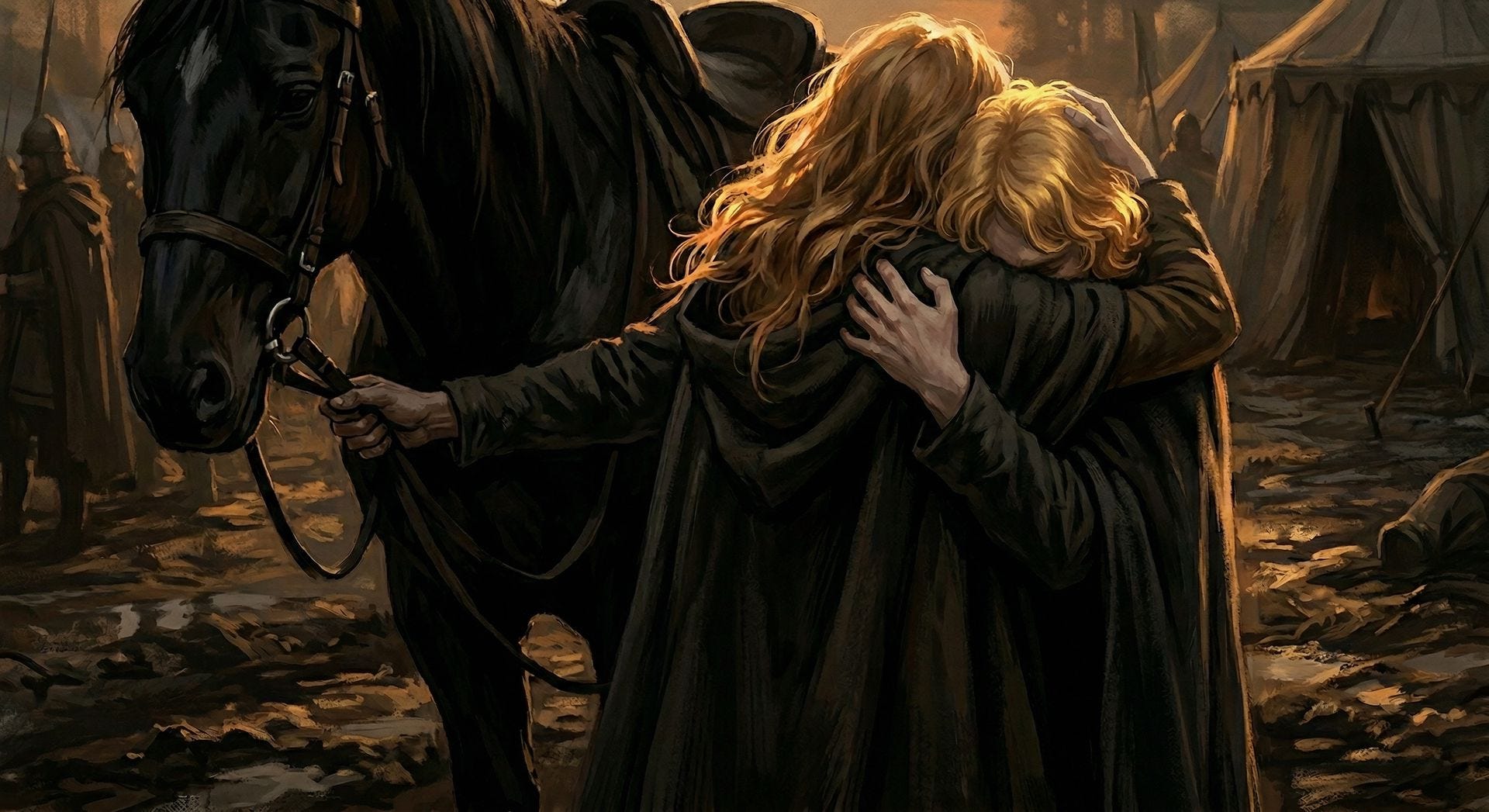
She pulled him into a crushing hug. Miro resisted for a second, then collapsed against her, his head on her shoulder as he let out a jagged, muffled sob.
“He’d better come back, Linde,” he muttered. “Because if he doesn’t, I’m coming back for you with an army.”
“I am not leaving you,” Linde said, her voice steady and mother-like. She framed his face with her hands, looking into his eyes until he truly saw her. “I am your big sister. I was the one who sang you to sleep when the fever was high. I was the one who taught you the names of the stars. I am staying here to build a world where you can visit and be safe. Gustav didn’t steal me, Miro. He saved me so I could be here for you.”
“He will return,” she whispered, kissing his forehead. “And when you come back for the wedding, you will see that I am not a captive. I am a Queen.”
They stood together a moment longer. Then the road claimed him.
🧠 Behind the Saga: Ancestral Feminine Networks and the Cognitive Architecture of Early Medieval Parenting
Historically and anthropologically, modern culture tends to view the domestic spaces of the 10th century through a highly diminished lens. We are conditioned to think of women in ancestral societies either as isolated victims or as passive observers of history. Chapter 19 completely shatters this framework by exposing the communal sanctuary of the hearth as an indomitable locus of female power.
When Linde’s regal, clinical shield collapses behind closed doors, her survival depends on a hyper-local network of female peers. In the early medieval Europe, a woman’s peer group was her primary psychological and physical defense treaty. The ritual preparation of the bath and the herbalism, infusing the water with chamomile for grounding and yarrow for literal and spiritual courage, serves as a highly structured, somatic restoration process.
This ancestral energy is exactly what has been stripped away from modern women. In our contemporary, hyper-independent, and deeply insulated societal structures, we have largely dismantled the physical proximity of the sisterhood. This chapter demonstrates that a permanent covenant cannot be sustained by an individual in a vacuum; it requires a collective foundation of women who know how to pick up the shattered pieces of a peer, hold her boundaries, and physically carry her through thresholds of profound existential transition.
The interactions between King Artemij, Linde, and young Miro form a study of what contemporary psychology terms “respectful” or “gentle” parenting (a framework frequently distorted by modern misinformation to mean permissiveness or lack of boundaries). On the early medieval frontier, high-functioning emotional regulation was a baseline tactical requirement to keep a ruling dynasty from fracturing from within.
We see this philosophy first in King Artemij’s profound ego-collapse. In a 10th-century geopolitical arena driven by empirical expansion, a patriarch’s baseline operational mode was hyper-vigilant control. Children were routinely treated as strategic capital. Yet, when Artemij confesses, “I was protecting myself from the silence of my own house,” he models the ultimate tenant of respectful parenting: recognizing one’s own projection and trauma.
He realizes his resistance to the Northman was a defensive shield against his own impending grief after losing Velena. By reframing Linde not as a prize or an extension of his legacy, but as “my heart walking outside my chest,” Artemij steps out of a power struggle and into absolute, respectful alignment with his daughter’s autonomy. He becomes a leader who de-escalates his own authority to let his child find her path to becoming a ruler.
Linde immediately inherits and executes this exact parental framework when she confronts Miro near the training grounds. Miro’s teenage defiance (“Why should I care about a sister who chooses a stranger over her own blood?”) is the classic presentation of adolescent trauma. To an unripe teenage mind, Linde’s political transition triggers a hyper-vigilant panic loop; his nervous system registers her departure as a repetition of their mother’s death.
Instead of fighting the surface-level disrespect or enforcing an authoritarian boundary, Linde practices intuitive containment. She ignores the behavioral noise entirely and addresses the root trauma with absolute clarity: “You’re not mad at me, Miro. You’re scared.” She steps into his line of sight, enforces a steady, mother-like physical grounding, and reframes his worldview from one of captive theft to sovereign expansion.
🔎 Historical Note: Dialogue and Mentorship in the Early Medieval Europe
This non-coercive, emotionally intelligent leadership style is deeply grounded in 10th-century historical realities. While pop culture imagines early medieval youths being raised purely through brutal martial discipline, historical and saga evidence paints a far more sophisticated picture:
The Sibling and Foster Kin Load: Early medieval Nordic and Baltic societies relied heavily on systems of fosterage and close sibling-kin networks to share the cognitive load of upbringing. Older siblings, particularly daughters trained in botany and household management, routinely stepped into high-functioning mentorship roles if a mother died, establishing an unbroken line of emotional security.
Dialogue Over Arbitrary Coercion: The Icelandic and Scandinavian sagas frequently depict parents and mentors reasoning with youth through proverbs, legal logic, and direct appeals to ancestral lineage rather than arbitrary physical dominance. A youth’s compliance was won by demonstrating clear, unwavering emotional stability and leadership.
🌱 Room for Thought
Historically, we are trained to look back at ancient halls and see nothing but brutal, authoritarian systems where warlords ruled their households with the same iron fist they brought to the shield-wall, and adolescent defiance was crushed by sheer dominance.
Yet, in Chapter 19 we challenge this belief system. When we witness King Artemij dismantle his own parental ego, and we watch Linde look past her teenage brother’s aggressive defiance to whisper the raw truth: “You’re not mad at me, Miro. You’re scared”, she cuts straight through the noise of deviance to address the underlying pain, trauma, and need behind the behavior.
When you look at this seamless, multigenerational demonstration of emotional containment and respectful leadership on the 10th-century frontier, it begs a question:
Have we moderns, in our highly hyper-independent, institutionalized approach to family, misunderstood the true roots of “gentle parenting”? Have we mistaken it for permissiveness, when in reality, it was an ancient, high-stakes ancestral tool of survival, one that required leaders to conquer their own defensive egos, meet unripe minds exactly where they were bleeding, and build an unbreakable emotional sanctuary out of the rawest elements of human connection?
If the escalating war path and the razor-sharp wit of the High Forest have you gripped, you can jump straight into the deeper history right now.
The first two complete volumes of the Firebound saga: Salt and Gold and Emerald to Steel are available for immediate reading on Kindle.