
Pain came first, blinding, immediate, wrong, tearing Linde from warmth into chaos.
For a fractured heartbeat she thought the fire had turned on her.
Then a scream split the night.
Hands seized her arms. She was dragged across cold ground, skin scraping stone and root. Her lungs burned as she tried to inhale.
“LAILA!”
The blow came from the side. The world vanished. She woke to agony.
Her head throbbed with a relentless, splitting pain that radiated down her neck and into her ribs. Each breath scraped. The world was dark, not fully: thin seams of daylight slipped through coarse fabric tied over her head.
She was moving. Wood creaked. The ground jolted beneath her. Hooves struck earth in an unforgiving rhythm. A wagon, her mind supplied slowly. Her wrists were bound behind her back. Her ankles too. Her throat burned with thirst so sharp it made her gag. She shifted.
Something wet smeared against her arm. It was blood. Not hers. Her breath hitched. She twisted as far as the ropes allowed and brushed against a body beside her. It was limp, too heavy, wrong in its stillness. Her fingers came away slick and warm. The smell of iron flooded her mouth.
“No,” she whispered.
Darkness took her again.
When Linde woke the second time, it was night. The wagon had stopped.
She heard breathing, shallow, broken, and small sounds that might once have been words. Her head pounded. Her ribs screamed. She swallowed painfully, her mouth lined with ash.
“Hello?” she whispered. “Who is here?”
“Linde.” Katrina’s voice, thin and shaking. “Linde, I’m here.”
“I’m here,” Linde said at once, forcing steadiness into her tone. Fear wastes breath, her mother’s voice reminded her. Breathe first. She turned her head carefully, mapping the space by sound. “Who else?” she asked.
“Galina.” “Nastja.” “Vasja.” Four.
“Laila?” Linde asked. Silence. Relief and terror collided so violently she nearly retched. She closed her eyes beneath the hood. Alive, she thought. Laila MUST be alive.
The few days that followed blurred into a long, grinding march. They traveled northwest, Linde realized, she felt it in the air as nights sharpened and the damp smell of lakes replaced forest loam. By the sun’s slant through the wagon slats. By the rhythm of movement: too steady, too deliberate. This was not a raid. It was transport.
They were given foul water twice a day. Hard crusts of bread once. When the men spoke, Linde listened, fitting rough sounds to patterns she knew.
The dialect was nomadic, border traders who moved along routes older than kingdoms. They spoke of Polesia, of river crossings that fed into the Baltic corridors, of reaching the great northern market where buyers gathered. She had heard of it.
Girls taken from the forests and borderlands: Slavic, Baltic, and sold as domestic and sexual slaves. Virgins prized highest. Untouched bodies meant obedience, they said. Meant profit.
Harems. Households. Ships. Her stomach twisted, but her mind stayed cold. This is sex slavery, she thought with clinical clarity. And we are merchandise. Great...
When the wagon finally stopped, the world lurched sideways.
Hands yanked her forward. The hood was torn from her head, and the midday light struck like a blade. Linde squeezed her eyes shut, her head ringing, blood drying stiff along her cheek. When she finally forced her lids open, she didn’t see spirits or monsters. She saw men. Six, maybe seven. They were wrapped in travel leathers and the sour stink of old sweat. Varangians, by the cut of their cloaks, were border traders who lived in the spaces between laws. Not soldiers. Much worse.
Before fear could settle fully, Linde spoke. She did not scream; she conducted an experiment.
“Let us go,” she said first in the northern tongue, steady and precise. “You have made a mistake.” Blank looks. One man spat into the dirt.
She shifted instantly, smoothly, into a southern trade dialect, her mind clicking through her “internal encyclopedia” of languages like a scholar at a desk. “I am a princess. Linde. Daughter of King Artemij of the North. My ransom is worth more than your lives.”
A laugh cut her off. A hard shove sent her stumbling into Katrina.
She tried again, this time in Old Ruthenian, sharper, edged with the authority she had seen her mother use to quiet a room of brawling lords. “You do not want this war. The King’s shadow is long, and his reach is longer.”
One of the men grabbed her chin, forcing her head up. His thumb was calloused and smelled of raw onion. “She thinks she’s a big deal,” he said to the others. “Strip them. Get them in the lake. The buyers won’t pay for the smell of a wagon.”
“No,” Linde said, loudly now, her mind revolting against the erasure of their dignity. “You do not touch us.”
The answer was a fist.
Pain exploded across her face. The world spun. She went down hard, tasting blood and grit, her brain briefly noting that her jaw was likely bruised but not fractured before the darkness threatened to pull her under. Suddenly someone knelt beside her. A different shape. Smaller. Hesitant.
“Enough,” a voice said, younger, softer. “You’ll kill her, and then we have nothing but a carcass to sell.”
His hands were gentler than the others, he helped her sit up. The man was a boy, really, with eyes that darted toward the leader in fear. He avoided her gaze as he untied her wrists. “Wash,” he muttered. “The lake. Now.”
The other girls were already pushed into the water’s edge and stripped under the open sky.
The lake was black and endless, its surface breathing mist. The water burned like knives. Rough hands scrubbed them until their skin stung, washing away blood and dirt and everything that marked them as themselves. When they were done, thin garments were ready to be thrown at them, pale, nearly transparent, clinging in a way that made their vulnerability unmistakable.
Erasure, Linde thought. This is how they erase us as people in preparation of what we are to become. Linde hesitated, her teeth chattering so hard she feared she’d bite her tongue.
The younger guard, Elian, hesitated too. He stepped between Linde and the other men, awkwardly holding out a tattered gray cloak to create a meager screen. “I’ll stand watch,” he said quickly, loudly enough for the others to hear. “So she doesn’t run.” He turned his back, not fully, but enough.
Over the next few days, Linde watched the variable that was Elian. On the second night, he brought her a handful of wild berries he’d found, hidden beneath his sleeve. When their fingers brushed, he recoiled as if burned, his face flushing crimson in the moonlight. He sat by the fire just outside their door, and Linde noticed he wasn’t looking at the flames; he was looking at her silhouette against the stone wall.
On the third morning, as he brought the water, he lingered longer than he should. “You have the eyes of a forest spirit,” he whispered, his voice cracking. “My mother told stories of girls like you. You don’t belong in a cage.”
Linde noticed everything. She noticed the way his ears reddened in the wind, the way his pulse thrummed in his neck. Kindness, she thought. Or fear.
“Then don’t let them take me to the market, Elian,” she said softly, in his own tongue.
He didn’t answer then, but that evening, Linde saw him arguing with the leader. He was gesturing toward the wagon, his voice rising in desperate, youthful anger until a heavy blow from the leader sent him sprawling into the dirt. He didn’t come to their door that night, but Linde heard him weeping softly in the dark.
The next night, the door to the stone room creaked open. Elian stood there, his lip split and his eye swollen shut from the leader’s beating. He held a set of keys in his trembling hand.
“Go,” he hissed, his voice thick with terror and love. “The path behind the well leads to the marshes. Follow the stars north. I... I will stay and tell them you overpowered me.”
Linde stared at him, stunned by the raw sincerity in his bruised face. “Elian, they will kill you.”
“I’m already dead if I stay,” he whispered, reaching out to touch a lock of her hair one last time. “Just go. Please.”
Hope flared, sharp enough to hurt. The girls began to scramble toward the door, their bare feet silent on the stone. But as they reached the threshold, the silence was shattered.
“You little rat!”
The leader emerged from the shadows of the corridor, his axe gleaming. He hadn’t been asleep; he had been waiting. Behind him, three other guards blocked the exit.
“I knew you had no stomach for this, boy,” the leader growled. He lunged forward, grabbing Elian by the throat and slamming him against the wall. “You’d throw away a fortune for a pretty face?”
“Run!” Elian screamed, struggling against the iron grip.
But there was nowhere to run. Hands seized Linde’s hair, dragging her back into the room. Ropes bit deeper than before, tying her wrists until the circulation numbed. The door slammed shut, but through the iron grate, Linde heard the sickening, rhythmic thuds of fists hitting flesh and Elian’s stifled groans. The boy now was being broken for his mercy.
Linde tasted blood and iron and a new, cold fury. We were close, she thought, leaning her head against the damp stone. Close means possible.
Next day she knew they were at the market when the air turned thick with the scent of salt-rot, woodsmoke, and a thousand unwashed bodies. Linde felt the shift in the earth. from the soft, forgiving loam of the High Forests to the hard-packed, filth-crusted soil of a city built for greed.
The hood was torn from her head, and the midday sun struck her eyes like a blade. The smell of the “salt-rot” or the “clashing tongues” feels like physical blows to her ears.
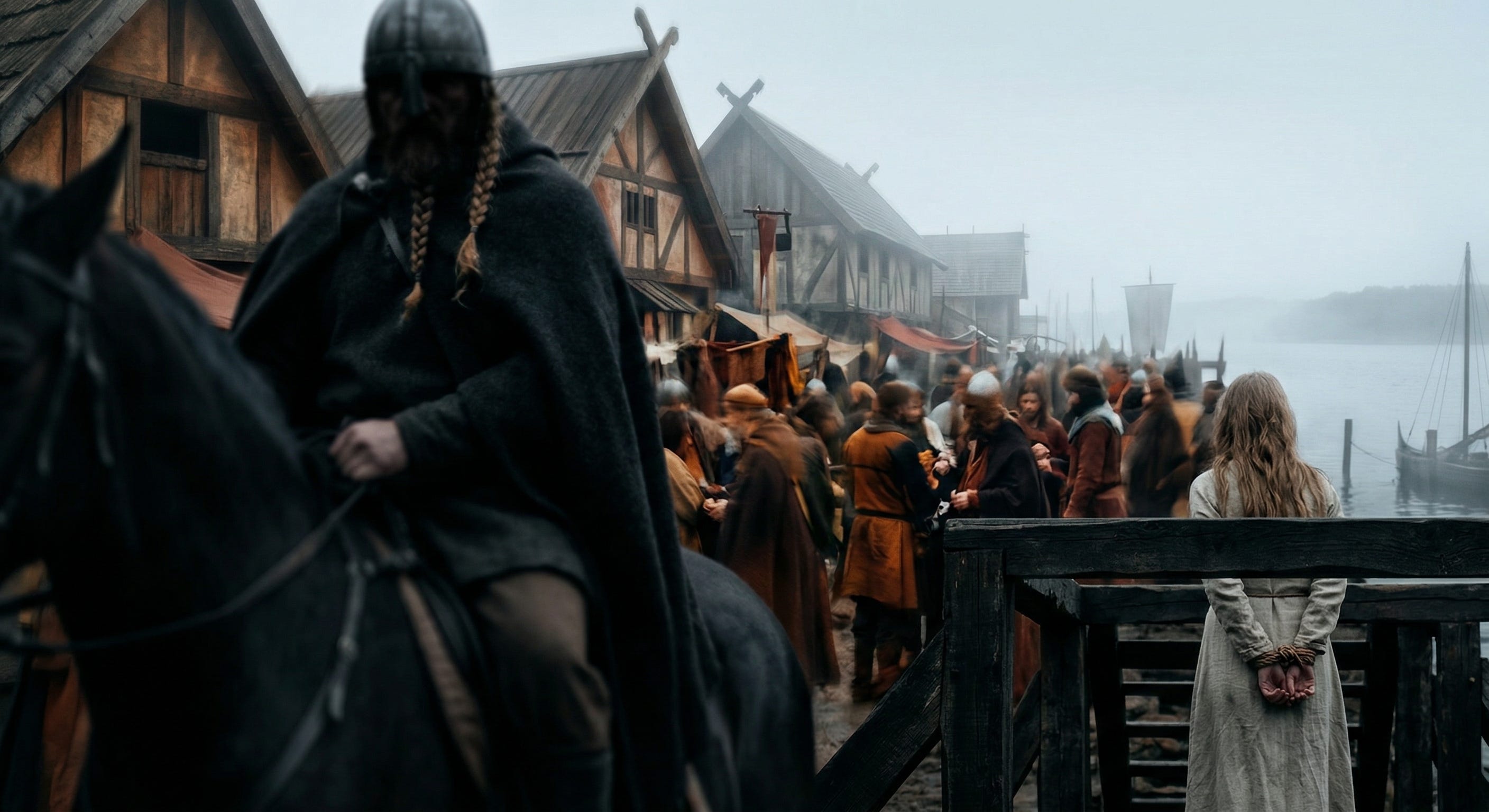
Hedeby. It was a sprawling, chaotic wound on the edge of the Schlei. Behind a massive semi-circular rampart, the market was a labyrinth of narrow alleys and wider thoroughfares, all leading toward the water. Linde’s clinical mind, even through the haze of pain, began to map the madness.
The sound was a physical weight, a cacophony of Norse, Saxon, Slavic, and Arabic tongues clashing like iron. To her left, Frankish merchants in heavy woolens argued over barrels of Rhine wine; to her right, a group of Frisian jewelers held up scales to weigh bits of hacked silver. The air was a thick soup of smells: the brine of the fjord, the copper tang of the smithies, roasting meat, and the pervasive, underlying stench of the “human pens.”
They were driven through the central square, past the great longhouses and the counting-stones. Hedeby was the heart of the world’s veins, where the Northern “Steel Road” met the Eastern “Amber Road.” Here, a man could buy anything from a Damascus blade to a piece of walrus ivory. And then there were the platforms.
Located in the most prestigious section of the harbor-side, the slave platforms were carved from dark oak, raised high so that the sun would catch the hair and teeth of the “merchandise.” Linde and her friends were forced upward. As she stumbled onto the boards, she looked out over the crowd. It was a sea of eyes. They were not looking at them as humans, but as skattr: wealth. She saw the wealthy merchant-princes of the Caliph Al-Ta’iate in their silks, appraising their “fairness,” and the local Norse Jarls looking for labor.
Someone shouted “princess”. Someone shouted “virgin”. Linde fought when they tried to bind her again. Pain exploded across her cheek. Warm blood slid down her skin.
Then, the air shifted. Horses.
Linde felt it before she understood it, a subtle thinning, as if the market itself had drawn a breath and was holding it. Voices faltered. Someone laughed too loudly, then stopped. The press of bodies eased, creating a narrow pocket of space where there had been none. She could hear them: the heavy, impatient sound of hooves on packed earth. They were Northmen.
Linde’s eldest brother, Andrej, had spent several winters fighting alongside the Northmen of the West to hold the river-mouths against the Pechenegs. He had returned with a deep respect for their “Stone Law” and their “Steel Vows.” The Baltic tribes and the Settled Northmen were the two halves of the Amber Road: Artemij’s people provided the wealth of the forests and the medicine of the earth; the Northern people provided the iron shield.
If these men are from the settled halls, Linde thought, her mind sharpening despite the pain, they aren’t here to buy slaves. They are the only ones left who can enforce the King’s Peace.
The crowd parted instinctively. Seven riders waited at the edge of the square, dark against the pale sky. Northern men: broad-shouldered, armed, unmistakable. At their center sat their leader, who held his horse with an ease that stilled the space around him. A man of broad, heavy-boned stature built like the weathered pines and granite of the coast. He loomed a full head above the average man, a compact mountain of muscle and iron that made the air around him feel thick with the weight of his presence. Blond hair was shaved close at the sides, a single braid drawn back from a scarred, steady face.
Linde kept her head lowered. A voice rose nearby, unfamiliar, edged with disbelief. “Look at her,” someone said. “Have you ever seen such beauty?”
Linde’s stomach clenched. She pressed closer to Katrina, who was shaking and weeping, Linde willing herself not to react. Another voice answered, sharper, older. “She’s barely of age. They’ve beaten her, look at her face. The Varjags are getting bold, taking from the High Forests now.”
Heat rushed to Linde’s cheeks. Shame and anger tangled in her chest. “These bastards,” the first voice went on, lower now. “They abduct girls from forests and borderlands and sell them like livestock.”
There was a pause. Then a third voice spoke: it was calm, restrained, carrying an authority that silenced the others. “This isn’t trade,” he said. “It’s theft.”
The word landed heavily. Linde’s breath caught. She could not see the speaker yet, only hear him, but something about the steadiness of it made the hair along her arms lift. “Gustav,” one of the men said quietly. “Look.”
The name lodged itself in her mind. She did not know why. She swallowed hard and tightened her hold on Katrina. To keep the others from breaking, and herself, she began to sing softly, the old soothing song her mother had used when fear threatened to swallow reason. Her voice trembled at first. Then it steadied. It was a song of the North, a slow, grounding drone that mimicked the deep sigh of the pines back home. There was no complex rhythm to it, only a steady, pulsing cadence that felt like a heartbeat beneath the ribs of the world. As she sang, the frantic energy of the market seemed to hit an invisible wall; the clatter of silver and the brine-soaked air softened, replaced by the hollow, ancient resonance of the tune. It was a tether, pulling them all back from the edge of panic and anchoring them to the cold, certain earth beneath their feet.
The market noise dulled around her. She felt it: the sensation of attention narrowing, of something shifting toward her without touch. She did not look up. A breath, sharp, uneven, reached her from somewhere ahead. The man who had spoken earlier did not say anything now. She felt his stillness like a weight.
When she finally lifted her head, it was not to search for him, but because she could no longer bear not to. Their eyes met. Emerald to steel. The world narrowed to that single line of sight. He looked at her as if he were seeing something impossible, not just a girl bound on a platform, but a memory trying to take shape.
He was staring at her now, no longer scanning the market, no longer detached. His gaze was fixed on her as if the sound had struck something loose, as if he were trying to place a memory that refused to settle. She saw confusion cross his face. Then something deeper.
She gasped. He knows this song, she realized with a jolt. Or it knows him. Her own breath caught. How do I know him?
The thought came unbidden, simultaneous, as if recognition had sparked on both sides at once, reaching across the space between them. Before fear could stop her, before doubt could take hold, she spoke, quietly, urgently, in his tongue.
“Please,” she said. “Help us.”
Confusion crossed his face, then something deeper, a dark, brewing storm. “I am Princess Linde,” she said, voice shaking now. “Daughter of King Artemij.”
Silence fell like a dropped blade. And in that silence, recognition ignited: slow, devastating, undeniable.
🧠 Behind the Saga: The Anthropology of the Amber Road
You might have noticed that when Linde is captured, her first weapon isn’t physical force, it’s language, observation, and somatic grounding.
Historically, this also reflects the brutal, complex reality of the 10th-century borderlands. The world Linde is dragged into isn’t a chaotic, lawless wasteland; it was a highly organized, devastatingly efficient global economy.
The settlement of Hedeby (in modern-day northern Germany) was the absolute epicenter of the Viking Age, a massive, roaring metropolis where the “Steel Road” of the Norsemen intersected with the “Amber Road” of the Baltic and Slavic tribes.
Mainstream pop culture often depicts Vikings purely as raiders. But the Varangian Rus’ and Northern Jarls were, first and foremost, apex merchants. As Linde observes the Frankish wine merchants and Frisian jewelers, she is witnessing the earliest iteration of globalized trade. And tragically, human beings were the most lucrative skattr (wealth) in that network. Women abducted from the East Slavic and Baltic forests were highly prized in markets stretching from Scandinavia all the way to the Abbasid Caliphate in Baghdad.
But what is crucial in this chapter is how Linde actively resists the erasure of her humanity.
In the face of extreme trauma and objectification, she relies on two deeply ancestral tools. First, her linguistic agility. In a market defined by “clashing tongues,” her ability to weaponize Old Ruthenian and Northern dialects is a display of high-level cognitive defense. Second, her use of song. When the terror of the auction block threatens to break the girls, Linde doesn’t scream; she sings a low, pulsing drone.
This lullaby is a profound neurological and anthropological tool. Ancient cultures utilized specific resonant vocal frequencies to regulate the nervous system and anchor the body during moments of intense communal fear. By singing, Linde creates an invisible, somatic shield around her people that even the noise of the world’s largest market cannot penetrate.
It is a powerful reminder that even when stripped of all physical power, our ancestors possessed internal architectures of resilience that could not be easily broken.
A Note on the Roots of the Story: The clash of cultures in Hedeby mirrors the complex history of the old European borderlands. The Firebound Saga is built on the reality that these ancient regions weren’t isolated, they were deeply intertwined through blood, trade, and language, creating a legacy of survival that echoes down through the centuries.
💭 Let’s Discuss in the Comments: When thrust into a moment of pure chaos, Linde uses an old, rhythmic song to regulate the nervous systems of the women around her. In moments of high stress or anxiety, what auditory or physical tethers do you use to ground yourself and regain your focus?
🔥 The Saga Continues: Thank you for reading Chapter 2! If you want to find out what happens to Linde without waiting for next chapter’s drop, you can pick up the first two published volumes of the Firebound Saga on Amazon Kindle today.