
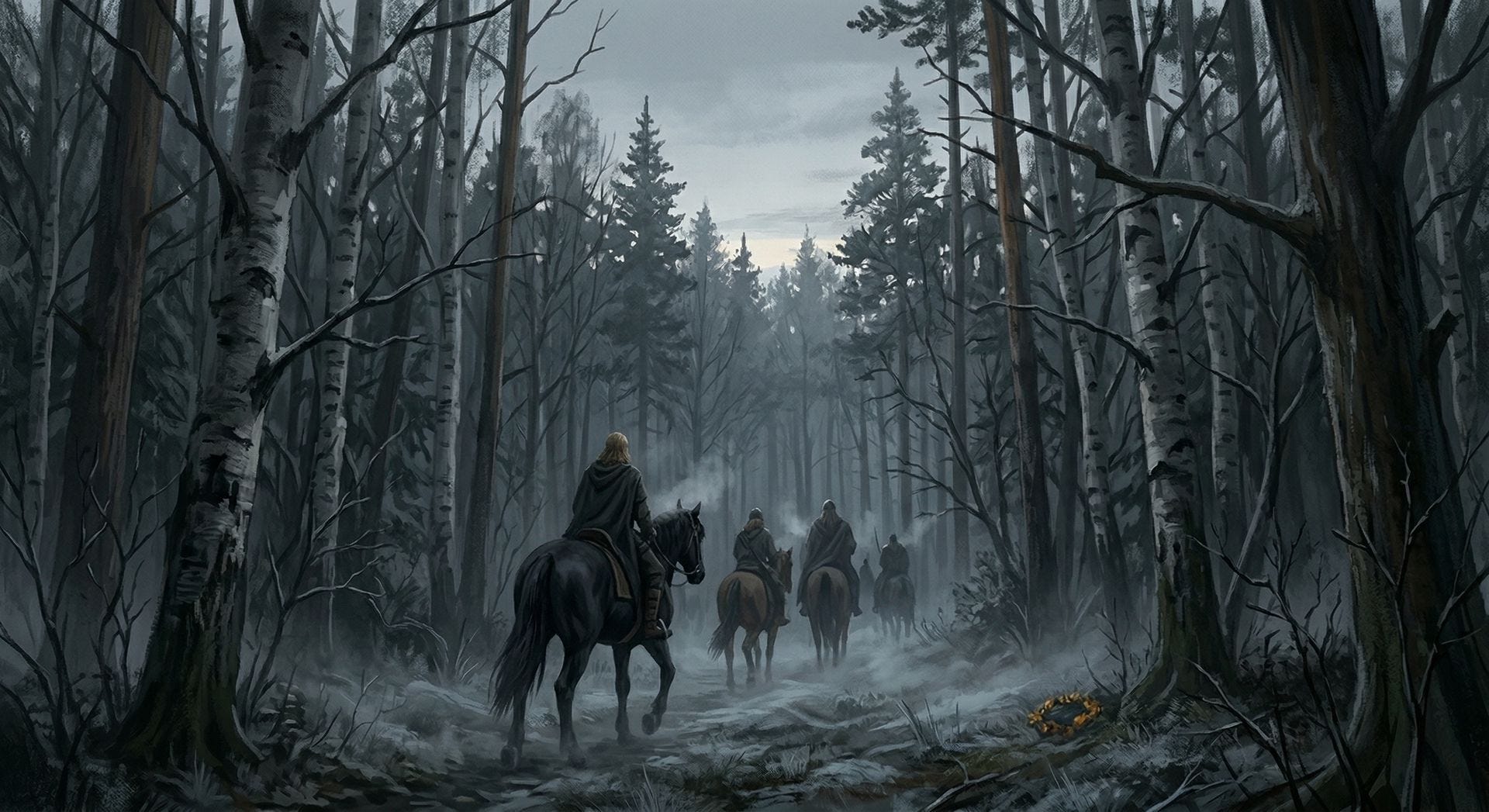
Gustav woke before the sun had even considered the horizon. In the disorienting haze of first light, he reached out, his arm extending into the cold, silver air where a radiating warmth should have been. His palm met only the coarse, empty furs. There was no quiet weight against his chest, no faint scent of chamomile and lake water lingering on his skin.
The realization that Linde was gone, retreated to her own chambers to protect the very honor he had sworn to uphold, struck him with a sharp, hollow ache. He sat up slowly, the stone walls of his loft feeling suddenly vast and indifferent. He understood the necessity of their distance, the price of the tradition they chose to respect, but the absence felt like a physical limb had been torn away.
In the courtyard, the atmosphere was a thick brew of tension and steel. Andrej was already there, a tower of a man checking the cinch of his massive warhorse. Laila stood beside him, her unbound golden hair a defiance against the morning chill. She wasn’t just a wife; she was the fire Andrej carried into the dark.
“Bring me back stories of your valor, my giant,” Laila announced, loud enough to reach every ear in the yard, her eyes sparkling with a fierce, knowing mischief as she looked at Gustav. “And do not fret over your Queen. She is utterly heartbroken and confined to her bed with a sadness so profound she cannot face the light”.
Gustav felt a ghost of a smile. He knew the “sadness” was a ruse to cover her absence from the gates, but he also knew Laila was telling him that Linde was safe within her walls.
Andrej groaned, a low, rumbling sound of pure adoration. He grabbed Laila by the waist, lifting her off the ground as he kissed her with an expressive, bone-deep hunger that sent a shockwave of silence through the gathered warriors. For a heartbeat, the Commander vanished. There was only a man and the woman who owned his soul.
He broke the embrace, his expression turning somber as he stepped toward Gustav. He clamped a heavy hand on Gustav’s shoulder, a grip that spoke of years of shared blood and a new, unbreakable bond of brotherhood.
“She’s stronger than the songs make her out to be, Gustav,” Andrej muttered, his voice for Gustav alone. “She’s our mother’s daughter. Focus on the road. The faster we break these bastards, the sooner you return to the bed you’re currently mourning”.
They rode northeast, the landscape hardening as they left the protection of the castle. By the second day, the forest thickened into a tangled mass of birch and pine. They stumbled upon the hamlet at noon. It wasn’t just charred; it was bleeding.
The smell hit them first, the sweet, cloying scent of burnt thatch and fresh copper. They found an old man sitting in the dirt near a well fouled with a slaughtered hound. He was clutching a handful of dirt, his eyes vacant.
“They took her,” the man whispered, the words rattling in his throat like dry seeds. “My Elara. She was barely of age... she had just woven her first crown of summer marigolds. They struck me down and dragged her into the trees like she was nothing but a pelt to be sold. They laughed, Lord. They laughed while she screamed for me.”
Andrej’s horse shifted, sensing the sudden, violent spike in its rider’s blood pressure. Andrej didn’t speak, but the leather of his reins groaned as his grip tightened.
“They have a head start,” Andrej hissed, his bogatyr fury radiating off him like heat from a forge. “But they are weighed down by their cargo. If we push through the night, we catch them at the pass.”
Gustav looked at the old man, then at the fresh, jagged tracks leading into the broken ridges.
“We do not ride in fury alone,” Gustav told the company, his voice ringing with a cold, terrifying clarity. “We ride to close the road. These men move women as merchandise because they believe the world is too quiet to stop them. Tonight, we prove them wrong. We are the silence that bites back.”
They moved on foot for the final league, the horses muffled and hidden in a ravine. The forest was a wall of silence until the smell of woodsmoke and unwashed bodies reached them.
The slavers’ camp was nestled in a ridge-hollow, a natural trap they thought was a fortress. In the center, penned like livestock behind a cage of sharpened saplings, were the women. Gustav saw the tattered marigold crown lying in the dirt. It was the only spark of color in a world of mud and fear.
The attack wasn’t a battle; it was an execution.
Vlad’s arrows were the first to speak: three sentries fell with feathered shafts in their throats before they could even draw breath. Then, the shadows moved.
Andrej was a force of nature. He didn’t use a shield; he used a massive two-handed blade that hissed through the air, reaping through the guards with a grim, rhythmic efficiency. Gustav moved with a cold, mechanical precision. His prosthetic leg was a solid anchor as he swung his axe, the weight of the iron meeting bone with a sickening thud. He fought with a terrifying silence, his mind a locked room where only the image of Linde lived.
One slaver, larger than the rest, tried to use a girl as a shield. Gustav didn’t hesitate. He threw his hand-axe with a flick of his wrist. It buried itself in the man’s collarbone, dropping him like a stone without grazing the girl.
It was over in minutes. The camp was a ruin of broken men and scattered fires. But as Gustav looked at the trembling girls emerging from the pen, their eyes filled with a glazed, hollow terror, the victory felt like ash.
He saw the girl, Elara. She was shivering so hard her teeth rattled. Gustav pulled the heavy wool cloak from his shoulders, the one that still carried the faint, dying scent of his chambers, and wrapped it around her.
“The road is closed,” he said, his voice rough.
“There are more,” the girl whispered, clutching his cloak. “A ‘Hub’ to the north... where the big ships wait.”
Gustav looked at Andrej. The Prince was covered in the blood of his enemies, his eyes glowing with a dark, satisfied fire.
“Then we find the Hub,” Gustav said.
The trail was fresh, the war was chosen, and far behind him, the woman who held his soul waited in a chamber filled with herbs and silent vows. He had tasted blood tonight, but he hungered only for the peace of her arms.
🧠 Behind the Saga: the Logistics of Human Commodification
A reader intersecting this chapter with modern geopolitical realities, and specifically the systemic, elite-backed networks of human trafficking typified by modern multi-layered criminal rings, is identifying an absolute anthropological truth. The phrase “the more things change, the more they stay the same” is too reductive for your feed; instead, we must look at the enduring survival of illicit supply chains.
In the 10th century, as in the contemporary world, human trafficking was never merely the work of isolated, opportunistic “brutes” lurking in the woods. It was, and remains, a highly sophisticated, institutionalized macroeconomic system. Slavers on the early medieval frontier operated as low-level extraction nodes for a much larger, cross-border commercial machine. They were commodity scouts.
When the girl Elara reveals the existence of a “Hub to the north... where the big ships wait,” she exposes the true geopolitical architecture of the crime. These hubs were historical trade centers, frequently tied to major maritime networks linking the Baltic and Slavic territories to the immense wealth of the Byzantine, Mediterranean, and Islamic markets. Human beings were treated with the exact same supply-chain logistics as timber, furs, or silver.
This historical model mirrors our contemporary global landscape with terrifying precision. Real-world data from the International Labour Organization (ILO) and the United Nations Office on Drugs and Crime (UNODC), human trafficking and forced labor generate an estimated $236 billion in illegal profits annually, a staggering 37% increase over the last decade alone. Globally, an estimated 50 million people are trapped in modern slavery on any given day.
The parallels in the mechanics of extraction and distribution are undeniable:
Just as Gustav’s adversaries rely on a northern maritime “Hub” to transition their cargo from land routes to international waterways, modern criminal syndicates utilize localized safe houses, border choke points, and transit hubs to aggregate victims before moving them across international jurisdictions.
In the ancient world, human livestock was embedded directly into the broader, legitimate mercantile traffic of the Silk Roads and Varangian river routes. Today, human trafficking is seamlessly interwoven into legitimate global industries—including agriculture, manufacturing, domestic work, and digital labor platforms—making the exploitation structurally invisible to the casual consumer.
The tattered marigold crown left in the mud of the ridge-hollow is the ancient equivalent of a modern border-crossing discard. The crime has never been random or impulsive; it has always been structural, logistical, and driven by an elite-backed market demand that relies on the calculated belief that the legal system is too fragmented, corrupt, or indifferent to intervene.
🌱 Room for Thought
Historically, we are trained to look back at ancient conflicts and view frontier banditry as primitive, isolated lawlessness, an ancient world disconnected from our own clean, institutionalized modern frameworks.
Yet, Chapter 20 completely subverts this comfort. When Gustav and Andrej dismantle the slavers’ camp only to discover that the hamlet’s stolen daughters are merely raw inventory being channeled toward a northern maritime “Hub,” it exposes a chilling, permanent infrastructure of human commodification. It reveals that the logistics of the frontier pipeline match the macroeconomics of modern international trafficking rings with terrifying accuracy.
When you look at this seamless intersection of 10th-century slave routes and the enduring, multi-billion-dollar global pipelines of our contemporary world, it forces an insightful question:
Have we moderns, in our highly insulated legal systems, fallen for the illusion that human exploitation is a relic of a more barbaric past? Or do we recognize that the structural systems of human trafficking have never truly changed—that whether it is a vellum map table tracking a northern maritime hub or a contemporary dark-web network leveraging encrypted supply chains, the mechanics of exploitation remain an identical, cold calculation of profit versus protection?
For those gripped by the unfolding campaign and the unyielding survival strategy of the High Forest, the journey doesn’t stop here.
The first two complete volumes of the Firebound saga: Salt and Gold and Emerald to Steel are available for immediate reading on Kindle.