
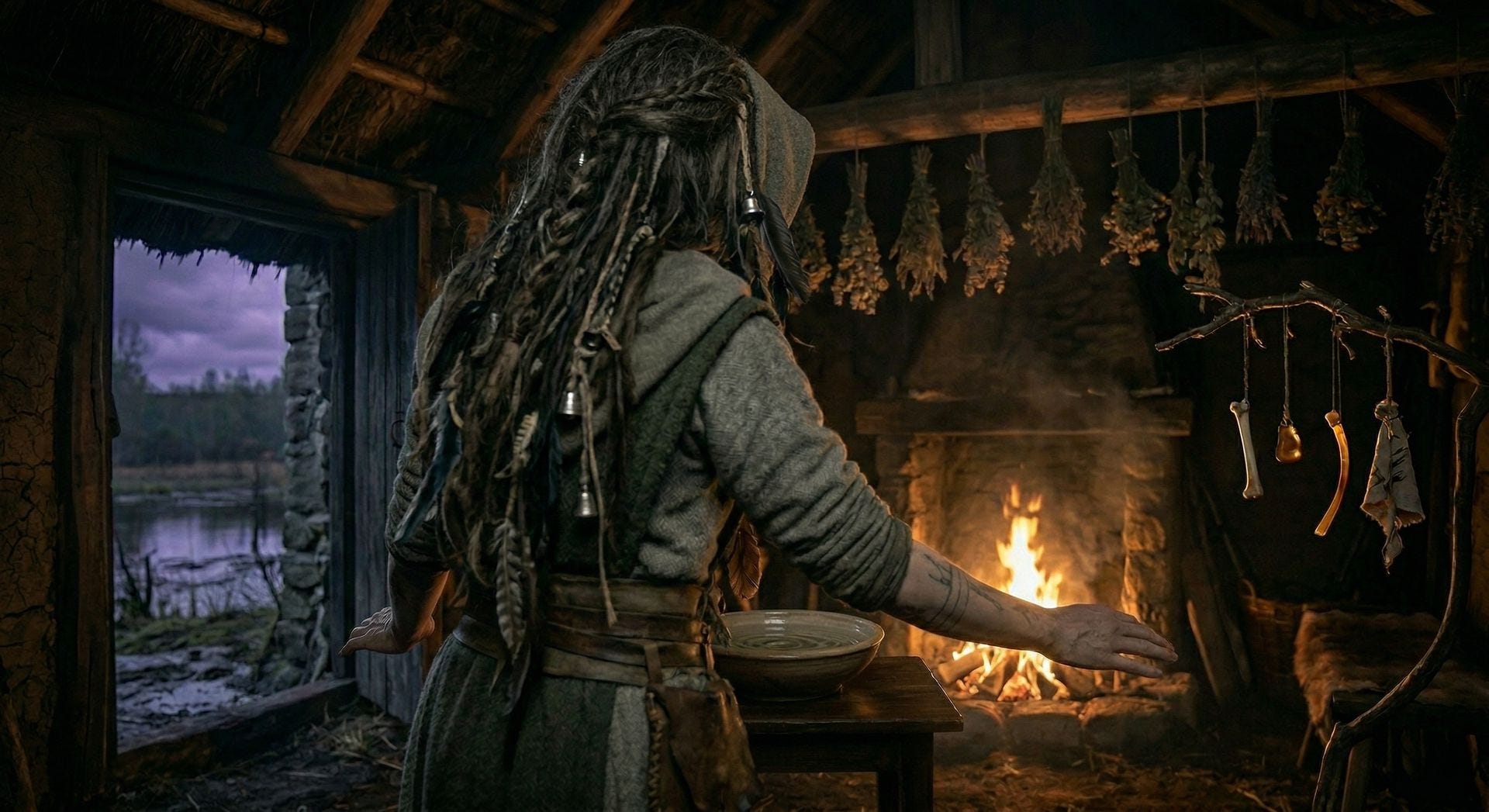
Sael’s dwelling did not sit in the castle so much as it leaned away from it.
It occupied the place where stone gave up and roots began, where the forest sank into dark marsh, where black water held the sky like a bruise, and the air carried the memory of rain long after the clouds had passed. The path narrowed as it approached, deliberately so, forcing the body to slow. Stones were stacked in spirals that were not decorative but directive, arranged to turn the foot, to unsettle the stride.
Charms hung from the lower branches: bone worn smooth by years of touch, amber threaded with sinew, scraps of cloth marked with signs older than kings. Some were offerings. Some were warnings.
Linde felt it immediately, the sensation she always felt before a difficult incision.
“This is not a place of illness,” Laila said quietly as they walked. Her voice carried none of its usual bravado.
The door opened before either of them knocked.
Sael stood framed by firelight and shadow, tall and spare, ageless in a way that made Linde’s eyes search instinctively for clues and find none. Their hair was woven with feathers and small silver bells that chimed softly as they moved. Wool, linen, and leather layered their body in ash and moss tones. Their face was sharp-boned, calm, their eyes pale and unreadable as river stone.
“Laila,” Sael said, voice low and amused, vibrating faintly in the floorboards.
“Still carrying more life than you intend.”
Laila snorted softly, one hand drifting, without thought, to her belly. “Three already,” she said. “Surely that qualifies as excess.”
Sael’s mouth curved, faint and knowing. “It is not finished.”
Their gaze shifted then, slow, deliberate, settling on Linde.
The air tightened.
“So,” Sael said. “This is Velena’s daughter.”
They stepped forward without asking permission and took Linde’s hands, turning them palm-up. Their thumbs traced the lines of her skin, the faint callouses earned through years of work, the absence of tremor that marked practiced precision.
“You cut clean,” Sael said.
The words landed like a blade.
“You learned that early.” Their fingers stilled. “And you act quickly. Because it works.”
Sael released Linde’s hands and stepped back.
Inside, the dwelling smelled of crushed leaves, smoke, and damp wood. Herbs hung in careful disorder from the ceiling. A shallow bowl of water sat at the center of the room, its surface trembling though nothing touched it.
“I am Sael,” they said. “I am neither man nor woman. I do not wear the body as a declaration. I tend the space between breaths.”
Linde, ever seeking form, asked, “Then... you are not a healer?”
Sael’s eyes flicked to her: sharp, almost amused.
“No,” they said. “I am not.”
They circled the bowl of water slowly.
“Healers mend flesh as if it were cloth,” Sael continued. “I listen to what moves beneath it. When the music stops, I help the soul find the door. When the music falters, I wait. This land bleeds not because wounds are untreated, but because they are treated too soon.”
Linde stiffened. Sael turned back to her fully now.
“You move toward pain the way fire moves toward air,” they said.
“Because action has saved you before. But action is not always mercy.”
Linde swallowed. Laila folded her arms, not defensive, but grounded. “She doesn’t know how to stand still when someone she loves is hurting,” she said. “She thinks it means she’s failing.”
Sael inclined their head. “That is her shadow.”
The word settled heavily between them.
“You will be a great healer,” Sael said to Linde. “You already are. But you will burn yourself and others if you do not learn when not to reach.”
They dipped two fingers into cold ash and marked Linde’s brow, then Laila’s.
“For a time,” Sael said, stepping back into the edge of firelight,
“you will work here.”
Linde looked up, startled. “Work?”
“Yes,” Sael replied. “You will watch births you cannot control. Deaths you cannot prevent. Women who scream not because they are dying, but because they are becoming.”
Their gaze softened, just barely. “And I will watch you.”
Laila released a breath she hadn’t realized she was holding.
“Good,” she said. “Someone should.”
Sael’s bells chimed softly as they turned away.
Outside, the marsh breathed.
And Linde, who had faced steel and chains and kings without flinching felt, for the first time, the uneasy certainty that the most difficult lesson ahead would not be how to save a life...
...but how to let one unfold without her hands on it.
Birth did not care that kings were planning wars or that banners were being stitched for an engagement feast. It arrived when it arrived, messy, unceremonious, and utterly indifferent to rank.
The infirmary lay in the older wing of the keep, where the stone walls were thickest and the ceilings low enough to hold warmth. Smoke from the central hearth clung to the rafters, tangled with the sharp green scent of crushed herbs. Bundles of yarrow, mugwort, and juniper hung from iron hooks, drying slowly, their shadows wavering in the lamplight. The floor was worn smooth by centuries of feet, soldiers, servants, mothers carried in on stretchers, children born screaming into a world that never paused to greet them.
Outside, the castle breathed: hooves in the yard, men shouting orders, iron ringing faintly as weapons were checked and rechecked. Inside, time folded inward.
Laila moved through the space like it belonged to her. No crown could have made her more certain.
Linde followed, watching, listening, restraining the instinct to act.
Linde was a surgeon by training. Her mind mapped bodies as structures: bone, tendon, artery, leverage. She knew where to cut, how deep, and when. Velena had taught her that precision saved lives.
But Laila had taught her something else entirely.
Years ago, Velena had seen Laila’s gift for what it was - her attunement. Laila felt bodies the way others felt weather. It was through this shared labor that she and Andrej had first met: him standing stiffly at a doorway, pretending not to listen, while she brought his cousin’s child into the world. Love born in iron, sweat, and first breath.
Now Laila stood at the foot of a narrow bed where a young woman labored, her hair plastered to her temples, her hands gripping the edge of the mattress as if it were the only solid thing left.
Marta, the senior midwife, stood at the woman’s head, steady and composed, her sleeves rolled high, her voice low and constant. Hugo’s wife had the calm of someone who had already seen too much blood to fear it. She dabbed the woman’s brow, murmuring reassurance that wasn’t false and didn’t need to be kind to be true.
“The pain is doing its work,” Marta said quietly. “Let it.”
The air was heavy with sweat and fear, and beneath it, the copper-sweet smell of blood waiting its turn.
Linde’s fingers twitched toward her kit. Laila caught her wrist without looking.
“Not yet,” she said softly.
Linde froze.
“Watch her breath,” Laila continued, her voice steady as a drumbeat. “See how it climbs too fast, how it breaks at the top. She’s afraid.”
The woman cried out, her jaw clenched so tightly her teeth ground.
“Fear tightens before pain does,” Laila said. “If you cut now, you fight the body. And the body always wins.”
Linde forced herself to breathe with the woman, matching the rise and fall. She felt it then, the tension coiled deep in the pelvis, the way the muscles resisted rather than opened.
The lesson settled, not in her mind, but in her hands.
Later, in a smaller hut just beyond the inner wall, one of the older timber buildings that leaned inward as if listening, they worked by firelight alone. The roof smelled of smoke and damp wool. A breech child. No room for haste. No room for fear.
Laila guided Linde’s hands beneath the blanket, her touch firm, precise.
“Feel for the curve,” she murmured. “Not the bone, the promise of where the body wants to go.”
Linde closed her eyes. And for the first time, she stopped looking. She listened.
She felt the pressure, then, the subtle shift. The almost-musical change Sael had named but never explained. The moment when resistance softened.
The child turned.
The mother sobbed, in relief so sudden it cracked something open.
Later still, another labor turned dangerous. There was too much blood, too fast.
Laila’s face changed, she met Linde’s eyes and gave a single nod.
“Now.”
And then Linde was lightning.
Her hands moved without hesitation, blade sure, mind utterly clear. Where patience would have killed, precision saved. Where waiting had honored the body, action honored life.
When it was done, when the cries had settled into breath and the room into silence, Linde leaned back against the wall, heart hammering.
Marta handed her water, her gaze warm and knowing.
“You have both gifts,” Marta said. “Just don’t forget which one to use first.”
Linde nodded, sweat cooling on her skin, the echo of Sael’s words threading through her bones.
Outside, the sound of men preparing for war rose again.
Inside, a child drew breath.
And Linde learned, viscerally, irrevocably, that healing was not about control.
It was about listening long enough to know when not to act.
Far to the northeast, the world smelled of iron and fear.
Gustav felt it before he thought it, the familiar surge, sharp and electric, crawling up his spine as the trail narrowed. Horse sweat steamed in the cold air. Blood darkened the stones ahead, fresh and careless. The traffickers were running badly now.
Too badly, Gustav thought, his grip tightening on the reins. A wounded animal hides; it doesn’t leave a trail this loud.
The gorge opened before them like a wound split in the earth. The Vulture’s Maw. Two sheer limestone cliffs pressed inward, their faces broken and jagged. Sound behaved strangely here, hoofbeats echoed back wrong, and the wind hissed through the crevices like a warning.
“They’re breaking!” Andrej roared. He was caught in the bogatyr fever, the ancient joy of the Rus warrior who sees the enemy’s back. He carved through a stumbling straggler, his heavy blade singing. “Look at them run! They can’t carry stolen lives and outrun Northern steel!”
Andrej didn’t see the silence on the ridges. He only saw the prize.
Gustav rode at the center, his prosthetic leg locked and steady against his horse’s flank. He cut down a man at the edge of the gorge, feeling the jolt shudder up his arm: a visceral release of weeks of unspent passion and restraint. This was why he rode. Here, the world simplified.
Forward. End it.
They plunged deeper. The cliffs rose higher, leaning in until the light thinned to a bruised purple. The fleeing men scattered, not panicked now, but disappearing, slipping into cracks in the stone too cleanly to be chance.
Gustav’s breath hitched. His eyes tracked upward. A glint of metal on the rim.
A horn sounded. Long. Low. Mournful. It was a predator’s call.
“Halt!” Gustav shouted, his voice tearing raw. “STOP! BACK!”
The gorge answered him with death.
Arrows fell like black rain. Men screamed as shafts buried deep into necks and shoulders. One horse went down hard, its shriek echoing off the stone as it crushed its rider. Fire-arrows struck the dry midsummer scrub at the base of the cliffs, and a wall of orange smoke rolled through the Maw, thick and choking.
“AMBUSH!” Andrej bellowed, his voice cracking as the hunt turned into a harvest.
Grind. Crash.
Boulders moved behind them, great stones shoved loose from hidden ledges, sealing the entrance with brutal finality. The Maw had closed its teeth. Gustav wheeled his horse, taking it in with agonizing clarity. Ridges above, lined with hundreds of men. This was not a band of thieves. This was a professional kill-box.
“Shields!” Gustav roared. “To the walls! Don’t bunch: MOVE!”
He rode into the chaos, hauling a man free from beneath a dying horse. An arrow grazed his shoulder; he didn’t feel it.
“Vlad!” he shouted.
Vlad, the physician, was already in motion. His surgeon’s mind had instantly prioritized the wounded, but he was also his mother’s son. He loosed arrows upward with a cold, methodical pace, his jaw clenched as stone chips sprayed his face. He wasn’t fighting for glory; he was fighting to keep the “patients” alive.
Andrej fought like a man possessed, back-to-back with Gustav as the first wave of slavers surged down the scree. Steel met steel. The air grew hot from the fires. Gustav realized then that they weren’t trying to win fast: they were waiting for the exhaustion to set in.
He made the calculation in a single, brutal breath. If they stayed, everyone died.
“Listen to me!” Gustav’s voice carried through the smoke with iron authority. “Small groups: NOW. Break south through the fire. Use the dead ground near the ridge bend. RUN!”
Men stared at him, stunned.
“GO!” he roared. “That is an ORDER!”
Andrej turned on him, his face masked in blood. “You’re not staying alone!”
“I am,” Gustav said, his eyes locking onto his brother’s. “This ends with me holding the line.”
Vlad grabbed Andrej’s arm, his eyes reflecting the fire. “We live if we obey. He’s right.”
Andrej hesitated, then slammed his forehead briefly against Gustav’s in a hard, warrior’s goodbye. “You’d better come back,” he snarled.
Gustav didn’t answer. He stepped forward into the narrowest part of the path, seax raised, shield high, drawing every arrow toward himself like a beacon. One punched through his thigh armor, pain flaring white-hot, but he stayed standing.
The Maw screamed.
Days later, the infirmary at the North Castle still smelled of lavender, birth-blood, and the quiet, rhythmic work of living. Linde was just finishing the cleaning of a sutured wound when the heavy oak doors burst open with a sound like a thunderclap.
A man stumbled inside. He was half-armored, his leather spaulders shattered as if by a giant’s hammer. He was soaked in dried gore and mountain mud, his eyes wide and vacant, the look of a man who had seen the gates of Hel and been spat back out. He collapsed at Linde’s feet, the iron of his belt clattering against the stone.
“Losses,” he gasped, his breath hitching around the fluid in his lungs. “Heavy.”
Linde was kneeling before he hit the floor. Her hands did not shake; she moved with the practiced, cold efficiency her mother had taught her. She had the impenetrable stillness of her expression, a shield of ice she had perfected over years of carnage.
“Where?” she demanded, her voice cutting through the panic of the room.
“The Maw,” he whispered, a red foam flecking his lips. “The princes... trapped. The stones... they closed the way.”
The word trapped struck Linde harder than any physical blow. She felt the blood drain from her face, leaving her as pale as the linen she held.
“And Gustav?” she asked. She didn’t realize she was gripping the man’s tunic so hard her knuckles were white. “Where is the King?”
The messenger swallowed, terror flooding his face as he looked at the woman who was supposed to be a bride in less than a month’s time.
“He held the gap,” the man said, his voice a broken rasp. “The fire was behind us, the arrows above. He stood in the narrowest throat of the Maw and told us to run. He said the North could not lose its heirs. Last I saw... he was a shadow against the flames, the only thing between us and the slaughter.”
The room seemed to tilt. Somewhere far beyond these walls, in a sunless gorge that smelled of scorched earth, Gustav stood alone. He was buying the world time with his body, fulfilling his vow to “hold the line” even if it meant becoming part of the stone itself.
Linde stood up slowly. The “Healer of Stone” looked at the blood on her hands, and then at the window where the late summer sun was beginning to set. The three-month measure was gone.
The threshold was closing, and the poison in her cabinet felt heavier than it ever had before.
🧠 Behind the Saga: Gender Liminality, the Illusion of Urgent Mercy, and the Cost of Holding the Gap
The introduction of Sael brings a profound, historically authentic concept into the saga: the existence of highly protected cultural containers for gender liminality in early medieval North-European philosophy. Sael’s dwelling physically embodies this threshold, leaning away from the castle “where stone gave up and roots begin.” Sael describes themselves explicitly: “I am neither man nor woman. I do not wear the body as a declaration. I tend the space between breaths.”
In modern discourse, we frequently treat non-binary identities as entirely contemporary phenomena. However, anthropologically, 10th-century North-European cosmologies possessed deep, specific frameworks for individuals who transcended the rigid binary of daily legal and social roles.
While Viking-age legal codes (Grágás) enforced strict binary dress and behavioral laws for the average citizen, the spiritual, medical, and magical landscapes were a completely different story. Practices like seiðr (shamanic magic) and cross-world guiding inherently required a state of internal liminality. Odin himself famously crossed gender boundaries to master these arts. Figures like Sael were not viewed as social outcasts, but as vital, sacred bridge-builders. Because they did not occupy a fixed gender role, they were uniquely trusted to navigate other terrifying, unmapped binaries: the boundary between the living and the dead, the flesh and the soul, the castle and the wild forest.
One of the most striking moments with Sael in the chapter occurs when they immediately diagnoses Linde’s instinctive impulse to intervene: “You move toward pain the way fire moves toward air... because action has saved you before. But action is not always mercy.” In contemporary neurodivergent terms, Sael is calling out Linde’s hyper-fixated “pattern-recognition urgency”, a trait driven by an analytical, system-mapping mind that interprets observation without action as an absolute failure.
Linde is a surgeon; her mind maps bodies as mechanical structures to be corrected through immediate leverage and precision. When she sees a system out of alignment, her impulse is to step in and fix it right now.
Sael strips away the romanticism of this trait, framing it as her deepest psychological shadow. In ancestral medicine, hyper-action can disrupt the natural somatic rhythm of a crisis. Sael’s assertion that “this land bleeds not because wounds are untreated, but because they are treated too soon” forces Linde to confront her own unregulated discomfort. She has to learn that true mastery doesn’t mean imposing her will onto a crisis; it means cultivating the agonizing self-restraint required to watch a process unfold without trying to micro-manage the pain.
In the infirmary, Laila catches Linde’s wrist as her fingers twitch toward her surgical kit, warning her, “If you cut now, you fight the body. And the body always wins.” Linde is forced to yield, learning to listen to the subtle, non-verbal negotiation of the flesh until the breech child safely turns. She integrates the lesson viscerally: healing is not about control, but about knowing when not to act.
🌱 Room for Thought
Historically, we are conditioned to view ancient societies as intellectually rigid environments, where gender roles were absolute, neurodivergence was ignored, and conflicts were won purely by the loudest voice in the shield-wall.
Yet, Chapter 21 completely upends these assumptions. Through Sael’s ageless, liminal framework and Linde’s grueling education in the birth chamber, we see that ancient survival required a terrifyingly sophisticated understanding of emotional regulation, cognitive diversity, and non-coercive patience.
If you are ready to explore the ancient philosophies, liminal spaces, and heavy cultural rituals that shaped the frontier, the foundation of this world is already written. You can dive straight into the first two complete volumes of the Firebound saga: Salt and Gold and Emerald to Steel are available for immediate reading on Kindle.