
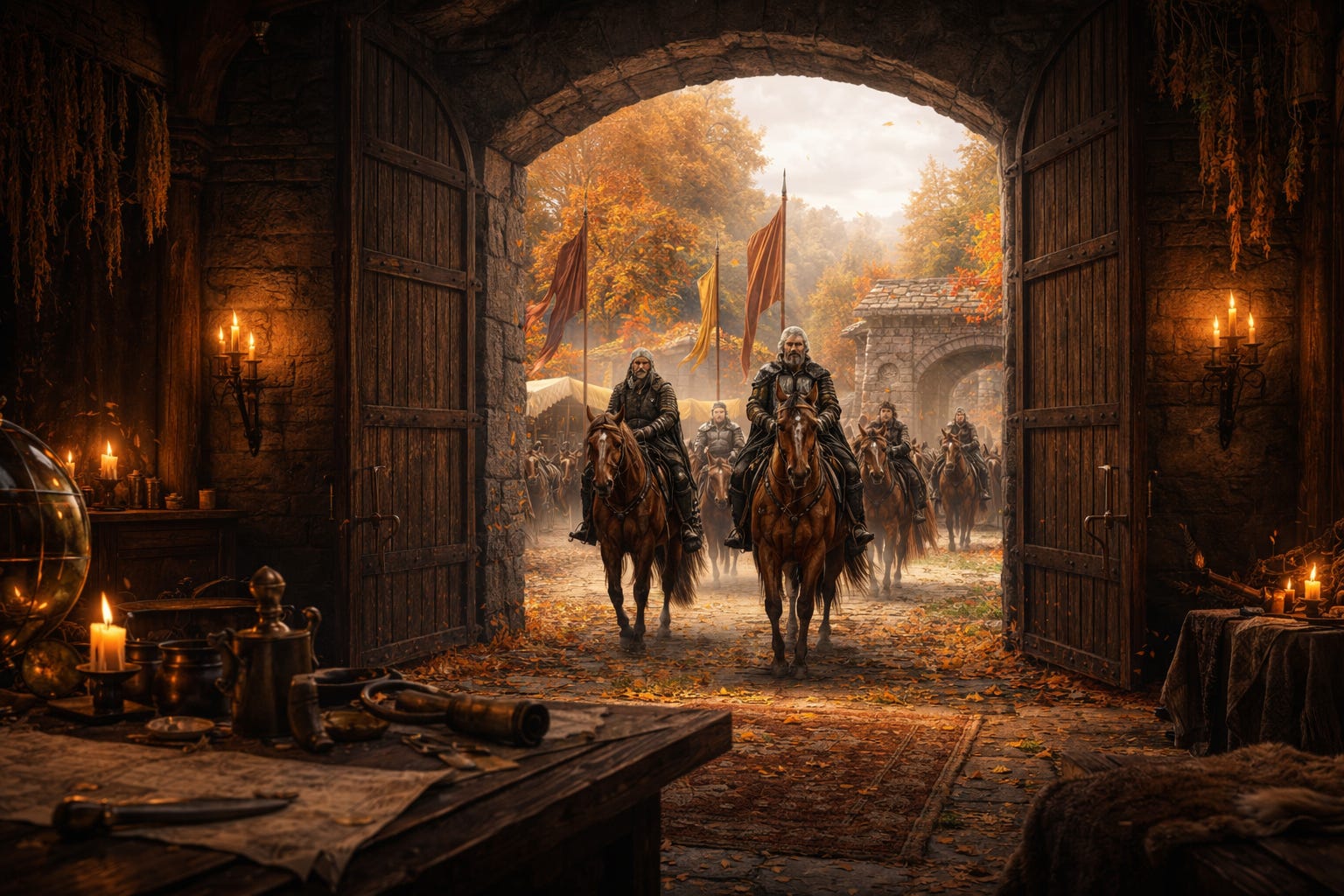
Grief does not end when the body is washed clean; it settles into the stone like frost in the marrow of the castle. By morning, the silence in the solar was a living thing. The boys who had survived looked at Einar’s empty pallet with hollow eyes, and the women moved with a quiet, spectral efficiency.
Linde felt the shift in the air. As she walked toward the Great Hall, her hands still felt the ghostly thrum of a heart that had refused to beat. She was a daughter of Velena, but in this gray Northern light, she felt like a failure wrapped in silk.
In the Great Hall, the tension had reached a breaking point. The village elders and a few disgruntled councilors stood in a semi-circle, their voices hushed but biting. The defeat of the slavers had brought safety, but the cost in blood had left the elders looking for a target for their mourning.
“The girl has the touch of her mother, but does she have her strength?”, one murmured, loud enough for the echoes to carry. “She spent hours on the boy Einar, and he is cold nonetheless. We need healers who can promise life, not just effort. Is this the ‘Witch-Queen’ we are to bow to?”
Gustav stood near the throne, his jaw set so tight the muscles in his neck stood out like cords. He moved to speak, to roar them into silence, but a sound from the shadows stopped him.
Chime. Chime.
Sael stepped forward, their silver bells ringing a cold, rhythmic warning. They looked at the councilors with eyes like river ice: ancient and unyielding.
“You speak of ‘promising life’ as if it is a commodity you trade for grain,” Sael said, their voice vibrating with a primal power. “Linde did not fail. She stood in the red tide and refused to look away. If you want a healer who only touches those they are sure to save, you want a coward. This Healer fought a battle in the dark that none of you have the stomach for. If you question her again, you question the very Earth that permits you to breathe.”
The councilors withered. Sael turned to Linde, a brief, imperceptible inclination of their head, with a recognition of one threshold-walker to another.
That evening, the heavy oak door to Gustav’s chambers clicked shut, sealing out the world. The air in the room was thick with the scent of pine-resin and the metallic tang of the maps spread across the table.
Linde did not move, she stood silently by the massive, hand-carved globe, her shoulders trembling under the weight of her cloak. The loss of Einar was a jagged shard in her chest that wouldn’t let her draw a full breath.
Gustav approached her. He looked at her as a man who knew what it was to carry the dead. He stopped inches from her.
“The elders are fools,” he whispered, his voice a low rumble. “They see the ending. They do not see the fight.”
Linde looked up at him, her eyes shimmering with unshed tears. “I followed every rule, Gustav. I held his life in my hands, and I felt it slip through my fingers like water. How am I supposed to lead a people when I cannot even keep a boy in the light?”
Gustav reached out, his large, calloused thumb tracing the line of her lower lip. The restraint between them was a wire pulled so taut it hummed. He wanted to pull her into the furs, to drown her grief in his own skin. He leaned down, pressing his forehead against hers. “Because you are the only one who stayed to watch him go,” he murmured. “That is the weight of the crown, Linde. We do not just lead them in the sun. We hold them in the dark.”
He took her hands: still scrubbed raw from the lye-water: and kissed each knuckle with a slow, reverent devotion. It wasn’t a prelude to a bed; it was a vow of a shield. “Three days,” he whispered against her skin. “Three days until the Hearth-Stone. Know that I am your shadow. Your pain is my pain.”
Linde let out a broken breath, leaning her weight into his chest. They stood there in the silence, anchored by a shared grief, waiting for a dawn they hadn’t yet earned.
The following dawn was shattered by the sound of horns, the long, deep, melodic resonance of the great Eastern steppes: the Tura.
The gates swung wide to a procession that silenced the castle. This was the marriage-gift.
Wagons rolled in, draped in heavy, weather-stained silks. They carried the massive oak chests bound in hammered silver. Behind them came the twenty magnificent horses with coats like polished copper, their manes braided with silver thread.
At the head of the column rode King Artemij. His silver hair was a crown in its own right, and his eyes, though weary from the road, burned with the sharp intelligence of a wolf. Beside him, looking like a god of war in his lamellar armor, was Miro.
Linde broke from the stone steps and ran. She collided with Miro, who caught her in his arms, his laughter a rough, familiar music that finally shattered the ice around her heart.
“You smell like yarrow and war,” Miro whispered, holding her so tight her ribs groaned. “I saw the smoke from the valley, sister. I knew you were holding the line.”
Artemij dismounted, his presence grounding the chaotic yard. He looked at Gustav, studying the man who had survived the Maw. There was no warmth in the King’s gaze yet, only the hard evaluation of a father and a sovereign.
“You carry the weight of my daughter well, Northman,” Artemij said, his voice carrying to every corner of the yard. “But a King is measured by the steel at his back.”
He signaled with a raised hand. Behind him, the ranks shifted. Three hundred elite riders straightened in their saddles, their scale armor glinting like a sea of silver.
Miro stepped forward, his eyes meeting Gustav’s with a new, hard-won respect. He gestured to the crates being unloaded, not just silk and honey, but master-forged blades and heavy bows.
“We did not come only to witness a wedding.” Miro said. “We came to ensure that the trade in human flesh never reaches our borders again. Let us show them how we hunt.”
Linde slipped her hand into Gustav’s. The pressure of the crown was still heavy, but as she looked at the wall of her father’s steel and the proud faces of her kin, the vacuum in her chest finally filled. The wedding was no longer just a union of two people; it was the birth of an empire.
🧠 Behind the Saga: The Politics of Healing, Liminal Authority, and the Geopolitics of the Dowry
Anthropologically, the role of a female healer who is also ascending to the throne is a precarious tightrope. The disgruntled village elders view medicine through a purely transactional, political lens: they want a healer who “can promise life, not just effort.” Because Linde is a foreigner, they weaponize biological failure against her political legitimacy. Her autistic shadow, which demands clinical perfection, is suddenly mirrored by a political court that demands the exact same impossible standard. The crushing weight of the crown is that her surgical outcomes are no longer just medical; they are seen as omens for the survival of the kingdom.
When Gustav’s roar of defense is preempted by Sael’s silver bells, we see a fascinating demonstration of ancient social structures. Sael, as a Seer and as a gender-liminal threshold-walker, operates entirely outside the standard patriarchal hierarchy of the councilors. They hold a primal, spiritual authority that trumps political rank. Sael redefines ancient medicine for the court, stating that a healer who only touches those they are sure to save is a coward. Healing is not a commodity traded for grain; it is the bravery of standing in the “red tide” and bearing witness.
Modern audiences often view the historical “dowry” as a patriarchal purchase or compensation for taking on a bride. Chapter 24 is showcasing the marriage-gift as a massive, aggressive geopolitical maneuver. The oak chests, the coppery horses, and the arrival of three hundred elite riders are not ceremonial ornaments. This dowry acts as a mutual defense pact and a declaration of war against the slaver routes. The marriage of Linde and Gustav is a macroeconomic merger and the dowry serves as a mechanism of power transfer.
🌱 Room for Thought
In Chapter 24 we see the profound cultural power of liminality. Sael, who exists entirely outside the traditional patriarchal and political structures, is the only figure capable of silencing the ruling council. Sael asserts an ancient spiritual authority that completely overrides political rank.
We also witness the macroeconomic reality of the historical dowry. It is a highly aggressive transfer of military and economic capital at the center of orchestrating a geopolitical merger that instantly shifts the balance of political power and prepares the North for war.
If you are ready to explore the ancient philosophies, liminal spaces, and heavy cultural rituals that shaped the frontier, the foundation of this world is already written. You can dive straight into the first two complete volumes of the Firebound saga: Salt and Gold and Emerald to Steel are available for immediate reading on Kindle.