
The morning of the wedding arrived with a triumphant, crystalline clarity. The sky was a pale, polished sapphire, scrubbed clean of the North’s usual brooding mists as if the Norns themselves had called for a truce between the wind and the sun. Below the castle walls, the valley had been transformed into a city of fallen stars. Thousands of tents: striped wool from the southern isles, heavy felt from the steppes, and shimmering silks from the trade routes, spanned the basin, their campfires sending up thin ribbons of cedar-scented smoke.
Inside the fortress, the Great Hall had been hollowed out and reborn as a Hof of the Forest. Massive pillars of oak were draped in deep emerald moss and braided with silver ribbons. Juniper and amber-resin burned in the central hearths, creating a low, sweet haze that tasted of ancient woods and sacred secrets. The air was a heady, thick perfume: the sharp, clean scent of crushed pine boughs, the rich musk of the furs, and the underlying sweetness of the wildflower honey used in the ceremonial mead.
The heavy oak doors groaned open on their iron hinges, a sound like a low, resonant bell. The chaotic hum of three thousand voices died instantly.
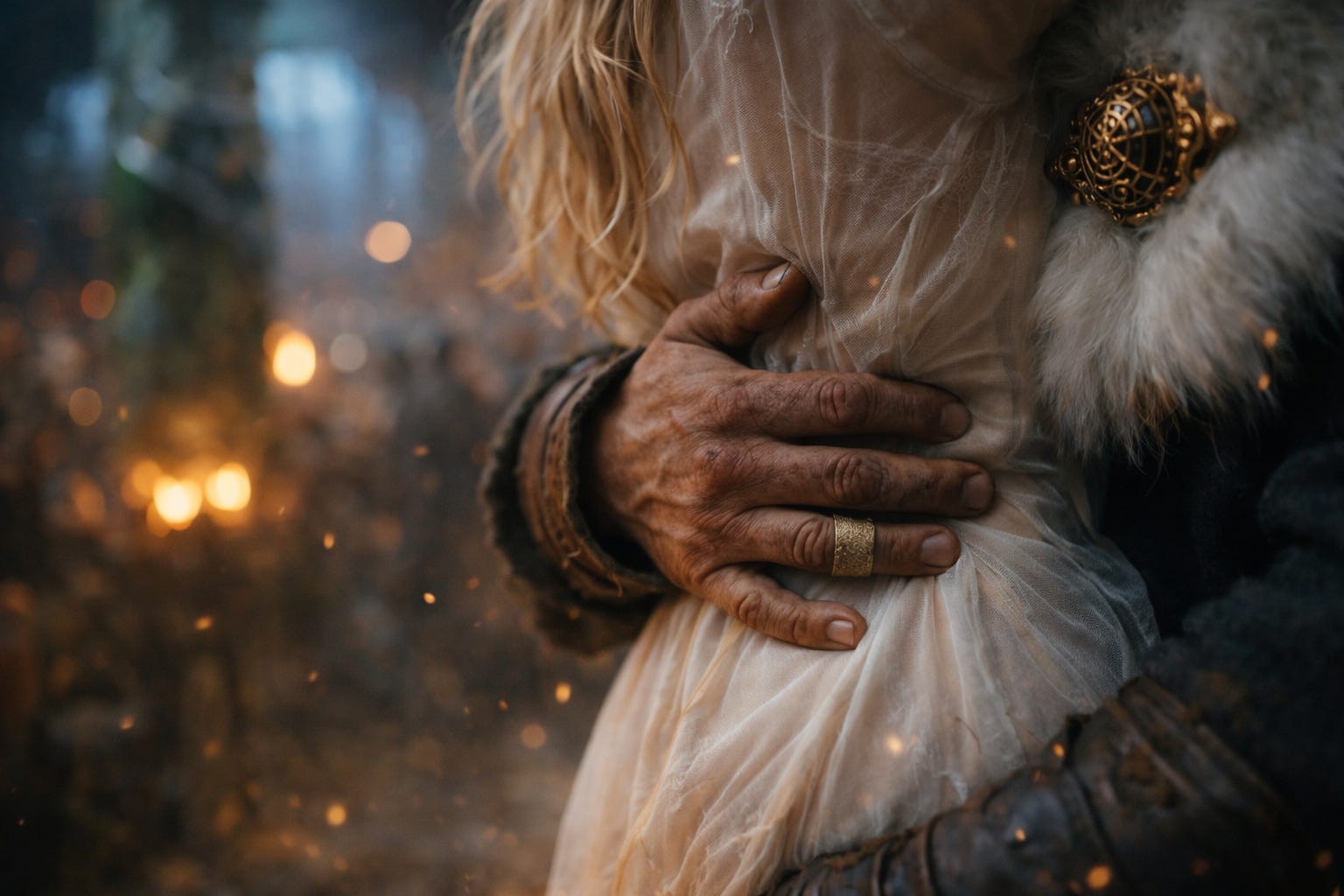
Linde appeared at the threshold, and for a moment, the world simply ceased to breathe. She was mounted upon a magnificent white mare, its coat brushed to a shimmering, pearlescent glow that matched the snow on the peaks. She was a sovereign of the dawn, draped in iridescent ivory silk that seemed to catch and hold the golden light of the braziers. But her heart was now anchored in the North; massive, gilded tortoise brooches: relics of Gustav’s own lineage: pinned her white fox furs to her shoulders.
As the mare stepped forward, the temple rings of filigreed silver dangling from Linde’s headdress chimed against one another. To the guests, it was a beautiful sound; to Linde, it was the rhythm of her new life, ice against stone, soft against hard. Beneath her sheer gossamer veil, embroidered with the silver Kupolė fern, her breath was shallow. She saw a sea of faces: Laila, whose eyes were wet with a joy that transcended their shared trauma; King Artemij, whose stern face was a mask of pride and bittersweet surrender; and the countless Northern commoners who looked at her not as a captive princess, but as the woman who had fought the shadows to save their heirs.
At the end of the hall, on the high oaken seat, sat Gustav. He was a mountain of fur and iron, his posture regal, his face a carved map of everything he had endured. When his eyes met hers, the weight of his stare was a physical thing: a warm, grounding pressure that told her the “wait” was over.
Gustav descended the steps, his iron-bound leg clicking rhythmically against the stone. a sound of survival. He reached the mare and drew his ancestral blade, barring the entrance in the ancient rite of the Hinn-Vatni. It was a symbolic test of the bride’s resolve.
Linde did not flinch. She reached out with a steady hand and pushed the cold steel aside with a firm, knowing finger, her eyes locking onto his through the veil. She entered this house not as a gift, but as a power. Gustav let out a breath he seemed to have been holding since the Maw. He reached up, his massive hands spanning her waist with a proprietary heat, and lifted her from the saddle as if she were made of air.
At the dais stood the two pillars of their spiritual worlds. Sael, ethereal and shimmering in Northern silver, stood beside Vaidila, the Eastern elder. Vaidila was a towering figure of the steppes, his robes of heavy hemp embroidered with the solar cross, his hands stained with the juices of sacred herbs.
Vaidila stepped forward first, binding their joined hands with the Ruchnyk: the red-embroidered linen of protection. “The River does not ask the Oak for permission to flow,” he intoned, his voice a deep, melodic rumble. “And the Oak does not ask the River for permission to stand. They simply exist in the same earth, giving life to one another.”
Sael then raised a bowl of snow-water and a branch of evergreen. “The iron is tempered. The light is caught.”
Gustav turned to her, his voice dropping into that low, poetic resonance that always made Linde’s skin feel electric.
“Linde, I have lived in the gray of the shield-wall for so long I had forgotten the color of the sun,” he began, his voice rough with emotion. “I thought I was a man built for war. But you... you found the cracks in the iron and planted a garden there. I love you with a passion that makes my blood feel like liquid stars. You are my Ljósálfar, my North Star, my one and only for eternity. I vow to be the shield that guards your light, the ground that holds your feet, and the sword that carves a path for your dreams.”
His expression shifted, the King emerging through the lover. “I bind my house to yours. Your people are my brothers; your enemies are my target. Together, we are the stone and the flame that shall never go out.”
Linde felt a tear escape, tracing a warm path down her cheek. She stepped closer, her voice clear, resonating through the hall with the authority of a Queen and the soul of a healer.
“You saved me from the fire, Gustav, but you gave me a fire of my own,” she whispered. “I love you so much it hurts, a sweet, sharp ache that tells me I am alive. You are the heartbeat I listen for in the dark. I vow to be the warmth at your hearth, the hand that mends what the world breaks, and the voice that calls you back from the gates of Valhalla. You are my husband, my partner, my soul’s anchor.”
She placed her hand over his heart, feeling its steady, powerful thrum. “I bind the wisdom of the East to the strength of the North. We are no longer two kingdoms apart, but one empire forged in blood and bound by light. I will protect your people as if they were born of my own blood, until the sun fails to rise.”
The kiss that followed was not the chaste peck of a ceremony; it was a passionate, desperate claim, a collision of two souls that had been through the fire and come out gold. The roar from the three thousand guests was deafening, a wall of sound that shook the very rafters.
The dinner was a legendary sprawl of excess. Whole roasted stags dripping with fat, barrels of the dark Eastern mead that tasted of summer sun, and piles of northern salmon smoked over applewood.
King Erik and King Artemij sat together, their cups raised in a toast that signaled a peace that would outlast them both. Andrej, Vlad, and Miro sat near the couple, their laughter ringing out as they teased Gustav about his “elf.”
Linde sat beside Gustav, her head resting on his shoulder. Under the table, Gustav’s large, warm hand rested heavily on her thigh, his thumb tracing slow, possessive circles that sent shivers up her spine.
“You are a Physician,” he whispered against her ear, his breath hot and smelling of the spiced ale. “Is it a symptom of a fever when a man’s pulse refuses to slow because his wife is breathing near his neck?”
“It is a symptom of a very dangerous imbalance, my King,” she whispered back, her eyes dark with a matching, unshielded hunger. “One I intend to treat with extreme measures the moment we are alone.”
As the moon reached its zenith and the Aurora: the green and violet fire of the Valkyries, began to dance across the sky, Gustav leaned in. “The world has had enough of us, my Queen.”
They slipped away, leaving the roar of the party behind, riding out toward the granite cliffs where the light of the heavens met the ice of the earth.
🧠 Behind the Saga: The Architecture of the Threshold and the Evolution of Marriage
In ancient societies, a wedding was not a party; it was a terrifying and highly structured rite of passage. Anthropologically, these rites are divided into three distinct phases: separation (leaving the old self), liminality (standing on the threshold, belonging to neither the past nor the future), and incorporation (re-entering society as a transformed entity).
While the chapter moves swiftly through the days-long pageantry of the event, one specific moment is deeply grounded in the historical research of 10th-century European marriage rites: the Hinn-Vatni, or the barring of the door with a blade.
In pre-Christian Norse and Germanic traditions, the exchange and negotiation of swords was a critical part of the marital contract. A sword was the ultimate symbol of bloodline, defense, and authority. When Gustav bars the entrance with his ancestral steel, it is a symbolic test of the threshold. If Linde were submitting to a traditional patriarchal capture, she would wait for him to lift it. Instead, she reaches out and actively pushes the cold steel aside. By voluntarily moving the blade, she signifies her active consent and agency. She enters the house not as a gift or a conquest, but as an equal power.
Fast forward a thousand years. As society industrialized and moved away from agrarian survival, the structural necessity of marriage fractured. We no longer marry to secure a harvest; we marry for emotional fulfillment.
This brings us to the profound societal shift outlined by psychotherapist Esther Perel, who observes that in the modern era, we ask one person to give us what an entire village used to provide. We expect our spouse to be our best friend, passionate lover, co-parent, and spiritual soulmate. We see this modern tension colliding in Gustav. He looks at Linde and sees his Ljósálfar—his Light Elf, the sole entity capable of pulling his mind back from the gray carnage of the shield-wall. He is applying the crushing modern burden to his ancient wife, asking one woman to be his entire emotional ecosystem.
The danger of both the ancient model (where a woman was a political commodity) and the modern model (where a partner must be your absolute “everything”) is the erasure of the individual.
This is the profound Eastern wisdom Vaidila speaks over their bound hands:
“The River does not ask the Oak for permission to flow. And the Oak does not ask the River for permission to stand. They simply exist in the same earth, giving life to one another.”
If you are ready to explore the ancient philosophies, liminal spaces, and heavy cultural rituals that shaped the frontier, the foundation of this world is already written. You can dive straight into the first two complete volumes of the Firebound saga: Salt and Gold and Emerald to Steel are available for immediate reading on Kindle.