
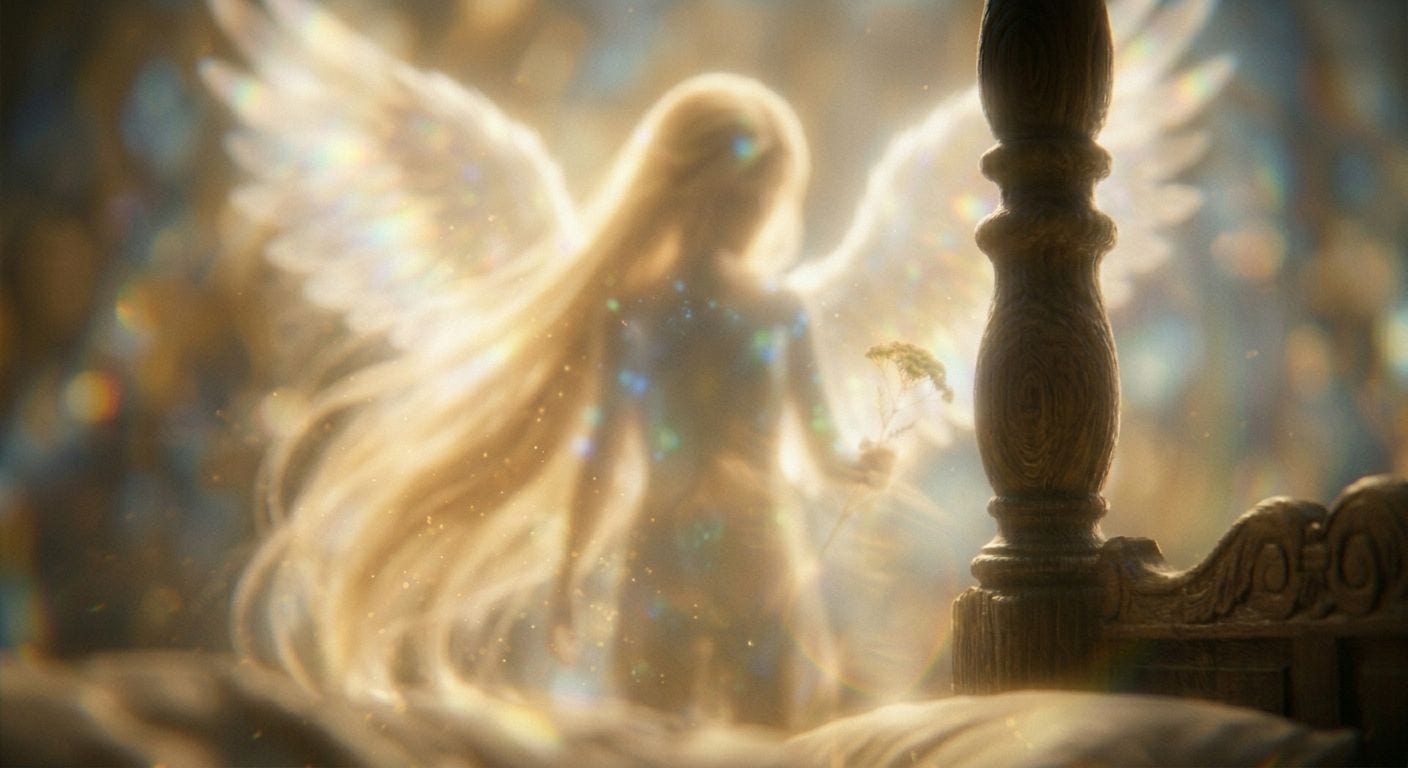
Gustav was not afraid of battle. He was afraid of this.
Pain had reduced the world to a single, white-hot point. His lungs felt as though they were filled with broken glass. Somewhere beyond the agony, memory flickered like the very fire that had nearly claimed him: a village hall in the borderlands, the doors barred from the outside by Pecheneg raiders, and the screams of three dozen souls trapped within.
The Pechenegs had wanted a massacre; they had piled brush and timber against the exits, turning the hall into an oven. Gustav hadn’t waited for the rams. He had thrown himself into the heat, his shield smoking as he hammered at the barricades. When the main support beam groaned, threatening to bury the women and children cowering in the corner, Gustav had stepped beneath it. He had held the main timber. He remembered the skin of his palms blistering, his muscles screaming under the weight of the burning roof as he used his own body to brace the collapsing structure so the villagers could scramble past him into the snow.
He had stayed until the last child was out, his leg pinned by a falling, white-hot joist just as the world turned to orange ash.
Then, a hand, massive and familiar, had seized his collar.
“I have you!” Andrej had roared over the inferno. Andrej, who had hacked through a wall of Pecheneg steel just to reach the doorway, now hauled Gustav’s dead weight into the freezing night just as the building groaned and surrendered to the earth in a shower of sparks.
Gustav had survived. But as he lay now on a carved oak bed in the great Eastern hall, he knew the price. His leg was a ruined mass of char and bone.
Hands pressed him down. “Easy,” a voice said, strained but steady. “Easy, brother. Stay with us.”
Andrej, his brother-in-arms stood tall, broad as a fortress wall, his blue eyes fierce with a desperate sort of concentration. They had fought the Pechenegs together for three winters, forging a bond that went deeper than any treaty. Andrej’s own tunic was singed, his face streaked with soot from the rescue, but he refused to leave Gustav’s side.
“She’s coming,” Andrej said tightly, his voice cracking with a rare tremor. “Hold on, Gustav. If anyone can keep the Valkyries at bay, it is her.”
The room shifted as Velena entered. She moved with a calm that silenced the room, her presence like a cool draft in a fever-ward. She was strikingly beautiful, but it was her eyes that commanded stillness: deep gray-green, endlessly kind, and utterly clinical. She carried a tray of tinctures and a bone-saw wrapped in clean linen, her expression unreadable.
Velena examined the leg with a practiced, unflinching gaze. She didn’t offer empty comforts. “You saved forty souls from the fire, Commander,” she said, her voice a low, melodic hum as she checked his pulse. “It would be a poor reflection on my skills if I let the fire take the hero after the fact.”
She looked at Andrej, who was hovering like a worried mountain. “Andrej, go fetch more ice. And stop breathing so loudly; you’re consuming all the oxygen the patient needs for his recovery. Men of your size are a vacuum in a sickroom.”
Andrej let out a breath that was half-sob, half-laugh, and hurried out. Velena turned back to Gustav, a small, wry smile playing on her lips. “He loves you like a brother, which makes him a terrible assistant. Now, look at me.”
“Will I... walk?” Gustav rasped.
Velena’s gaze was steady. “You will live,” she decided. “But the leg is lost. If we do not act now, the rot will take the man along with the limb. You have a kingdom to lead and a life to live, Gustav. I intend to see you do both, even if I have to carve the path myself.”
Gustav tried to speak, but the darkness was already pulling at him. Velena’s hand came to his temple, her touch surprisingly cool. “This poppy-draught will take you far from the pain,” she said. “Do not fight it. When you wake, the fire will be gone.”
When Gustav woke, there was no pain. He woke to a world that was far too bright and smelled far too much like lavender to be a battlefield. The sudden absence of the fire’s roar was terrifying. He felt weightless, as if he were drifting on a calm sea under a shroud of silver mist. So this is it, his sedated mind supplied. I have passed through the veil. I am in Álfheimr.
Then he heard it.
A song. Soft, clear, and impossibly sweet. The melody was an ancient Norse incantation, a series of low, steady vowels that resonated with a natural, unforced beauty. It was a sound that made a man think of hearth-fires and the first light on a fjord.
A cool cloth touched his forehead. A small, warm hand, no larger than a sparrow, slipped into his calloused, bandaged palm.
“You’re safe now,” a young voice said, sounding remarkably composed. “The inflammation is receding, and your pulse is stabilizing, though you’re still quite pale. Mother says your humors were in a riot, but the willow-bark has done its work.”
Gustav slowly forced his eyes open. Through the golden haze of the poppy-draught, he saw a girl standing beside him. She was perhaps eleven years old, her honey-blond hair escaping its braids in a messy halo that caught the morning light. Her eyes were an incredible, deep green, the color of moss on ancient stone, and she was looking at him with a mixture of intense curiosity and something that felt like grace.
“A Ljósálfar...” Gustav rasped, his voice a dry, agonizing scratch. “I have died... and a little light elf has come to mend what the fire broke.”
The girl blinked. She didn’t blush; instead, she looked slightly offended by his lack of logic. She adjusted the cloth on his head with a firm, professional pat.
“Oh, absolutely not,” she said, shaking her head with quiet conviction. “Light elves are made of starlight and I am quite certain they don’t have to practice their Greek declensions or get into trouble with their father for hiding frogs in the infirmary... I’m Linde.”
Gustav felt a ghost of a smile tug at his parched lips. Her practicality was more grounding than any myth. He tried to move, but the heaviness of his body anchored him.
“Don’t try to get up,” Linde cautioned, leaning over him so her face was only inches from his. She smelled of rain and dried herbs. “You’ve lost a significant portion of your mass, and your center of gravity will be... altered. But your heart,” she placed her small hand over his chest, “your heart is very strong. It beats like a war-drum.”
“Linde,” he whispered, testing the name.
“You saved them,” she said, her voice softening as she squeezed his hand, her green eyes searching his. “Andrej told me how you held the roof. He cried when he told it. I’ve never seen a giant cry before. You’re a hero, Gustav. Even if you are a bit confused about which realm you’ve woken up in... You were very brave..”
She picked up a small cup and held it to his lips. “Drink. It’s honey and lemon. It will help the ‘glass’ in your throat.”
As he drank, he watched her. She wasn’t afraid of his scars or the phantom space where his leg had been. She looked at him as if he were a fascinating puzzle she intended to solve.
“Will you stay?” he asked, his eyes closing again.
“I have to check your bandages every two hours,” she said matter-of-factly. “And I have many more songs. Mother says music helps the vital spirits align.” She started to sing again, that same clear, soothing melody, and Gustav drifted back into the darkness. He wasn’t in the land of the elves, but as he felt her small fingers checking the pulse at his wrist, he believed he was in the hands of a spirit who knew the way back to the light.
The memory shattered.
The market slammed back into focus, the stench of the slave pens, the snapping banners, and the horses stamping their hooves in the mud.
The song.
The girl on the platform lifted her head. Emerald eyes met his steel-blue ones. She was no longer a child of eleven with ink on her fingers. She was a woman grown, bruised and bound, yet her voice was the same one that had called him back from the grave.
Gustav’s breath caught in his throat, a sharp, physical ache.
The little light elf, his mind whispered, the word no longer a drugged hallucination, but a desperate plea.
He looked at her cheek, the blood, the bruise: and felt a rage so cold and absolute it threatened to swallow his reason. These captors weren’t just selling a princess; they were selling the girl who had held his hand when his world was ending.
🧠 Behind the Saga: The Anthropology of the Healing Song
In Norse and pre-Christian Northern European medical practice, specific vocal incantations called galdr were understood as direct physiological interventions not merely symbolic, but physically acting on the body’s vital spirits. The word derives from the Proto-Germanic root for “to sing” or “to crow,” and galdr was distinct from other forms of Norse ritual precisely because it worked through sound: vibration, resonance, the sustained movement of breath through the body.
The ancient Norse medical tradition, like the Greek, the Arabic, and the early Chinese, understood that sound had measurable effect on the body. Specific frequencies were observed to slow the pulse, regulate breathing, reduce fever-induced agitation. A series of low, sustained vowels creates resonance in the chest cavity, activates what we now understand as the vagus nerve, and measurably shifts the autonomic nervous system from fight-or-flight toward rest. They didn’t have this vocabulary. But they had centuries of observed results, passed from healer to healer, mother to daughter, in exactly the way Velena passed it to Linde.
When Linde places her small hand on Gustav’s chest and tells him his heart beats like a war-drum, she isn’t being poetic. She is taking a pulse and reporting findings. When she sings him back from the edge of fever, she is doing what she was trained to do: using galdr as a sedative, a nervous system regulator, a bridge back from the body’s panic response toward something survivable.
“Your humors were in a riot,” Linde tells a Norse king, with the calm of someone filing a report. According to Greek humoral theory (the framework of four bodily fluids whose balance determined health) reached the borderlands of Eastern Europe through multiple routes simultaneously: Byzantine trade networks moving north along the Varangian routes, Arabic medical texts filtering through Silk Road connections, and direct contact between the Norse-Rus merchants and the Mediterranean world. By the 10th century, an educated healer in a cosmopolitan Eastern court was not choosing between Greek theory and Norse practice. She was using both, fluently, alongside whatever the Arabic pharmacopoeia had most recently contributed.
Linde’s sickroom is a perfect map of this synthesis. Poppy draught is an opiate preparation with roots in Arabic and Byzantine medicine for pain management. Willow-bark is documented in Norse, Celtic, and Greek folk medicine, the precursor to aspirin, for inflammation and fever. Honey and lemon for throat tissue. And galdr running underneath all of it, the indigenous Northern technology that no Greek text could fully account for but that every experienced healer knew worked.
When Gustav wakes into the haze of poppy and fever and sees a honey-haired girl with green eyes singing over him, he reaches for the highest available framework in his cultural vocabulary: Ljósálfar. Light elf. A being of Álfheimr, one of the nine worlds of Norse cosmology, the realm associated with light, liminality, and the threshold between mortal and sacred.
Many pagan cultures had a sophisticated understanding of liminal experience, moments that exist at the boundary of ordinary human comprehension, that exceed the language available for them. The elves were a cultural framework for processing encounters that felt categorically different from ordinary human interaction. When something happened that a person’s existing vocabulary couldn’t contain, they reached for the sacred to contain it.
Gustav has just survived an unsurvivable experience. He held a burning roof on his body until the last child escaped. He crossed a threshold between the living and the dead, between the man he was and whatever he will now become and on the other side of that crossing, there was a girl with a steady voice who smelled of rain and dried herbs and told him his heart was strong. His brain does exactly what human brains do at the edge of death: it reaches for the framework that makes survival meaningful. It makes her Ljósálfar. It makes the experience sacred rather than merely terrible.
What Linde does with this is quietly, perfectly in character. She looks slightly offended by his lack of logic. She refuses the mythologizing with the same efficiency she would use to refuse a bad diagnosis.
She was always going to be the one who insisted on being just a person.
💭 Let’s Discuss in the Comments: Linde’s healing song works because it operates below the level of language, directly on the body’s nervous system. Ancient cultures understood intuitively what neuroscience is only now fully mapping: that certain sounds, rhythms, and frequencies can bring a dysregulated body back to itself. What sounds, rhythms, or physical anchors do you reach for when experience exceeds your language for it?
🔥 The Saga Continues: Thank you for reading Chapter 3! If you want to find out what happens to Linde without waiting for next chapter’s drop, you can pick up the first two published volumes of the Firebound Saga on Amazon Kindle.