
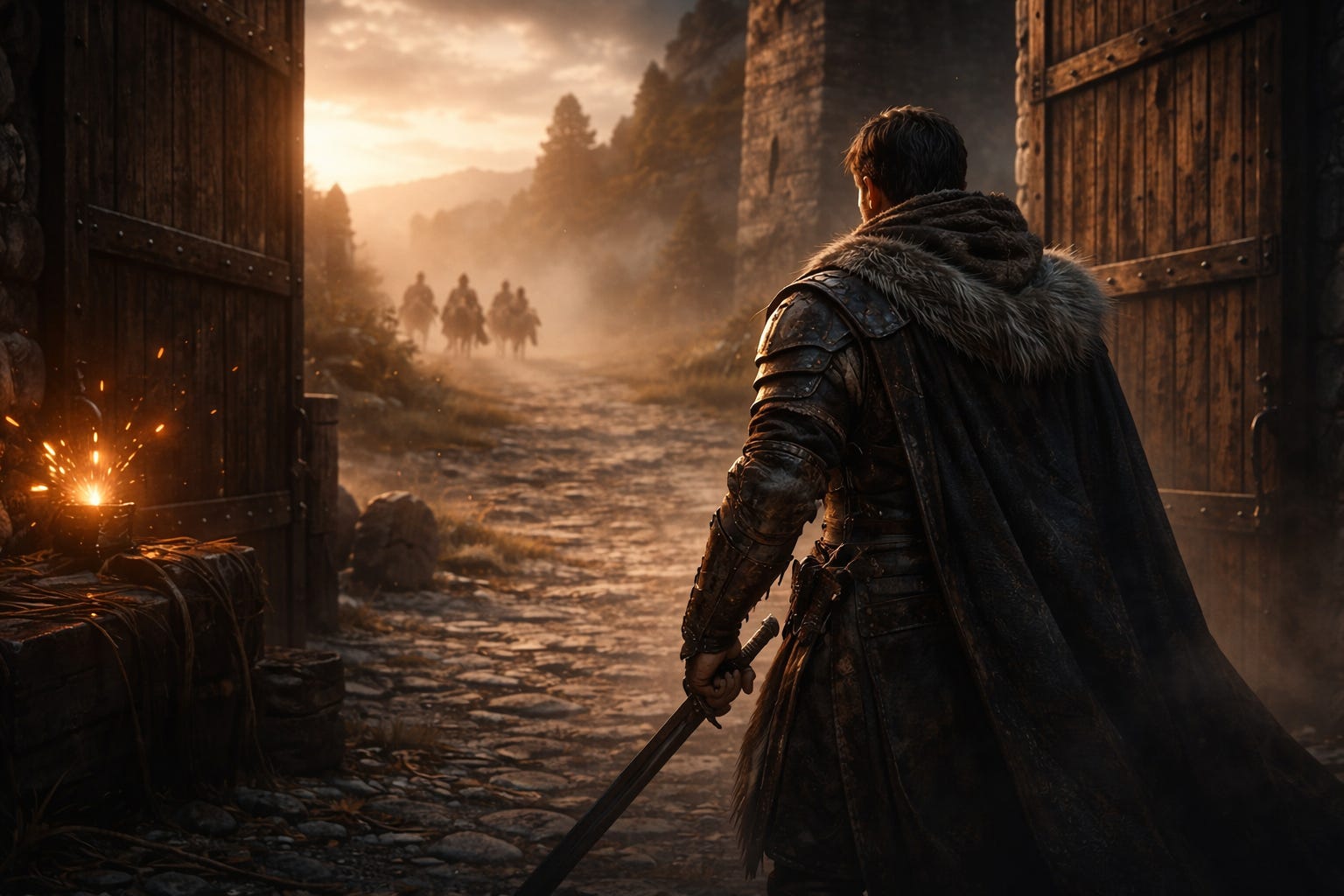
The descent from the plateau was like a slow agonizing stripping of a dream.
As the horses picked their way down the rocky trail, the silence of the hidden valley was replaced by the sharpening sounds of the new reality. They heard the rhythmic ring of a blacksmith’s hammer, the dogs’ barking, the heavy, metallic scent of a gathering army.
The air somehow grew colder as they lost altitude, but the fire bond between them remained a physical thing. They rode close so their knees occasionally brushing through the furs of their saddles. Linde felt a puzzling dual existence. She was the Queen returning to her people, riding with her back straight and her chin high, but she was also the Witch whose skin still felt the phantom pressure of Gustav’s hands.
Gustav’s posture had completely changed. His jaw was now set, and his eyes were meticulously scanning the ridgelines with the practiced caution of a Commander. But every time his eyes caught hers, his gaze softened for a heartbeat. In that glance was still their silent promise, that the world might have them, for now, but the man and the woman from the cabin were still there, breathing beneath the leather and mail.
Before they even signaled, the main fortress gates groaned open. Chaos emerged. The courtyard practically vibrated with it. Axes grinding on stone, horses getting shod. They could feel the sheer, frantic weight of a kingdom bracing for the slaughter.
Andrej was waiting by the stables. He skipped the usual heavy-handed greeting entirely. His eyes were shot red and his face pulled tight.
‘She’s leaving, Gustav.’ The words scraped out of his throat like glass.
“Laila. She says the pull of the children is too much. And with the babe...” He gestured vaguely toward his own stomach, his voice breaking. “She’s five months gone with our fourth. She won’t risk the winter storms trapping her on this side of the Great River.”
Gustav dismounted, stepping toward his friend. He didn’t offer empty platitudes, instead, he placed his heavy, grounding hand on Andrej’s shoulder. “A mother’s heart is the only compass that doesn’t lie, Andrej. If she stays and the passes close, she will wither. You know this.”
“I know it,” Andrej snapped, his grief turning to a brief, sharp anger. “But the war is here and I have to stay. I have to lead the Wolves while my soul rides home without me.”
Inside, the atmosphere was stifling. King Erik and King Artemij were hunched over a map that detailed the vital river arteries. Gustav didn’t wait for a briefing, he leaned over the parchment, his eyes dissecting the terrain.
“They’re not hitting the trade hubs,” Gustav observed quietly, his finger tracing the Black Gorge. “They’re bypassing the gold to seize the heights. Look at the elevation here. If they hold this ridge, they don’t just raid the boats, they sink them with gravity alone.”
“They’re mercenaries, Gustav,” Erik grumbled. “They want the loot.”
“No,” Gustav countered, his voice steady and cold. “Mercenaries want to live to spend their coin. These men are digging in. This isn’t a raid; it’s a blockade. Hugo, I want your scouts to stop looking for campfires. Look for the absence of birds. If the Gorge is quiet, it’s full of Southern steel. We don’t march the main host until we’ve baited their archers.”
Hugo nodded, leaning in. “And the river-crossings? If we lose the bridge at Valder, the East is cut off.”
“Then we burn it,” Gustav said simply. “We sacrifice the bridge to save the province. We force them into the shallows where our heavy cavalry can actually reach them. Andrej, your Wolves are the bait. Can you hold the shallows for three hours?”
Andrej’s eyes, usually so full of light, were now as cold as the river itself. “I’ll hold them until the water turns red, Gustav.”
While the men carved up the world, Linde found Laila and her friends in the Queen’s solar. The air was thick with the scent of drying herbs and the heavy, bittersweet weight of departure.
Linde’s heart pinched at the sight of Laila’s packed trunks. She thought of her own childhood home where the sun felt warmer and the forests deeper. She thought of Laila’s children: her little cousin, eight years old and already trying to lift his father’s sword; and twin girls, six and full of her mother’s fire.
“I miss them already,” Linde whispered, crossing the room to take Laila’s hands. “I can almost hear the girls laugh. And little Peter... he’ll be so tall when I see him next.”
“He has your brothers’ stubbornness,” Laila said with a watery smile. She placed Linde’s hand on her own stomach. “And this one... he already feels like a restless traveler.”
Laila looked at her friend deeply. “I have to go, Linde. My heart is being pulled across the forest. I can feel them... I can feel that they need their mother.”
“I know,” Linde whispered, her voice thick. “I would never ask you to stay, but the halls will be silent without you. Who will keep me honest when the crown feels too heavy?”
Laila let out a broken, watery laugh and pulled Linde into a fierce embrace. “You don’t need me to tell you how to be a Queen anymore,” Laila whispered. “You have the fire. You have the iron. Just promise me you will come to visit when the snows are high and the children can meet their Aunt.”
All the women then stepped forward, Galina joining them one last time before she stayed behind with Rolf. “We cannot let the High Witch depart in silence,” she said, her voice thick. “One last ritual. For the road. For the protection of the babe.”
They formed a circle, their hands interlocking. They sang a Varna, a song of shielding. Their voices rose in a haunting harmony, their feet striking the floor in a heartbeat rhythm. It was a song of the home Linde had left behind, and for a moment, the solar was transformed into a sacred grove.
When the last note faded, Linde leaned in one last time. “Go to them. Be their Aunt’s eyes. Tell little Peter I’m sending him a Northern dagger when he’s of age. Tell the girls to keep the herbs drying. And tell yourself... tell yourself you are the strongest woman I have ever known.”
Linde stood on the ramparts as the sun began to dip, watching the departure. Laila was mounted, surrounded by Andrej’s elite guard. All her friends but Galina rode with her, their faces set toward the East.
Andrej stood at the gate, his figure small from this height but his agony palpable. He didn’t wave. He didn’t shout. He stood like a statue of salt as the banners of the East disappeared over the ridge.
The transformation in him was chilling. When Laila was present, Andrej was the heartbeat of the army, a man who fought because he had a reason to return. As the dust of her horses settled, the warmth died in him completely. He turned back toward the fortress, his movements no longer boisterous, but stiff and predatory.
He passed Gustav in the courtyard, his hand resting heavily on the hilt of his sword.
“She’s gone,” Andrej said, his voice a flat, dead thing.
“She’s safe,” Gustav corrected firmly.
“She’s gone,” Andrej repeated, his gaze fixed on the maps of the Black Gorge. The Lover-Andrej had departed with his wife and his unborn child. What remained was the Commander of the Wolves, a man who had just traded his heart for a blade, and intended to use it until there was nothing left to bleed.
Linde watched them from above, the weight of her crown finally settling on her brow. Their days of sacred isolation were over. The war had begun.
🧠 Behind the Saga: The Gendered Spaces of War and the Psychological Severing
The descent from the plateau is a literal and psychological threshold. In the cabin, Linde and Gustav stripped away their armor to become simply a man and a woman. Chapter 30 is the agonizing process of putting that armor back on. Notice how Gustav’s physical posture shifts the moment they hear the blacksmith’s hammer. The world demands the Commander, so the Lover must be suppressed. But because of the crucible of Chapter 29, the Lover survives just beneath the mail.
This is the true emotional climax of the chapter. In warrior cultures, a man cannot effectively lead a vanguard if his mind is paralyzed by the fear of leaving his family unprotected.
When Laila rides away, Andrej doesn’t just say goodbye to his wife; he executes a brutal psychological severing. He intentionally kills the warmth, the light, and the “Lover” inside himself so that only the “Commander of the Wolves” remains. When he tells Gustav, “I’ll hold them until the water turns red,” he isn’t being heroic; he is a man who has just traded his heart for a blade because it is the only way his psyche can survive the coming carnage.
This chapter provides an anthropological contrast between how the men and women prepare for annihilation. Down in the war room the mean are entirely focused on sacrifice. They are locked in a space of cold, gravitational logic, studying maps to calculate exactly what infrastructure they must burn and whose blood they must spill simply to maintain the border. They are engaged in the violent mechanics of saving the land.
But up in the Queen’s solar, the geometry shifts entirely toward preservation. When Laila packs her trunks to move her children across the river, she isn’t just fleeing; she is calculating the survival of the bloodline. It is easy for a modern reader to underestimate the sheer, terrifying permanence of 10th-century physical distance. Today, we measure separation in hours of air travel, but in this era, a journey East required weeks of punishing riding. With the winter passes threatening to close, saying goodbye meant facing the very real possibility of permanent separation. This staggering distance highlights why extended kinship networks—especially the fiercely protective bonds between aunts, nieces, and nephews—were the true safety net of ancient societies. Linde isn’t just losing her dearest friend; she is losing her proximity to the very future they are trying to protect.
This agonizing reality is what makes the farewell ritual in the solar so historically significant. The women interlocking hands to sing the Varna—the song of shielding—is a reflection of how ancient women exerted their power in the face of impossible geography. They were not passive bystanders to war; they used these highly structured, emotionally charged rituals to weave a psychological and cultural shield over the vulnerable before a perilous journey. While the men in the war room are sacrificing the present to save the territory, the women singing in the solar are the ones actively saving the future.
If you are ready to explore the collision of ancient cultural rituals and raw psychological depth where the fiercest battles are fought in the quiet spaces between two people, the foundation of this world is already written. You can dive straight into the first two complete volumes of the Firebound Saga: Salt and Gold and Emerald to Steel are available for immediate reading on Kindle.