
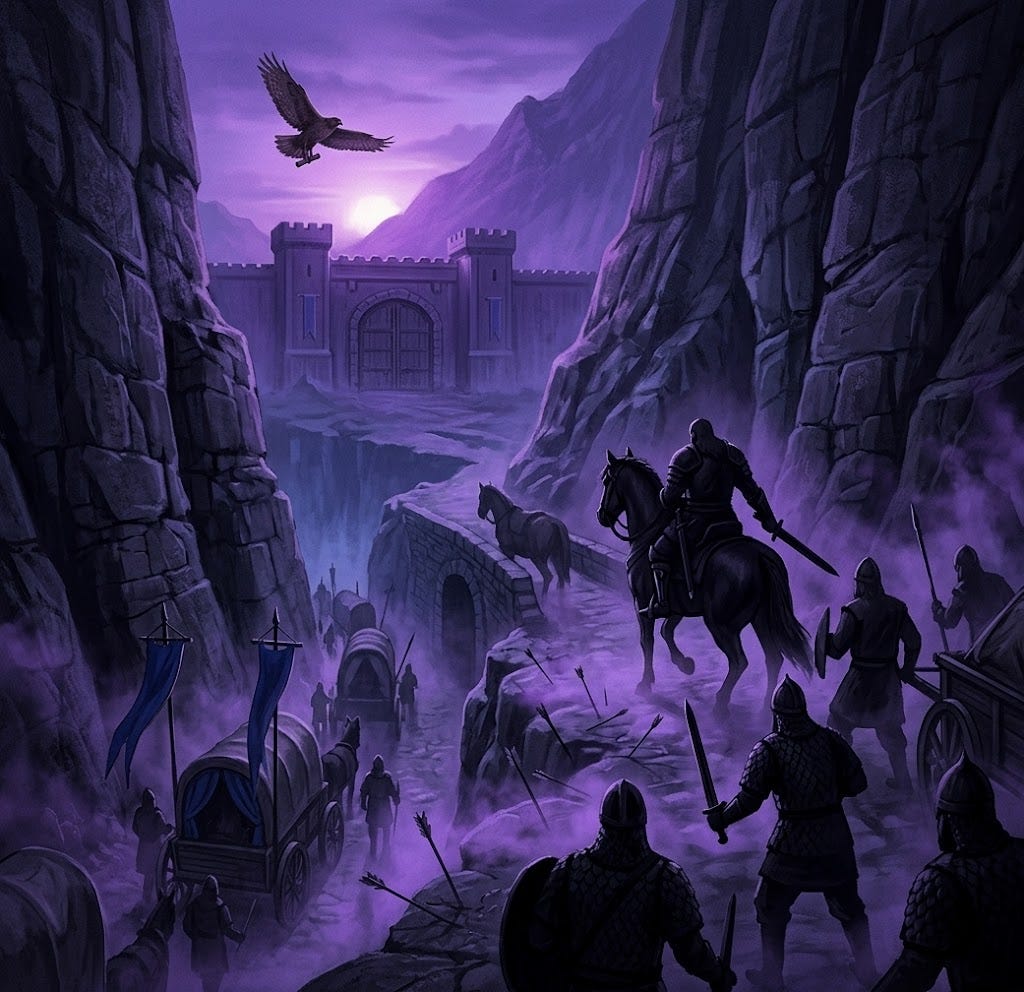
The decision had been made in the cold, blue light before dawn. Gustav and King Artemij stood over the maps, their faces etched with the exhaustion of a week of planning.
“You stay,” Gustav had said, his voice leaving no room for argument. “The Black Gorge is a funnel, Linde. It is stone and shadow. If we are ambushed, there is no room to maneuver. I will not have you trapped in that throat.”
Linde had wanted to protest, to argue that her skills were needed where the blood would flow heaviest, but she saw the tremor in Gustav’s hand as he adjusted his gauntlet. Because he wasn’t just protecting his Queen, he was protecting his heart. If he knew she was safe behind the walls of the Iron-Fast, a northern fortification three hours back from the Gorge, he could fight like the God of War himself.
While the army marched into the claustrophobic silence of the Gorge, Linde transformed the Iron-Fast into a masterpiece of medical logistics. She stood in the center of the stone courtyard, her boiled leather vest pulled tight, her honey-pale hair braided back so fiercely it pulled at her temples. Around her, Marta and the other women moved with the precision of a clockwork mechanism.
“The vats of vinegar must be kept at a simmer,” Linde commanded, her voice ringing off the stone. “We need the linen strips boiled and dried. And I want the poppy-syrup measured into small vials, if they come back in the dark, we won’t have time to weigh doses.”
The waiting was a physical weight. Linde climbed to the ramparts, her eyes fixed on the narrow trail. Beside her, Laila’s absence felt like a physical wound. She missed Laila’s steady hand. “They’ll be alright, Linde,” Galina said. “Andrej is too stubborn to die, and Gustav... Gustav has the strength of the mountains.”
Linde didn’t look away. “It isn’t their strength I’m worried about. It’s the Varjags. They don’t fight for honor. They fight for the gold of the Aurelian League.”
A hawk shrieked overhead, circling the courtyard before diving toward the mews. Attached to its leg was a frantic, blood-stained scrap of parchment. Linde recognized the handwriting instantly, it was Vlad’s, her brilliant physician brother who had insisted on riding with the vanguard scouts to study the local flora for field dressings.
Linde,
The air is wrong. They are using glass spheres. If they break, the scent is of bitter almonds. It is not just a gas, it is a catalyst. It reacts with the iron in the blood. Do not use water on the skin, it only accelerates the rot. Use milk and ash. I have found the source of the violet toxin: it is a concentrated distillation of Night-Bell from the Southern marshes. I am going to try to intercept the supply line near the river.
Vlad
A chill that had nothing to do with the mountain air settled in Linde’s marrow. Vlad was out there, alone, chasing a poison that could turn an army into a graveyard.
Just as the sun began to dip behind the peaks, a lone rider appeared, leaning low over his horse’s neck. “Open the gate!” Linde screamed.
The rider collapsed as he entered the courtyard. He was a Northern scout, but it wasn’t an arrow that had taken him down. His skin was a sickly, mottled grey, and his eyes were rolled back. Linde knelt beside him, her fingers flying to his pulse. She stopped, her blood turning to ice.
There was no wound, but his breath smelled of bitter almonds and something metallic. “Poison,” she whispered. “Vlad was right. They aren’t just using steel.”
Before she could process the shock, the heavy rumble of wheels sounded outside. The first wagon from the Gorge arrived, and it was a bloodbath. Men were piled together, some screaming, some eerily silent.
“Bring them in! Now!” Linde bellowed.
Meanwhile, in the depths of the Gorge, the air was thick enough to chew. It wasn’t just the mountain mist; it was the smell of damp stone, horse sweat, and the metallic tang of hidden steel.
Gustav sat astride his stallion, his iron leg locked into a custom stirrup that allowed him to put the weight of his entire body into a swing. Beside him, King Artemij was a statue in leather and fur.
“It’s too quiet,” Artemij murmured.
Suddenly, the silence shattered. Rhythmic whistling cut the air: hundreds of arrows. But as they hit the stone walls and the ground, they shattered into a fine, violet mist upon impact.
“Hold your breath!” Gustav roared, pulling his cloak over his face. “Shields up! Do not let the mist touch your skin!”
The enemy’s warriors emerged from the shadow. These were mercenaries in polished scale-mail, guided by a man in a crimson cloak: an emissary of the Aurelian League. Andrej didn’t wait; he spurred his horse forward, Miro right at his heels.
“For the East!” Miro screamed, his voice breaking with adrenaline. He swung his blade wildly, but Andrej was a scalpel. Yet, the mist was doing its work. Andrej felt a sudden, sharp dizziness. His horse stumbled, foaming at the mouth. He looked back and saw Miro swaying in his saddle, his face turning that sickly, mottled grey.
“Miro!” Andrej lunged for his brother’s reins just as a Varjag leveled a heavy crossbow. The bolt thudded into King Erik’s shield as the old King threw himself forward.
“Get him back!” Erik bellowed. “Take the boy to Linde! Go!”
The battle was a nightmare of blurred vision. Gustav hacked through a Varangian guard, but every breath felt like inhaling ground glass. He stayed at the very back of the line, his iron leg the only thing keeping him upright as the toxin sapped his strength.
Stay alive, Linde, he thought, his vision flickering. Stay alive, because I don’t think I can lead them back from this.
Back at the Iron-Fast, the second wagon lurched through the gates. Linde ran toward it, her heart a drum. The blue banners of the King were draped over the side, but it wasn’t Gustav she found.
It was Miro.
Her youngest brother lay deathly still, his skin the color of a winter sky. Andrej was slumped over him, shaking. Behind them, King Erik sat clutching a wound in his side, his face grey with the toxin.
“Where is Gustav?” Linde screamed, grabbing Andrej.
“He’s... holding the bridge,” Andrej wheezed. “He stayed back to let us through. Linde... the mist. Vlad... we lost Vlad in the trees near the river.”
Linde looked back at the gates. In the distance, she could almost see the silhouette of a massive man on a horse, standing alone against the mouth of the Gorge. She looked at the vial of violet liquid in her hand, the sample Andrej had managed to seize. She looked at her dying brother, her wounded father-in-law, and the brother who was missing in the dark.
“Marta! Get the King inside!” Linde’s voice was a command of ice and iron. “Marta, prepare the charcoal and the ash. No water! Use the milk! I’m going to save my brother. And then I’m going to bring my husband home.”
🧠 Behind the Saga: The Anthropology of Ancient Chemical Warfare
The smell of "bitter almonds" is a historical nod to cyanide-producing plants, which have been manipulated by alchemists and assassins since antiquity. The Firebound Saga leans into the reality that the ancient world was not just a place of brute force; it was a frontier of terrifying, experimental chemistry, and surviving it required as much intellect as it did iron.
Historically, this reflects the profound social and psychological disruption that chemical weapons caused in ancient martial cultures. The 10th-century battlefield was built on a very specific, deeply ingrained anthropological contract: honor, physical prowess, and the visceral, face-to-face reality of steel.
The introduction of chemical warfare—like the distilled Night-Bell—completely shatters this social structure. In ancient societies, poison and toxic gases were universally reviled. They were not just lethal; they were a profound cultural transgression. A weaponized mist strips the warrior of his agency, rendering a lifetime of training and physical strength entirely useless.
From the perspective of our autistic protagonist, when the external environment becomes chaotic or overwhelming, Linde creates rigid, hyper-focused systems (like her medical triage) to regain control. For neurodivergent minds, hyper-focusing and creating rigid, predictable systems during a crisis is a highly effective way to regulate an overwhelmed nervous system. By turning the courtyard into a clockwork mechanism, Linde is anchoring her own mind against the chaos.
The medical protocol itself is deeply rooted in ancient toxicology. Vlad’s note to use "milk and ash" rather than water is a historical reflection of early pharmacology. Ancient healers understood that water would only accelerate the absorption of certain caustic agents on the skin, whereas ash (acting as a primitive activated charcoal) and milk (providing fat and proteins) could bind to and neutralize the toxins.
If you are ready to explore the collision of ancient cultural rituals and raw psychological depth where the fiercest battles are fought in the quiet spaces between two people, the foundation of this world is already written. You can dive straight into the first two complete volumes of the Firebound Saga: Salt and Gold and Emerald to Steel are available for immediate reading on Kindle.