
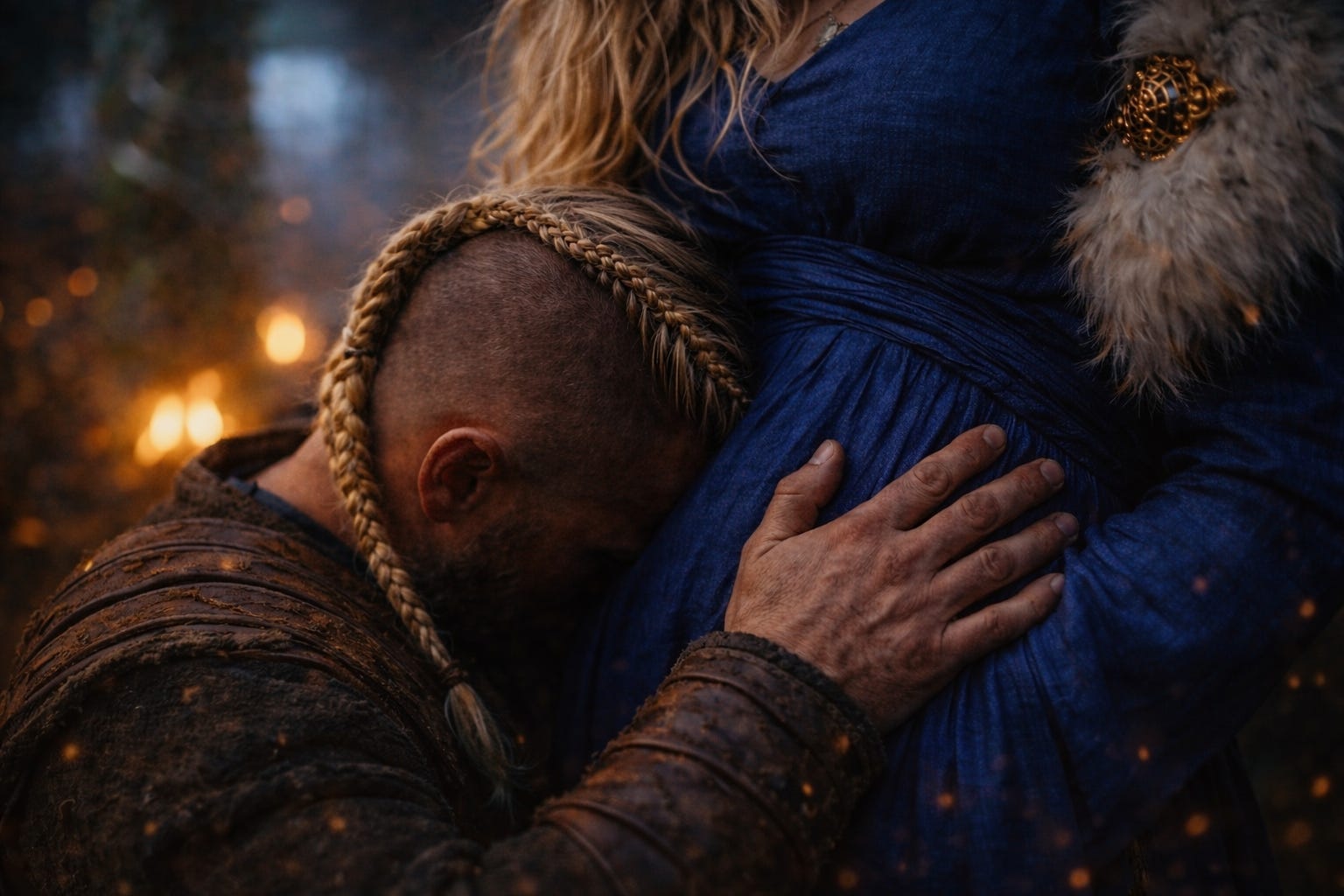
The light in the royal chambers was soft, filtered through thick wool hangings and the pale, hazy gold of a northern afternoon. Linde drifted back to consciousness slowly, her body feeling as though it were made of lead, yet strangely buoyant, as if she were floating in the warm shallows of the Baltic. The sharp, metallic scent of the infirmary was gone, replaced by cedar, old books, and the faint, salty musk of the man sitting beside her.
She opened her eyes to find Gustav.
He was still in his travel-worn leather, the salt of the sea and the grime of the hunt still clinging to him. He hadn’t even stopped to wash. He was slumped in the chair by her bedside, his large hand enveloping hers, his thumb tracing the blue veins on the back of her wrist with a rhythmic, reverent touch.
“Gustav,” she whispered, her voice a mere shadow of itself.
He was alert in an instant, leaning forward, his eyes bloodshot but burning with an intensity that made her heart stutter. “Don’t move,” he commanded, though his voice was thick with a tenderness that broke her. “You’re to stay exactly where you are.”
Linde blinked, the memories of the solar, the dizziness, the swaying walls, the sudden darkness, rushing back. “Vlad?” she asked, her breath catching. “Did you...”
“He’s home, Linde. He’s currently complaining that Marta is using too much yarrow in his poultice. He’s alive. You saved us.” Gustav leaned in, his forehead coming to rest against hers. “If you hadn’t come to that bridge... I wouldn’t be here to hold you.”
Linde let out a long breath. “I thought I was dying, Gustav. I went through every toxin in my mother’s journals. I was convinced it was a slow-acting paralysis of the heart.”
Gustav was silent for a long moment, pulling her hand up to his lips. “Marta says it wasn’t the toxin.”
Linde squinted at him, her physician’s mind already whirring. “Then, I need more red meat. I’ll make a tonic in the morning: “
“Linde,” Gustav interrupted, a liquid silver of tears in his eyes. “You aren’t anaemic. And you aren’t making any tonics.” He placed her hand firmly against her own abdomen.
Linde went still. She looked at her hand, then at his face. The realization hit her like a lightning strike. She thought of the cabin, the fierce, endless heat of their union, and the sudden, violent nausea at the smell of his horse.
“A baby?” she breathed, the word feeling impossible. “Now? In the middle of a blockade?” She looked at him with a flash of her usual wit. “Gustav, my timing is usually much better than this. I had a whole winter of surgeries planned.”
“An heir,” Gustav corrected, his voice a low rumble of pride and terror. “A little wolf. Or a little healer. Marta says you’ve been fainting because you’ve been doing the work of three people while your body was trying to build a life.” He squeezed her hand, his gaze fierce. “No more, Linde. No more battlefields. No more midnight councils. For the next months, your only duty is to exist.”
Linde let out a soft, melodic laugh that ended in a tired sigh. “You expect me to sit still while the Aurelian League is still breathing down our necks?”
“I expect you to let me be the shield,” Gustav said, his hand moving instinctively to her abdomen, resting there with a tentative, massive warmth. “You’ve spent your whole life mending things. Let me guard this.”
An hour later, after Linde had been forced to eat a bowl of broth and some honeyed bread, the doors opened to admit the family. King Artemij and King Erik entered first, looking older and more haggard than Linde had ever seen them, followed by Andrej and a limping, bandaged Vlad.
The room was silent as they approached the bed. Vlad, usually the most stoic of the brothers, sat on the edge of the mattress and pulled Linde into a one-armed embrace. “I saw you fell over just to welcome me back,” he teased, his voice rasping from the smoke of the Varjag ships. “Next time, a simple wave will do.”
“Next time, don’t get captured by southern mercenaries,” Linde countered, her eyes stinging as she held him.
King Artemij stepped forward, his gaze moving from his daughter to Gustav, and then to the hand Gustav still held over Linde’s stomach. The hard, war-bitten King of the East seemed to crumble for a second, his eyes softening with a profound, quiet joy.
“Your mother always said that life grows strongest where the earth has been burnt,” Artemij said, his voice gruff. “It seems she was right. The Aurelian League has no idea what they have unified against them.”
King Erik nodded, his hand resting on Gustav’s shoulder. “We have the emissary, Gustav. The one we pulled from the wreckage of their camp. He’s talking. He’s terrified.”
Gustav looked at Linde, then back at the kings. The news of the child hadn’t softened his resolve; it had turned it into something unbreakable. “The war isn’t over,” he said. “But the terms have changed. We aren’t just fighting for trade routes anymore. We’re fighting for the world our children will inherit.”
Andrej stood by the window, watching the exchange. His face was a mask of joy for his sister, but beneath it lay a hollow ache. He looked at the empty chair where Laila usually sat, his fingers tracing the hilt of his sword. The news of the child made his own isolation sharper. Laila, he thought. She is now six months gone, and I am a world away. He slipped out of the room quietly, unable to bear the weight of a domestic bliss he couldn’t share.
That night, after the kings had retreated to their wine and the brothers to their rest, Gustav remained. He had finally washed, his skin smelling of lye and cold water, and he lay beside Linde on top of the furs, holding her as if she were made of the finest glass.
“I was so afraid,” he whispered into the dark. “When I saw you fall, I thought the world had finally taken too much from me.”
Linde turned in his arms, her face inches from his. “The world tried. But we are the North and the East, Gustav. We don’t break.” She took his hand and pressed it firmly against her belly. “Can you feel it?”
Gustav closed his eyes, his breathing syncing with hers. Beneath his palm, there was only the steady, quiet pulse of her life, but in his mind, he saw a future, a girl with emerald eyes and a crown of iron, or a boy with the heart of a healer and the strength of a bear.
“I feel it,” he whispered. “And I will burn the seas to ash before I let anything touch it.”
The shadows in the room deepened, the orange glow of the dying embers casting long, flickering shapes against the cedar beams. The heavy oak door had been barred, shutting out the kings, the war, and the weight of the crown. For the first time in weeks, they were not symbols of a kingdom; they were simply a man and a woman, reunited at the edge of life.
Gustav’s touch was initially hesitant, his large hands hovering over her as if he feared his own strength might shatter the miracle growing inside her. But Linde reached up, her fingers tangling in the damp hair at the nape of his neck, pulling him down until his lips were inches from hers.
“I am not made of glass, Gustav,” she whispered, her emerald eyes dark with a hunger that the exhaustion couldn’t touch. “I am made of the same fire that brought you home.”
He groaned, a low, primal sound that vibrated against her chest, and captured her mouth. The kiss was desperate, tasting of salt and long-awaited relief. It was the re-awakening of the wild rhythm they had found in the cabin.
He moved with a slow, agonizing reverence, stripping away the linen of her shift. When his eyes fell upon her, his breath hitched. Her body hadn’t changed much yet, but to him, she looked luminous, her skin glowing in the firelight. He knelt between her legs, his hands sliding up her thighs with a proprietary heat.
She felt the familiar, building electricity, the same one from the Kupolė dream, but sharpened by the reality of his presence. She reached for him, her voice a broken command. “Come here, Gustav. Now.”
“Look at me,” he whispered, his eyes wet. He began to recite, his voice a low, royal rumble against her skin.
“The stars may fall, and the seas may freeze, but the sun is rising in the house of my heart. You are the earth, Linde, and I am the rain. Together, we are the kingdom that will never fall.”
They lay there for a long time, their hearts beating in a frantic, synchronized beat. The air in the room was heavy with the scent of their union and the fading smoke of the hearth. Gustav shifted his weight, resting his forehead against hers, his hand coming to rest once more over her belly.
“We are going to be a family,” he whispered, the reality finally settling into his bones.
Linde smiled, a tear of pure, exhausted joy tracking through the sweat on her temple. “We already are, my King. We already are.”
🧠 Behind the Saga: The Geopolitics of Blood and the Anthropology of the Rites of Passage
Chapter 33 marks a profound pivot in the Firebound saga. We transition from the external, chemical warfare of the Black Gorge into the most intimately guarded space in the kingdom: the royal bedchamber. But in the 10th-century world, the bedchamber was just another front line.
In the ancient and medieval world, pregnancy carried a massive, dual psychological weight for women. On one hand, it was a time of extreme physical vulnerability in an era with staggering maternal mortality rates; on the other, it was the ultimate source of female political power. The moment Gustav places her hand on her abdomen, Linde’s status shifts abruptly. She is no longer just the High Witch or a battlefield triage surgeon, she is the literal vessel of the state’s future. Her body has diverted all of its executive function and resources to build a life, forcing her to surrender the mechanical control she relies on to survive.
In the 10th century, alliances forged on parchment or spoken oaths were notoriously fragile. The only binding, unbreakable contract between warring tribes or disparate kingdoms was blood. Marriages were strategic mergers, but a child was a “living treaty.” By creating an heir that shares their blood, Gustav and Linde are cementing an anthropological mechanism for mutual survival. The child guarantees that neither kingdom will abandon the other, turning a temporary military alliance into a permanent empire.
In the 10th century world, highly personal life events like marriage and pregnancy are inherently geopolitical, they are matters of state security and tribal survival. Even today, though the stakes are different, personal milestones can carry heavy external weight.
Today, the “kingdom” is our digital network. Milestones are broadcasted on social platforms not just as personal joy, but as a signaling mechanism to our extended kinship networks. We are signaling that we are hitting the expected markers of stability, maturity, and societal contribution. The pressure to document and “perform” these milestones perfectly is the modern equivalent of ensuring the neighboring Jarl sees that your alliance is strong. Contemporary society is built around a standard chronological timeline (graduate, marry, buy a house, have children). This timeline is highly optimized for capitalist consumption and structural predictability. When you hit these milestones, society rewards you with tax breaks, social validation, and easier integration into community infrastructure (like school systems). The "weight" we feel is the invisible pressure of the socio-economic machine urging us to stay on the conveyor belt.
We live in an era that fiercely promotes hyper-individualism. We are told that our weddings are “our special day” and our family planning is a “private choice.” But the anthropological reality is that humans are an obligate communal species. The moment you invite witnesses to a milestone, or register it with the state, you are inviting the external world to hold a stake in your private life. The weight we feel is the cognitive dissonance between the modern myth of total independence and the ancient, hardwired reality of tribal obligation.
If you are ready to explore the collision of ancient cultural rituals and raw psychological depth where the fiercest battles are fought in the quiet spaces between two people, the foundation of this world is already written. You can dive straight into the first two complete volumes of the Firebound Saga: Salt and Gold and Emerald to Steel are available for immediate reading on Kindle.