
The victory had brought Vlad home, but it had not brought peace. While the castle celebrated the return of the princes, a darker work was being done in the damp, salt-stained cells beneath the north tower.
Gustav and Andrej descended the spiral stairs, the air growing colder with every step. In the center of the iron-barred room sat the Aurelian emissary. He was a man of fine silks and soft hands, now tattered and trembling, his golden rings having been stripped by the dungeon guards. He was a creature of the southern courts, entirely unprepared for the cold, direct brutality of a Northern King who had almost lost his wife.
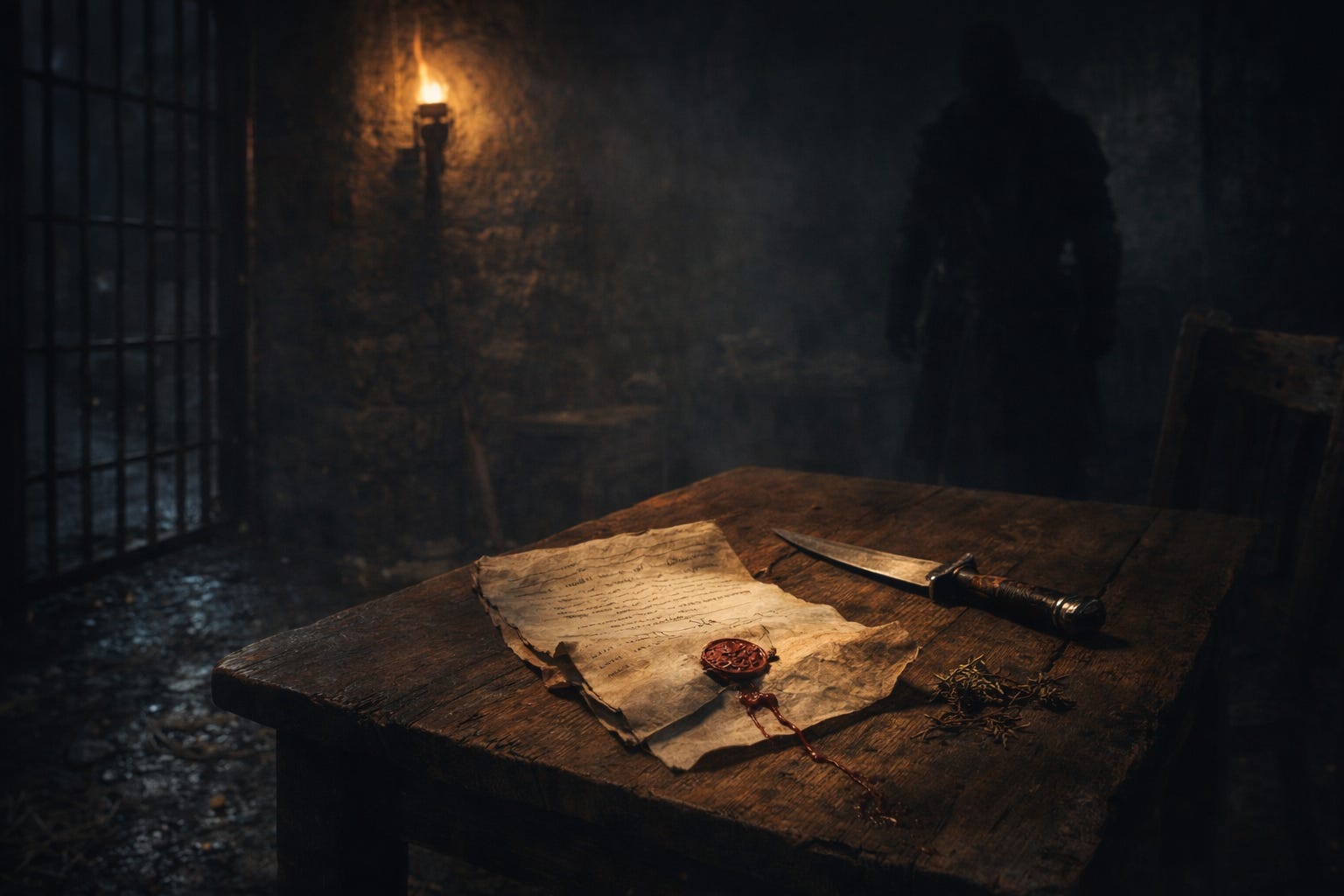
Gustav didn’t use the rack or the irons. He simply sat across from the man, the light of a single torch glinting off his iron leg and the cold steel of his gaze.
“You are a long way from the sun, Southerner,” Gustav said, his voice a low, terrifying rumble. “Your allies are dead or scattered. Your gold didn’t buy the Gorge. It only bought a shallow grave for your mercenaries.”
The emissary swallowed hard, his eyes darting to Andrej, who stood in the shadows sharpening a hunting knife with a rhythmic, sickening shink-shink sound. “I am a diplomat of the League,” the man wheezed. “You cannot hold me. The trade guilds will...”
“The trade guilds aren’t here,” Andrej interrupted, stepping into the light. “But the brothers of the men you poisoned are. Tell us how you found the secret pass. That trail wasn’t on any map. Someone gave it to you.”
The emissary broke. The prospect of Andrej’s knife was more persuasive than any southern diplomacy. “A man... a man with a seal of the North. He met us at the Hedeby crossing. He gave us the maps and told us the Queen would be vulnerable at the Iron-Fast.”
He reached into his tunic and produced a small, crumpled piece of parchment. It was a ledger of payments, but it was the signet pressed into the wax at the bottom that made Gustav’s blood run cold. It was the crest of the High Steward, Gustav’s own cousin, a man who had sat at their wedding feast and toasted to their long life.
The arrest was swift and silent. They found the Steward in the solar, mid-meal, his bags already packed for a “diplomatic trip” to the coast. Gustav didn’t offer him a trial. He presented the ledger.
The betrayal cut deeper than any Varjag blade. The Steward had sold the lives of his kinsmen for the promise of a governorship under the Aurelian League once the North was broken.
“I did it for the future,” the Steward spat, his face twisting with a sudden, ugly envy. “You married an Eastern Witch and brought the wolves into our halls. The League offers order. They offer gold. You offer nothing but endless winter and war.”
Gustav looked at him with a profound, icy pity. “You sold your soul for gold that will never reach your pockets.” He turned to the guards. “Take him to the bridge where the scouts died. Let the river decide his fate.”
As the political rot was purged, the private world of the King and Queen took on a new, feverish intensity.
Marta had warned Linde that the pregnancy might bring fatigue, but for Linde, it brought a primal, ferocious hunger. The scent of Gustav, of leather, salt, and raw masculinity, now acted as a constant aphrodisiac. Her body, realizing it was now a vessel for a new dynasty, seemed to demand the presence of the man who had sparked it.
One evening, after a grueling day of councils, Gustav returned to their chambers to find Linde standing by the large copper tub, her hair unbound and a thin, silk wrap clinging to her damp skin.
“You’re supposed to be resting,” Gustav murmured, his voice thick as he watched the way the firelight played over the new, subtle curves of her body.
“I have rested enough,” Linde replied, her emerald eyes burning. She walked toward him, her hands moving to the fastenings of his tunic. “The child is greedy, Gustav. And so am I.”
She pushed him back into the large oaken chair, her movements bold and hungry. She didn’t wait for him to lead. She straddled his lap, her hands wandering beneath his leather vest, finding the heat of his skin.
They explored each other with a new, uninhibited curiosity. Linde, emboldened by the change in her body, led him into new territories of pleasure. She was watching the way his head fell back and his eyes rolled as she used her healer’s knowledge of the body to drive him to the edge of madness.
When they finally moved to the bed, the lovemaking was a storm of skin and breath. Linde was vocal, her moans turning into demanding cries as she guided his hands and his body to satisfy the ache that seemed to radiate from her core. She wanted him deeper, harder, faster, and a wildness in her blood that made Gustav feel like a man reborn.
“You’re going to be the death of me,” Gustav gasped as they lay tangled in the aftermath, their skin slick with sweat and the scent of jasmine oil.
Linde leaned over him, her lips grazing his ear. “Not the death of you, my King. The life of you.”
The war was coming, the South was plotting, and a traitor’s blood was cooling in the river, but here, in the sanctuary of their bed, they were making a future that nothing could destroy.
🧠 Behind the Saga: The Architecture of Treason and the Primal Shift
Chapter 34 of the Firebound saga moves the war from the battle field into two most dangerous rooms in the 10th-century world: the dungeon and the bedchamber.
In modern political dramas betrayal is usually bureaucratic, but the 10th century it often deeply, violently intimate. The greatest threat to a Northern King was rarely the army at the gates, it was the man pouring his wine.
The High Steward’s betrayal highlights a massive geopolitical friction of the era. He didn’t just sell out his cousin for gold; he sold him out for “order.” The Steward’s xenophobic disdain for the “Eastern Witch” and the “wolves” perfectly mirrors the historical clash between the older, decentralized tribal alliances of the North and the encroaching, highly structured, “civilized” empires of the South. The Steward is a man who wants the comfort of imperial bureaucracy, and he is willing to sacrifice his own bloodline to get it.
Notice the swiftness of the execution. There is no trial, no council, no debate. Gustav simply presents the ledger and hands down a death sentence.
To modern readers, this feels abrupt, but it is a highly accurate depiction of ancient autocratic power. In 10th-century feudalism, the King did not merely enforce the law; his word was the law. Furthermore, Gustav’s choice of execution (letting the river decide his fate at the exact spot where the scouts died) is an act of poetic, spiritual justice.
The transition from the cold, salt-stained dungeon to the heat of the royal chambers is a massive tonal shift, driven by pure biology.
Throughout the siege, Linde’s body was running entirely on cortisol and adrenaline, the hormones of survival. Now, with the immediate threat neutralized and a pregnancy beginning, she is experiencing a profound somatic rebound. The massive influx of estrogen and progesterone during early pregnancy drastically alters the physical landscape, increasing blood flow and hypersensitizing the nervous system.
But anthropologically, this is also a psychological reclamation. After days of being reduced to a triage mechanic, and realizing her body is now a geopolitical “vessel of the state,” Linde refuses to be passive. Her ferocious, uninhibited hunger is a fierce reclamation of her own agency. She isn’t just carrying the future of the kingdom; she is actively, aggressively demanding the pleasure of creating it.
If you are ready to explore the collision of ancient cultural rituals and raw psychological depth where the fiercest battles are fought in the quiet spaces between two people, the foundation of this world is already written. You can dive straight into the first two complete volumes of the Firebound Saga: Salt and Gold and Emerald to Steel are available for immediate reading on Kindle.