
The morning after the dawn of blood, the sun rose over the Eastern spires with its indifferent brightness. Linde lay in the silence of her father’s palace, her body a map of agony. Every breath was a sharp, jagged reminder of the ribs the mace had crushed, and the deep, hollow ache in her pelvis felt like a heavy stone she was forced to carry.
She was a healer, she knew the cost of the blood she had lost… The verdict by Laila and Vlad had been clear: if she stood, if she even rolled onto her side too quickly, the remaining heartbeat, the one they were all praying for, would flicker out like a candle in a gale.
“I cannot leave him in a box by the bed,” Linde whispered, her voice a ghost of itself, yet carrying the iron of her lineage. “He is our son, he cannot be forgotten in a corner like a discarded thing.”
“Linde, you must stay still,” Gustav rasped from his vigil on the floor. He hadn’t slept, hadn’t eaten. The harrowing, the battle-shadow, clung to him like a second skin. His eyes were sunken and rimmed with red, and his large hands resting uselessly on his knees.
“I will not move my legs,” she replied, a single tear tracking through the soot and dried salt on her cheek. “But you can move them for me. You must me to the grove, Gustav. If I do not plant him, he will never find the way back to the light. And neither will his brother. The living needs the dead to be at peace.”
Because she could not go to the bathhouse, the ritual was brought to her chamber. Laila and the elder midwives moved with a silent, practiced reverence, their faces masks of solemn duty. They placed Linde on a bed of fresh, sun-dried linen. While Gustav and the men stood guard outside the heavy oak doors, a wall of silent, grieving steel, the women performed the Praustynės.
Laila used silver bowls filled with water from the sacred spring, infused with mugwort and yarrow to ward off the “death-clinging.” They dabbed her skin with soft wool, washing away the dried blood and the dust of the Steppe.
“The shadow to the water, the water to the earth,” Laila chanted softly, the rhythm of the words matching the dabbing of the wool. “The mother to the living, the soul to the ancestors.”
Linde lay perfectly still, her hands clutched over her belly, physically shielding the survivor. She felt the warmth of the water fighting the unnatural, bone-deep cold that had settled in her marrow since the mace struck. She was a vessel that had been cracked, and the ritual was the first thin layer of glaze meant to hold her together.
When the washing was done, they dressed her in the Drobulė, a heavy gown of undyed, raw linen that symbolized the fog between the worlds. Gustav entered the room then, his face a mask of controlled agony. He was silent, he simply couldn’t say a word. He reached down and gathered Linde into his massive arms, lifting her with a tenderness that made his powerful muscles tremble. He held her as if she were made of thin ice, her head resting against the gap in his leather armor, the very spot she had saved with her dagger.
Vlad walked beside them, his hand never leaving Linde’s wrist, his fingers constantly monitoring the thin, thrumming pulse of her life. Andrej followed, his towering frame bent low as he carried the small cedar box. Behind them, Miro and King Artemij walked in a silence so heavy it felt like part of the forest itself.
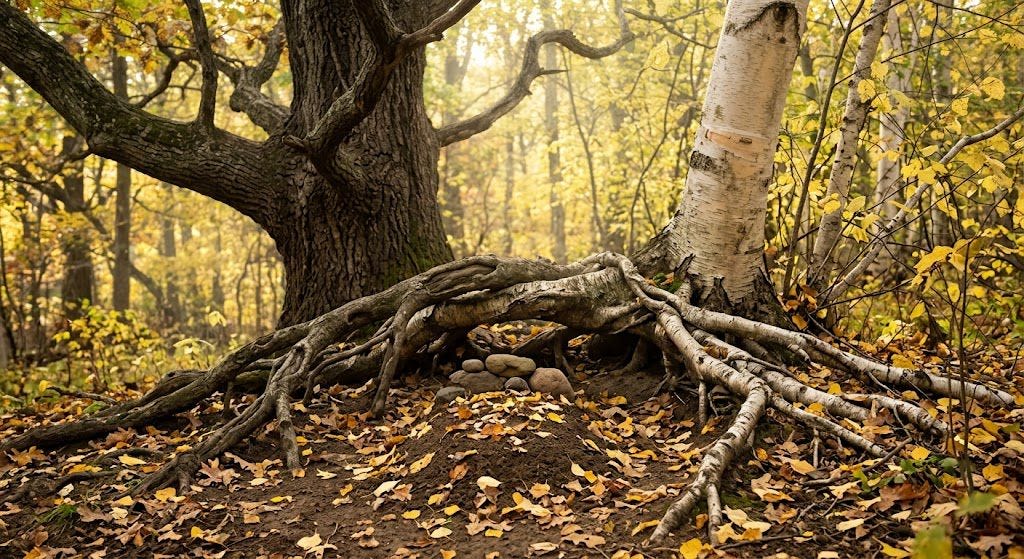
They reached the center of the royal grove, where the ancient oaks of the East met the silver birches of the North. Gustav knelt, still holding Linde against his chest, his iron leg acting as a steady pillar. He lowered his frame so she could reach the damp, fragrant earth without straining her core.
“He needs a name,” Linde whispered. “He cannot go into the dark as a stranger.”
King Artemij stepped forward, his eyes wet. In the East, a child who died before the naming ceremony was often called Bevardis, the Nameless, but Linde’s gaze was too fierce for such a fate.
“In the North,” Gustav rasped, his voice cracking like dry wood. “We do not name those who do not walk the earth. But this one... he fought. He shielded the heir.” He looked down at the tiny cedar box with a look of devastated pride. “He is Bjorn. My little bear. The one who stood at the gate.”
Andrej lowered the box into the earth he had dug with his own dagger. Linde reached out, her fingers trembling as she touched the smooth wood of the lid.
“Bjorn,” she repeated, the name a soft prayer that seemed to still the wind. “Our little bear... Find your grandmothers. Tell them you are the first of our house to reach the halls, and you did so as a guardian.”
Vlad stepped closer, his hand on Linde’s shoulder, anchoring her. “He took the blow so the other might breathe,” he whispered. “He was a sentinel before he was a man.”
Linde took a handful of the cool, damp soil. She crumbled it over the silk-wrapped wood, her eyes closed. For a moment, she felt a soft, phantom weight against her breast, a final, fleeting goodbye from the little bear who had saved his brother.
“Go,” she whispered. “Grow into the roots. Stand as our guard.”
As Gustav carried her back to the palace, the sun hit the yellowing leaves of the grove, turning the world to gold. Linde felt hollowed out, as if the salt and the steam had scoured her clean.
She was no longer just a Queen or a healer; she was a survivor. The “death-shadow” had lifted slightly, replaced by a heavy, permanent ache that she knew would never truly leave her.
Gustav, however, didn’t look at the trees or the sun. He looked only at the path ahead, his eyes scanning every shadow, every rustle of the grass, for an enemy that had already done its worst. He held Linde tighter, his grip almost bruising, as if he could keep the world away by sheer force of will. The ritual had mended the mother, but the King was still lost in the mist of the harrowing.
Inside her, the survivor gave a small, persistent kick, like a reminder, or a promise. Bjorn was in the earth, but her world still had a heartbeat.
🧠 Behind the Saga: Cultural Containers and the Agency of Grief
Chapter 36 transitions from the physical terror of the battlefield into the devastating stillness of survival. In this chapter, the Firebound saga explores how ancient societies handled the profound, crushing weight of loss, offering a stark contrast to how we often process mourning today.
In modern society, we frequently carry our grief individually, isolated in our own internal landscapes. But in the 10th-century world, grief demanded a community “container.” When loss lacks a structural ritual to hold it—when it is allowed to become “un-funeraled” grief—that raw, unprocessed energy goes underground and can silently destroy human bonds from the inside out.
By demanding the Praustynės (the ritual washing) and the burial in the grove, Linde is constructing a vital cultural container. The ritual holds the agonizing emotionality of their loss and places it into a defined context, physically carrying the soul of her child from its earthly presence into the ancestral unknown. The ritual is the container that actually makes moving forward possible.
We so often limit our understanding of grief to the finality of change, treating it as something that happens to us passively. But Linde’s stillness in this chapter is not passive; it is a display of profound, active agency.
As she lies on the bed of sun-dried linen, physically shielding the surviving twin by refusing to move, she is actively choosing to continue living. She is making the agonizing choice to carry the pain, the empathy, and the love all at once.
Agency is the spark that allows her to choose life, and the ritual provides the structure she needs to survive it.
Gustav and Linde refuse to let their son go into the dark as a “discarded thing” or the “Nameless.” By breaking tradition to name him “Little Bear,” they give his sacrifice a permanent, honored architecture in their bloodline. He is recognized not as a tragedy, but as a guardian who took the blow so the heir might breathe.
Notice the sharp contrast in the final lines of the chapter. Because Linde engaged so deeply with the ritual container, she feels the “death-shadow” begin to lift slightly, replaced by a heavy, permanent ache and the persistent kick of the survivor.
Gustav, however, remains trapped. He is a wall of grieving steel, his eyes endlessly scanning the treeline for an enemy that has already done its worst. While the ritual has begun to mend the mother, the King is still lost in the mist of the harrowing, unable to find a container for a grief that has entirely rewritten his world.
If you are ready to explore the collision of ancient cultural rituals and raw psychological depth where the fiercest battles are fought in the quiet spaces between two people, the foundation of this world is already written. You can dive straight into the first two complete volumes of the Firebound Saga: Salt and Gold and Emerald to Steel are available for immediate reading on Kindle.