
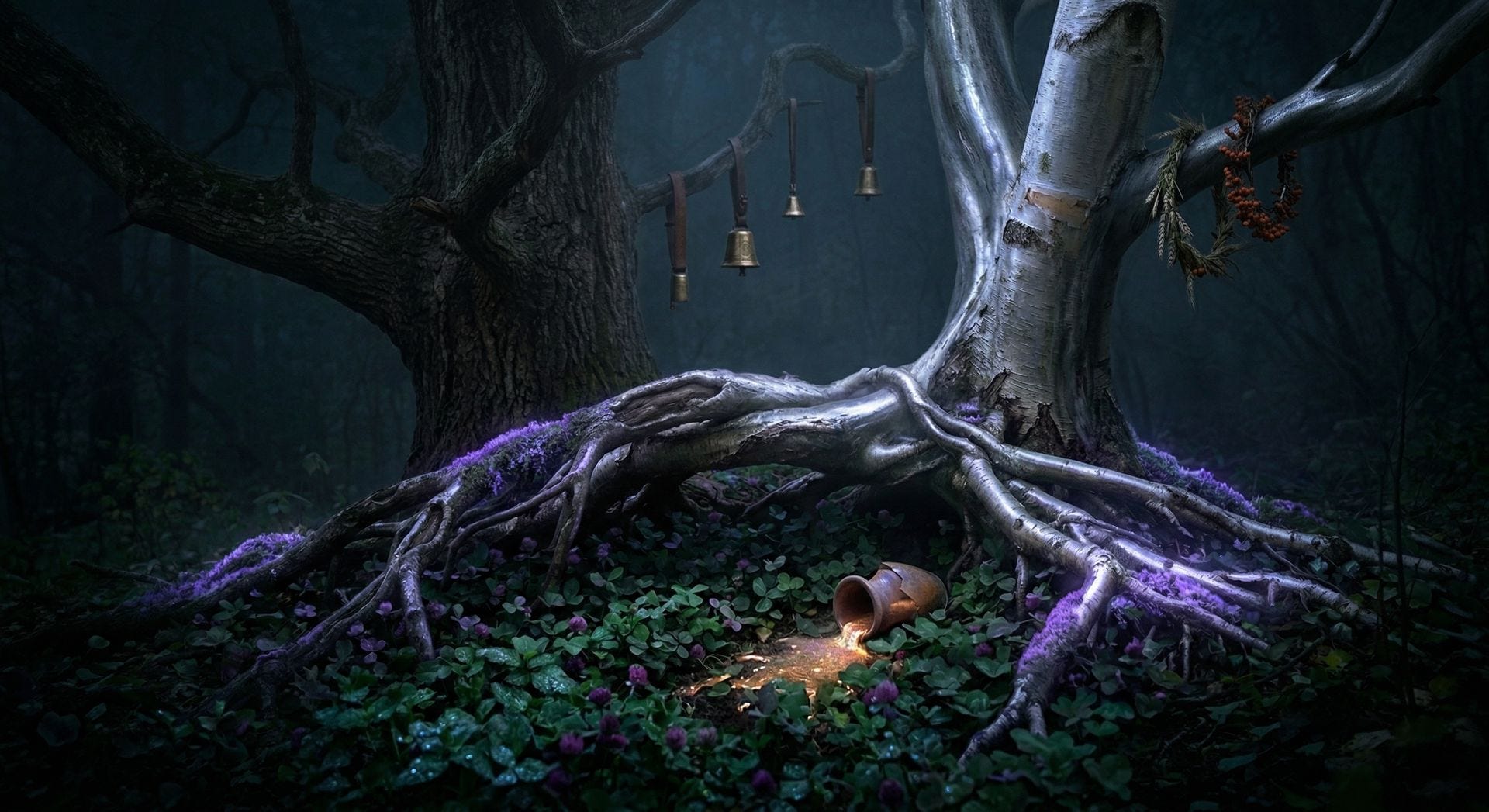
As the weeks turned toward early summer, the heat returned to the land. The forests turned a lush, deep green, and the rivers swelled with the thaw. Linde was now seven months along, her body ripe and heavy with the heir.
The silence in the bedchamber was no longer the peaceful quiet of a sleeping household; it had become a heavy, pressurized thing, like the air before a terminal storm.
Linde watched the moonlight play over Gustav’s shoulders. He sat on the edge of the bed, his back a rugged landscape of muscle and old scars, yet he looked more fragile than she had ever seen him. She moved toward him, the shift of the linen sounding like a landslide in the stillness.
When she placed her hand on his back, he didn’t flinch, but she felt the instantaneous ripple of tension, the way a soldier readies for a blow.
“Gustav,” she whispered, her voice thick with the months of unspoken words. “Look at me.”
He turned, and the exhaustion in his eyes nearly broke her. There was a desperate, starving love there, but it was clouded by a grey film of grief. He reached out, his calloused thumb tracing the line of her cheek with excruciating gentleness. He was touching her as if she were made of ice that might shatter at a degree’s change in temperature.
Linde leaned into his palm, then tilted her head to press a firm, grounding kiss into the center of his hand. She saw his pupils dilate. She didn’t wait; she moved into his space, her hands sliding up his chest to find the heat of his neck, and she pulled him down.
The moment their lips met, the world should have righted itself.
For the first few seconds, it was the old Gustav, her man who kissed with the weight of a mountain. His arms wrapped around her, pulling her heavy, pregnant body flush against his, and Linde felt a surge of triumph. He’s coming back, she thought. He’s finally coming back to me.
But then, the shift happened.
As the kiss deepened, as the heat began to pool in her belly and the rhythm of their breathing synchronized, Gustav’s grip suddenly tightened into a spasm. Beneath his eyelids, he wasn’t seeing the gold of her hair or the safety of their room. He saw the spray of crimson. He felt the phantom weight of the son they had buried, the coldness of that small, still body.
He felt the life kicking inside Linde now, their heir, and instead of joy, a cold, oily dread flooded his veins. If I love this child, he will die. If I touch her too hard, she will break.
Linde felt the change instantly. The passion in his kiss turned clinical, then panicked. His tongue stilled; his body became a pillar of salt. She tried to chase him, deepening the contact, her fingers tangling in his hair to hold him in the present, but she felt him retreating into the harrowing.
Gustav was the first to pull away. He broke the contact abruptly, his breath coming in ragged, shallow hitches as if he had just run a league through deep snow. He didn’t look at her; he looked at his own hands, trembling as they rested on her shoulders.
“I can’t,” he choked out, the words sounding like they were being dragged over broken glass. “Linde... every time I feel you pulse, I feel the end of it. I feel the blood.”
Linde sat there, her lips still swollen from his touch, her heart thundering with a rejection that wasn’t about her, but felt like it all the same. She felt a hollow ache in her chest, the grief of the “almost.” They were like two people trying to hold hands through a sheet of thick, distorted glass; they could see the shape of their love, but the warmth couldn’t pass through.
Gustav closed his eyes, a single tear cutting through the grit on his face. “I don’t know how to be a husband to a woman I am terrified to lose. Forgive me, Linde.”
She settled behind him, her knees framing his hips, and she wrapped her arms around his broad, scarred chest, leaning her cheek against the rough linen of his shoulder.
“There is nothing to forgive in a heart that loves too much, Gustav,” she whispered, her voice a low, melodic vibration against his spine.
“The winter was long, Gustav,” she whispered, her voice a soft, steady thrum in the quiet room. “And the shadow you carry is heavy. I know you are trying to keep the world still so I won’t break, but you don’t have to hold the sky up alone.”
“I am right here,” she murmured, her gaze never wavering from his bowed head. “I am not going anywhere, and neither is our child. We are the spring, my Bear, and we will wait for you. Whether it takes a night or a thousand, I am right here... whenever you are ready to come home to me.”
She remained there, a pale flame in the moonlight, offering him the one thing he didn’t think he deserved: a sanctuary where he didn’t have to be a King, or a protector, just a man who was loved in the dark.
The summer nights in the East were heavy, smelling of damp earth and blooming linden. For Linde, the palace had become a place of silent tiptoeing, but the sacred grove was where she could finally breathe.
She joined the women in the Sutartinės. It was a rhythmic, polyphonic dance where the women sang and moved in interlocking circles. The contact was communal, it was warm and soothing to Linde who felt cold in her loneliness. She closed her eyes, letting the feminine hum of the voices vibrate through her heavy belly. In this circle, she wasn’t a fragile Queen to be protected; she was a woman of the earth, ripe and powerful.
It was during one of these dances that she noticed the woman who didn’t quite fit. Unlike the palace handmaidens in their clean linens, Zora wore a shift of dark, unbleached hemp and a belt of brass bells that jingled with every bold step. Her hair was a wild thicket of curls, and her eyes held the amber light of a predator.
She had heard the whispers about Zora, they called her Raganė. The handmaidens spoke of a woman who lived in a hut of woven willow, who didn’t mend bones with bandages but with the song of the sap. They said she was a creature of the old ways, unburdened by the laws of Kings. Linde, educated and disciplined healer, but as much of a witch in her bones, felt a powerful, magnetic pull toward this chaos.
Zora was stunningly, dangerously beautiful, a creature of sharp angles and gold-flecked eyes. Her hair was a dark, controlled riot, and her skin held the tawny glow of someone who lived entirely in the sun.
They met in the dance.
The circle shifted, and suddenly Zora was Linde’s partner. They didn’t speak. Their connection was purely physical, a wordless conversation of skin and weight. As they moved, Linde felt an electric shock of recognition. Zora’s movements weren’t just rhythmic; they were intentional, tracing the same ley lines of energy that Linde used when she healed.
They began to mirror each other. When Linde reached high, Zora followed. When Zora dropped into a low, earthy crouch, Linde’s body responded. In the firelight, their shadows merged, two witches, two daughters of the high woods, recognizing the same ancient power in the other.
In the days that followed, their bond deepened through a series of Grey Hour meetings. While the palace slept, they sat by the stream, trading secrets of the craft.
Zora was fascinated by Linde’s logic of a physicus, her understanding of silver-leaf and sutures, while Linde was mesmerized by Zora’s language of the sap. They bantered in a rhythmic, earthy dialect of the old woods, a witch-tongue that allowed them to speak of desires and spirits without the constraints of courtly language.
“Your King treats you like a fine-spun glass,” Zora noted one evening, her tattooed fingers weaving a crown of wild rye. “He thinks by not touching you, he is keeping the shadows away. He doesn’t realize that a fire without air eventually turns to ash.”
“He loves me with a fear that is its own kind of devotion,” Linde replied, though her voice lacked conviction.
Zora didn’t back away. Instead, she stepped closer, her brass bells let out a low, discordant shiver. She reached out, not to touch Linde’s belly, but to trace the line of her throat, where the pulse was jumping like a trapped bird.
“Devotion is a dog that sits by the door,” Zora said, her amber eyes searching Linde’s. “What you have is a jailer who calls his chains ‘protection.’ Tell me, Healer, when you look into the fire, do you see the hearth, or do you see the blaze that wants to swallow the house?”
Linde’s breath hitched. “I see a man who lost a son. I see a man who cannot look at me without seeing the mace falling.”
“Then he is blind,” Zora hissed, her voice dropping into a rhythmic, witch-like cadence. “Because I look at you and I see a summer storm. I see the sap rising so thick it cracks the bark. You are a Queen of the High Woods, Linde. You are the ripening fruit that the world is starving for, and yet you stand here apologizing for your own heat.”
Zora’s hand moved from Linde’s throat to her jaw, her thumb brushing against the swell of Linde’s lower lip. The contact was electric, a sharp contrast to the antiseptic distance of the palace.
Linde felt her own resistance crumbling, the months of loneliness rising up in a wave of sudden, dizzying vertigo. “Zora, I am... I am his wife.”
“And you are my Queen,” Zora replied, “And a Queen should be worshiped until the stars grow dim with envy. Not just protected. Worshiped.”
Zora took Linde’s hands, her peat-stained fingers rough and grounding. “Tomorrow, the moon is a silver sickle. We will hold the Ladynės. It is the Washing of the Mother. The spirits of this land do not listen to the prayers of the mouth; they listen to the prayers of the skin. They are stirred by the scent of a woman’s heat and the sound of her release. When we bring you to that peak, your ecstasy acts as a beacon. It ‘wakes’ the ancestors. It tells the spirits of the grain and the water: Behold, the Mother is ready. Pour your strength into her.“
“Expect to be unmade,” Zora continued, her voice dropping to a velvety, hypnotic hum. “We will strip you to remove the ‘dead skin’ of your titles. We will use the oils to make you slick and shimmering. You will feel a heat that starts in your heels and rises like a tide until your mind is a white sun. Do not fight it. Every moan you give is a blessing for your child. Your pleasure is the prayer that ensures your son never walks in shadows.”
Zora’s thumb brushed the swell of Linde’s lower lip. “There are fires in the woods that don’t need a King’s permission to burn. Do you feel that trembling? That is the Goddess waking up.”
Zora leaned in, capturing the corner of Linde’s mouth in a slow, honeyed claim that tasted of wild herbs and woodsmoke. It was a promise of a touch that didn’t fear her fragility, but craved her strength. Before Linde’s hands could find Zora’s shoulders, the witch broke the contact. She vanished into the humid thicket with a predator’s grace, the bells on her belt laughing in the silence of the grove.
Linde stood alone, her fingers touching her lips, her heart thundering a rhythm that had nothing to do with healing and everything to do with the hunt. Driven by a sudden, frantic pulse that tasted of honey and woodsmoke, Linde pushed through the heavy, humid ferns. Linde found Zora in a pocket of moonlight that felt as heavy as water, where the air was thick with the scent of crushed mint and ozone. The witch was caught in the Pasiutimas, a trance of feral divinity that looked less like a woman alone and more like a celestial struggle.
She was arched against the silver, glass-smooth bark of an ancient willow, her body moving in a slow, agonizingly deliberate undulation. It was a dance of friction and spirit; she was a bow being drawn to its breaking point. Her head was thrown back, exposing the long, strained column of her throat to the stars, while her hands traced the ley lines of her own skin as if she were a map being rewritten by a phantom touch. She didn’t merely move; she vibrated with a rhythmic, subterranean power, her tawny skin slicked with a shimmering blend of the tree’s rising sap and a feverish, internal heat. Every sway of her hips and every sharp intake of breath was a pulse in a larger, invisible geometry.
Zora seemed lost to the world, a creature of bark and shadow, but as the first tremors of a shattering, bone-deep ecstasy took hold, her eyes snapped open. They didn’t just see Linde; they pinned her. Through the haze of her own unmaking, Zora held Linde’s gaze with a burning, amber stare: a look of terrifying, unshielded obsession that demanded witness.
Linde didn’t flinch. The antiseptic composure of the physician fell away, replaced by a dark, shimmering clarity. She stepped into the clearing, her fingers closing around Zora’s pulsing wrist, stilling the witch’s frantic movement.
“I am going to that grove tomorrow, Raganė,” Linde whispered, her voice no longer a balm, but a command. “And I will let you worship the Mother. But know this: I am the storm that has been brewing behind the ice, and I am through being cold.”
Zora let out a low, melodic sound, a note of tragic triumph. She leaned her forehead against Linde’s, her skin radiating a heat that felt like a sunstroke.
“The earth is already shivering, my Queen,” Zora breathed, her amber eyes bright with the lethal knowledge of the pact. “Tomorrow... we will make the whole forest roar.”
When Linde entered her chambers, she carried the scent of the reeds and the electric static of the pact. Gustav was a pillar of stagnant iron, still obsessively grinding his axe.
Linde stepped into the firelight, her shadow stretching long across the floor. “Tomorrow is the Ladynės. I am going to the High Grove. I will stand naked at the center of the circle, and I will let the daughters of the East celebrate the life I carry. They will use the oils of the night-bloom and the heat of their own skin to remind me who I am. They believe that my pleasure feeds the earth and protects our child from the winter.”
The grinding stone slowed, then stopped. Gustav finally looked up. He moved with the heavy deliberation of a man waking from a fever, his gaze climbing from the hem of her gown to her face.
She paused and looked at him, meeting his gaze with the fire in her eyes. For the first time in months, he didn’t look away. In the amber flicker of the hearth, he saw it, the fire that was burning from within. It was a searing, defiant heat that demanded he acknowledge her not as a ghost or a patient, but as a woman of blood and desire.
“Does the thought of it trouble you, my King?” she asked, her voice dropping to a low, velvet challenge that vibrated in the small space. “Does the ancient ritual of my people offend the sensibilities of the North? Or do you find the old, honeyed rites of the East, the ways we wake the earth with our own skin, to be something beneath the dignity of a King?”
Gustav felt the words like a physical blow to his chest. The harrowing that usually shrouded his mind flickered and thinned, unable to withstand the intensity of her stare.
“No,” he said, his voice a low, guttural rumble that felt raw in his throat. “Our women have their own ways with the moon. I do not fear the rites, Linde. I only fear the forest is a place where I cannot protect you. Where I cannot reach you if the shadows return.”
“Then come and protect me,” she whispered, her eyes never leaving his. “Come and watch me.”
She reached into the folds of her kirtle and pulled out a small vial of dark, iridescent glass. She placed it on the workbench next to his sharpening stone. It caught the firelight, shimmering with an amber, oily light.
“If you come, drink this before you enter the grove,” she said, her gaze unwavering. “It is a decoction of sun-dew and crushed pearl. It will loosen your humors and pull the veil of the past from your eyes. It will allow you to see with more than your eyes. Drink this when the moon hits the center of the grove.”
She didn’t wait for his answer. She turned and moved toward the bed, leaving him with the vial and the silence.
That night, they lay in the vast expanse of linen, a chasm between them. Gustav lay perfectly still, but his mind was a tempest. Every time he closed his eyes, he saw the scene she had painted: the nakedness, the flickering firelight, the hands of other women tracing the curves of the skin that used to belong only to him.
He felt a sharp, biting jealousy, a primal, territorial heat that had nothing to do with courtly morality and everything to do with possession. He wasn’t angry at the ritual; he was starving. The thought of a girl’s mouth where his should be, or foreign fingers tracing the swell of the heir he was too terrified to acknowledge, made his blood burn.
He lay awake until the first grey light of dawn, watching the vial on the workbench. The harrowing was finally being crowded out by a raw, desperate need to reclaim his place at her side, not as a shield, but as a man.
The silver hook of the moon hung in the sky, but to Gustav, it was a shard of burning mercury.
The potion had turned his blood into a river of molten gold. As he stood in the deep shadows of an ancient oak, the harrowing, that suffocating, grey film of grief, didn’t just fade; it felt absurd, a brittle husk of a memory incinerated by a liquid fire. Every sense was dialed to a screaming pitch. He could hear the sap moving in the trees and smell the intoxicating musk of the women: a heavy, dizzying blend of salt, honey, and night-bloom.
Gustav stood now in the deep shadows of an ancient oak, the liquid fire of the potion sliding down his throat. It tasted of bitter roots, copper, and crushed starlight. Within moments, the world began to warp. The “harrowing”, that grey, suffocating weight on his soul, didn’t just lift; it evaporated.
The forest was no longer a collection of trees and dirt. It was a breathing, luminous entity. The shadows were deep violets, and the light from the central bonfire didn’t just flicker; it sang.
Through the haze of the potion, Gustav saw her. Linde stood at the center of the circle, she was the Light Elf of Northern legend, her skin radiating a soft, incandescent glow that seemed to push back the very night. She was a goddess-like creature, her pregnancy making her look like a vessel of the sun itself.
The women surrounding her were no longer mere handmaidens. In his altered state, they appeared as ethereal forest spirits - nymphs with skin the color of bark and eyes like polished silver.
The ritual began with the Sutartinė. The chanting wasn’t a sound; it was a physical vibration that hummed in Gustav’s bones. The women moved with a synchronized, fluid grace, their hands peeling away Linde’s linen shift as if they were removing the husk from a golden fruit. They began to stroke her, their fingers tracing the curves of her body with a reverence that made Gustav’s breath hitch. He saw the violent heat radiating from her, a shimmering distortion in the air, like the haze over a summer field.
Then, he saw Zora. In his clouded mind, she was a creature of otherworldly beauty. Zora moved behind Linde, her amber eyes burning with a predatory, divine love. As Zora’s oiled hands found the swell of Linde’s breasts and the heavy dome of her belly, an unbearable heat overcame Gustav.
He watched in awe as the women began to play with each other, ignited by the heat Linde was radiating. They kissed and entwined, their bodies a tapestry of shifting shadows and firelight.
He realized with a bone-shaking clarity: Linde was not his possession.She was the Goddess of the Earth, a conduit for the life-force of the world. He was not her owner; he was her worshiper.
As the ritual reached its peak, Linde’s head fell back, her eyes closed in a trance of pure sensation. She let out a sharp, piercing scream of joy that echoed through the oaks, and in that cry, she called his name.
“GUSTAV!”
The name was a command that bypassed his mind and went straight to his blood. He stepped out from the shelter of the oaks, his knees weak, his vision swimming with the sight of her. She was incandescent, her skin slicked with the oil of the Ladynės, her emerald eyes blown wide and dark with a trance-like ecstasy.
The women didn’t scatter. Instead, they turned toward him with knowing, wicked smiles, their eyes glowing like forest cats in the dark. They moved as one, a silken wave of forest spirits that swarmed him before he could find his footing.
They guided him down onto the thick, fragrant bed of crushed clover and mint. Gustav let out a low, guttural groan as he felt their hands, too many to count, begin their playful ensemble. They stripped him and worshipped his body with a playful, rhythmic precision.
Two women knelt at his chest, their fingers trailing over the jagged marks of the Steppe-wars, their lips following the path of the steel that had nearly killed him. They kissed the trauma out of his skin, replacing the memory of pain with a sharp, insistent heat. One of them, her eyes bright as a fox’s, unlaced his leather breeches with agonizing slowness, her breath hot against his inner thigh, while her companion used a silken sash to gently bind his hands above his head. Gustav’s breath came in ragged hitches. He was forced to watch the center of the circle, where Linde remained locked in Zora’s embrace. Zora was relentless. Her tattooed hands were a blur of motion between Linde’s thighs, her fingers slick with the amber oil, driving the Queen into a second, deeper frenzy.
Linde’s head was thrown back, her breasts glistening with sweat and oil, her emerald eyes fixed on Gustav. She watched his unraveling with a fierce, regal hunger. Every time a girl’s mouth found a sensitive patch of his skin, or a hand moved with a daring, expert pressure against his length, Linde would let out a low moan that seemed to vibrate through his cock.
The air in the grove grew thick with the scent of musk, crushed nightshade, and the metallic tang of the amber stone. The women grew bolder, their giggles turning into soft, synchronized moans as they began to please each other across Gustav’s body. He felt the weight of their breasts against his ribs, the slide of their oiled bellies against his hips, and the frantic rhythm of their fingers as they brought him to the absolute brink of his endurance.
He was drowning in them. He felt the slick friction of their lips and the sharp, playful nip of their teeth against his neck and shoulders. He was a King reduced to a trembling, high-strung instrument, played by nymphs’ hands.
Just as he felt the white-hot surge of his release beginning to build, a pressure that threatened to shatter his very soul, Linde broke away from the witch and moved toward him. She looked down at him, her hair a wild halo of gold, her eyes dark with the power of the Goddess.
She straddled him, her thighs pinning him to the clover. She sank onto him in one slow, devastating motion that stole the breath from his lungs. She claimed him with a fierce, rhythmic authority that silenced the forest. Around them, the sisters didn’t stop; they continued their play, their soft moans forming the soundtrack to the King and Queen’s long-delayed union.
When the release came, it wasn’t just physical; it was an exorcism. As Gustav reached his crest, he felt the last shards of the harrowing, the grey ghosts of the Steppe and the cold stone of the North, shatter and dissolve. He let out a jagged, melodic roar of surrender that harmonized with Linde’s own piercing scream of joy. They collapsed together into the bed of mint and clover, their hearts hammering against each other in a frantic, shared rhythm. The nymphs gradually slowed their movements, their laughter turning into soft, melodic humming as they began to drape the couple in silken veils and forest flowers.
As the first hint of grey light began to bleed through the oak canopy, the golden fever of the potion did not ebb; it condensed, turning Gustav’s senses into a sharpened blade. He lay in the flattened clover, staring up at the stars, feeling as though he had been dismantled and put back together by hands made of light.
He turned his head to look at Linde. She was draped across him, her skin shimmering with a pale, pearlescent glow in the pre-dawn. He felt stunned, not by the act itself, but by the intent behind it.
“What manner of terrifying magic was that, Linde?” he rasped, his voice vibrating with a low, primal resonance. “In the North, we fight for our pleasure. We claim it. But tonight... you stood by and let them unmake me. You watched them spoil me... Why?”
Linde raised her head, a playful, knowing smile tugging at the corners of her mouth. She looked like the Raganė herself, her skin shimmering with the oils of the ritual. “I felt the most intense joy watching you tremble. Seeing you magnificent and undone, seeing your iron melt under the heat of my sisters... it was the most exquisite pleasure. It wasn’t just for you, my love. It was for me.”
Gustav stared at her, the realization sinking in. She hadn’t just saved him; she had mastered him. The thought ignited a second, darker fire in his blood, a powerful, masculine heat that demanded he reclaim the ground he had surrendered.
He pulled her up, his hands tangling in her wild, oil-scented hair with a grip that was final and possessive. He leaned in, his forehead grinding against hers, and spoke the words into the heat of her mouth, as a vow carved into the bone.
“Salt-streams surge in my spirit, Mountain-marrow mends my might. I was iron-bearer of the ice-grave, A warden of woe.
You are the Hearth Goddess, hidden in the humid earth, The sun bright secret the sap-roots spoke. Your witchcraft woke the warrior’s heart.
I am through with the thrall chains of shadow and shame. I am home in your heat. I am lost in your light.”
The raw vulnerability in his voice, the sound of a man finally laying down his shield, broke something inside her. Warm, heavy tears spilled from her eyes, tracing paths through the dried honey on her cheeks. She let out a soft, broken sob of joy, but the sound was cut short. Gustav didn’t answer with comfort. He rolled her into the clover with a sudden, rhythmic authority that made the bells on Zora’s discarded belt shiver in the grass.
He took her again as the stars faded, his movements no longer the playful teasing of the nymphs, but a deep, relentless reclamation. He was a King of the North, and he rode the summer storm of her body with a ferocity that bordered on the divine. He was tireless, driven by the potion and the months of starvation, his mouth a searing brand on her skin, his body a heavy, driving force that demanded every moan she had suppressed.
By the time the sun fully broke the horizon, the ritual grove was silent, save for the sound of their ragged breathing. Linde lay beneath him, a throbbing, exhausted mess of sweat, amber oil, and spent desire. Her skin was flushed a deep, violent rose, and her limbs were heavy, vibrating with the aftershocks of a night spent at the center of his storm. He had not just met her fire; he had consumed it, leaving her utterly undone in the dew-soaked mint.
He stayed over her for a long time, his heartbeat a steady, heavy drum against her ribs, watching the light return to the world as a man who finally knew exactly what he was protecting.
🧠 Behind the Saga: The Ladynės, Somatic Exorcism, and the Sacred Flesh
In Chapter 38 we explore how ancient cultures viewed trauma, pleasure, and the divine power of the female body—views that heavily contradict modern, puritanical sensibilities.
Gustav is suffering from profound PTSD (the “harrowing”). His nervous system is locked in a trauma response; he associates his wife’s pregnant body with the fragility of life and the inevitability of death. He is terrified to touch her because his brain expects blood.
By using a psychoactive decoction and subjecting Gustav to a sensory overload of uninhibited, communal pleasure, his nervous system is finally breaking out of its trauma loop. The memory of pain is now replaced with a sharp, undeniable heat, effectively rewiring his brain through the flesh.
The ritual in the grove challenges a major modern fixation: the idea that sexual experimentation and bisexuality are “non-normative” or taboo. In many ancient, pre-Christian pagan cultures, sexuality was far more fluid. Rituals involving communal pleasure among women weren’t viewed through a lens of shame; they were often seen as sacred acts that channeled the life-giving power of the earth. The Ladynės in this chapter is a celebration of the Mother and the divine feminine, where pleasure is treated as a prayer that feeds the soil.
Perhaps the most radical element of the chapter is Linde’s rejection of possession. Modern romance heavily relies on jealousy as a metric for love. But Linde refuses to cage Gustav. When she watches him being unmade by the women of the grove, she feels power, not jealousy. She tells him, “I do not own your flesh, and I have never sought to cage it.”
In modern society, we often view love and physical intimacy through a lens of strict ownership and possession. Linde challenges this, finding empowerment in releasing that control to heal the man she loves. When do you think history shifted from viewing communal/fluid sexuality as a sacred, natural part of life, to labeling it as “taboo”?