
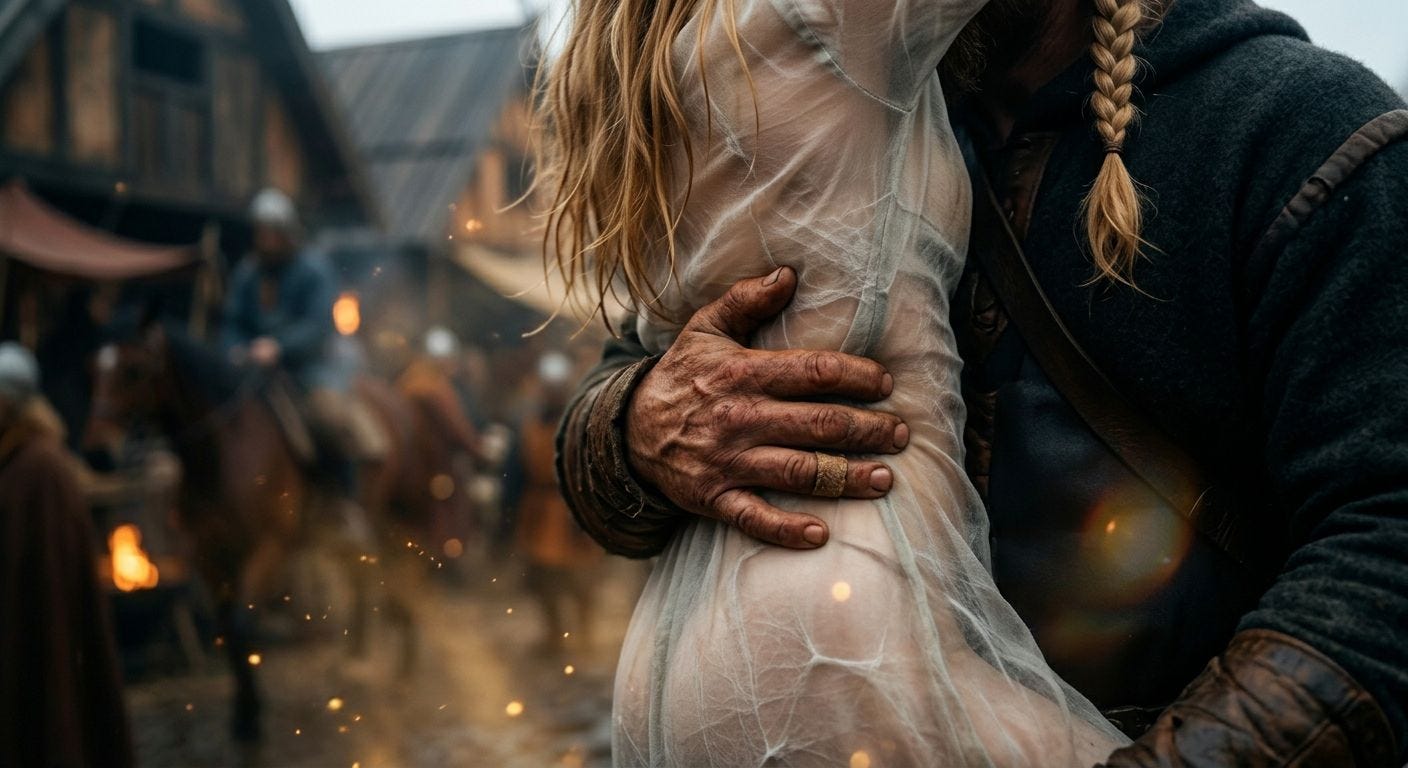
Gustav did not look away when Linde spoke her name. He didn’t rush forward either, which Linde found both impressive and deeply annoying.
A little urgency would be appreciated, her mind snapped, even as her heart hammered against her ribs. I am currently wearing a garment that has the structural integrity of a cobweb.
“Lower your eyes,” Gustav murmured in her tongue, his voice so low it was like the rumble of a distant storm. “They’re watching. Don’t give them a reason to tighten the noose.”
Linde obeyed, dropping her gaze to the mud, but her thoughts remained sharp. The dress was a disaster. It was far too sheer, clinging to her skin in the damp air and tracing every curve of her hips and thighs with agonizing detail. She felt like a specimen laid out on a dissecting board, and she hated the kind of study these men believed their eyes entitled them to.
But then, she looked at Gustav. He was the only man in the square whose eyes didn’t roam. He looked at her face: and only her face: with a fierce, protective focus that made her feel, for the first time in days, like a person rather than a prize.
Gustav turned his horse toward Marek, the Varangian commander. He didn’t draw his sword; instead, he leaned on the pommel of his saddle with a terrifying, casual familiarity.
“Marek,” Gustav called out, his voice smooth and dangerous. “You’ve grown bold since we last shared ale in the Southern Ports. I didn’t realize your ‘trading’ had extended to the daughters of kings.”
Marek’s face went pale, then mottled with a desperate sort of bravado. “Gustav. I didn’t know you were in the market for... luxury goods. I have a buyer from the South who has already promised a chest of silver for the blonde. She’s a rarity.”
“She is a death sentence, Marek,” Gustav replied, his blue eyes turning to ice. “And you are standing on a platform that belongs to the gallows. You have exactly three minutes to realize that the girl behind you is worth more dead than your entire crew is worth alive. Or,” he tilted his head, “we can discuss the ‘Stone Law’ right here in the dirt.”
Marek laughed, though it sounded thin. “The Stone Law? You have seven men, Gustav. I have twenty blades and a square full of merchants who want their prize.”
While Marek spoke, Linde saw Gustav’s hand move subtly behind his back. It was a series of quick, sharp finger signals. Two to the left. Three to the rear. Wait for the breath. He was orchestrating an ambush in plain sight.
The market, meanwhile, was descending into a bidding frenzy. “Seventy!” a man in silk screamed, his eyes raking over Linde’s form. “For the Khagan! She goes south!”
The handler behind Linde yanked her rope, dragging her forward. She stumbled, the dress riding up her thigh, revealing the pale, trembling skin beneath. A murmur of lust rose from the front row of buyers. Linde’s stomach turned. If I survive this, she thought furiously, I am going to invent a fabric that is opaque, heavy, and impossible to tear...
“Eighty!” Gustav’s voice cut through the air, louder now, carrying the weight of a decree. “For the Princess. And for the peace of your neck, Marek.”
“Please,” Linde whispered fiercely toward the horse. “The others. I won’t go without them. If you leave them, I’ll jump off the horse myself, I swear it.”
Gustav’s gaze flickered to her for a split second. “Wait,” he said.
Marek signaled his men to move the girls toward the buyers. Galina let out a sob as a handler claimed her rope. Linde’s control shattered. She wasn’t a little light elf; she was a sister, a healer, and a daughter.
“Now!” she begged. “Please!”
For the first time, Gustav looked directly at her face. “I know,” he said.
His fingers brushed her bound wrists, a light, deliberate touch that tested the tension of the hemp. Then, in a blur of movement that Linde’s eyes could barely track, steel flashed. The ropes at her wrists fell away, the fibers snapping with a sound like a small, final breath.
“Run toward the horses,” Gustav commanded. “Stay low. Try not to get stepped on.”
Linde didn’t wait. Chaos exploded.
At Gustav’s signal, his men unleashed a volley of short-range throwing axes from their cloaks, taking down Marek’s front line before they could even draw steel. One of Gustav’s men vaulted onto the platform, his axe singing a low, lethal song.
A guard lunged for Linde, his hands reaching for her waist. She didn’t scream. Instead, she remembered Andrej’s drunken lessons in the courtyard. She drove her knee up with surgical precision into the guard’s groin.
“That,” she hissed as he doubled over, “is for the dress.”
She seized a dropped club, swinging it with more enthusiasm than accuracy, striking blindly as she scrambled toward the horses. Shouts tore through the air. Arrows whistled. The adrenaline was a roar in her ears, making her skin feel electric.
She saw a rider haul Galina up; another grabbed Katrina. All of them.
Suddenly, Gustav moved his horse into her path. He didn’t just grab her; he leaned down, the sheer mass of him eclipsing the sun. His arm wrapped around her waist, hoisting her up into the saddle with a force that knocked the air from her lungs.
Because of the sheer dress, there was nothing between her skin and the rough, warm leather of his gauntlets, or the hard, unyielding iron of his breastplate. As he pulled her up, she was hauled flush against him. Her damp, nearly-nude body pressed against the heat of his chest, the thin silk of her dress offering no protection from the raw, masculine power of the man holding her. For a heartbeat, the danger of the market vanished, replaced by a sudden, dizzying rush of heat that had nothing to do with the sun. She could feel every muscle in his arm, the hard line of his thigh against hers, and the heavy thud of his heart.
“Hold on,” he growled, his voice vibrating through her entire body.
The horse surged forward. They tore through the market, hooves pounding, scattering stalls and screaming traders like leaves in a gale. Linde twisted in the saddle, her hair whipping into her eyes, her arms locking around his thick waist, her fingers digging into the leather of his belt. Being this close to him, feeling the friction of his movement against her bare legs, was terrifying and exhilarating all at once.
One. Two. Three. Four.
“We have them!” she yelled over the roar of the pursuit. “Everyone is present and accounted for! Also, your horse is breathing a bit heavy on the left lung: you should check his airways when we stop!”
Gustav didn’t answer, but she felt his chest vibrate with what might have been a huff of laughter: a deep, resonant sound that she felt against her own ribs: as they plunged into the safety of the dark, ancient forest.
🧠 Behind the Saga: Textiles as Armor and the Psychology of the Gaze
To understand Linde’s visceral reaction to the sheer dress, we have to look at the material reality of 10th-century Northern European clothing. In Linde’s world, a woman’s garments were literal and social armor. The standard dress consisted of a sturdy linen underdress (the særk) layered beneath a heavy wool apron-dress (the smokkr), physically anchored by massive brass or silver tortoise brooches. These garments were opaque, durable, and heavy. They were built for survival in a harsh climate, but they also communicated a woman’s status, her household wealth, and her autonomy.
By forcing Linde into a sheer, clinging silk “cobweb,” the kidnappers are doing more than exposing her body; they are deliberately stripping away her cultural identity. The dress is likely an import from the Byzantine or Arabic trade routes, a garment meant for a secluded court. It is a physical manifestation of her displacement.
When we view this through a behavioral and somatic lens, Linde’s horror becomes even more profound. We rely on the weight and texture of our clothing for proprioceptive feedback, the unconscious awareness of where our bodies are in space. For a woman accustomed to the grounding, stabilizing weight of layered wool and heavy metal brooches, being reduced to a whisper of sheer silk is an immediate shock to the autonomic nervous system.
This historical and somatic context elevates Gustav’s reaction in the square. The market operates on the visual consumption of the “exotic” and the vulnerable. The men bidding on Linde are participating in a culturally sanctioned erasure of her humanity, dictated by the costume she has been forced to wear. When Gustav leans on his saddle and looks exclusively at her face, he is actively refusing the visual narrative of the sheer dress. He does not buy into the illusion of the luxury slave; he offers her a mirror to her true self that allows dignity and safety. In a moment where her nervous system is stripped bare by a garment designed to humiliate her, his steady, focused gaze becomes a substitute for the armor she lost.
💭 Let’s Discuss in the Comments: History often views fashion through the lens of aesthetics, but for the people wearing the clothes, it is always a matter of function, status, and physical grounding. When you think about your own wardrobe, do you have specific garments that serve as “sensory armor” to help regulate your nervous system on high-stress days?