
They named him Lykos, a name that carried the sharp instinct of the forest and the melodic, ancient resonance of the Baltic woods. It was a name for a leader of the pack, short, striking, and echoing through the stone halls like a vow.
The first days after the birth were a blur of golden light and the sweet, milky scent of new life. In the quiet of the royal solar, the war felt like a distant memory. Linde spent her hours in a state of soft, heavy grace, her body recovering its strength as she nursed Lykos. Her skin, once taut and battle-ready, had softened into something luminous and ripe. Yet, in the quietest hours of the night, when the moon cast silver bars across the floor, her eyes would often wander to the empty space in the cradle beside him, the silent reminder of the twin who never drew breath. A phantom ache, a quiet salt-sting in the back of her throat that she only allowed herself to feel when the world was asleep.
Gustav was a constant shadow at her side. The fierce King, whose presence usually demanded the room’s oxygen, had been replaced by a man utterly enthralled, hushed by the sheer fragility of what they had created. He sat by the bed for hours, his massive frame hunched over the tiny bundle in Linde’s arms. He was exhausted, dark circles hanging beneath his eyes like bruises of devotion, but his face was transformed by intense, vulnerable joy.
“I never knew the world could hold something so small,” Gustav whispered one night, his hand resting on Linde’s shoulder as she leaned her head against him. His thumb traced the line of her neck, feeling the steady, rhythmic pulse of her life-force. “Or that I could be so afraid of my own hands touching him. I feel as though I am made of stone and iron, and he is made of starlight.”
“You created his home, Gustav,” Linde murmured, her eyes half-closed in a peace she had fought for in blood. She took his large, scarred hand and pressed it over her own, where it rested against the baby’s back. “ He knows he is safe because he feels the mountain behind him. He carries the strength of two, my love. One who walks with us, and one who watches from the stars.”
As the weeks bled into the golden haze of late summer, Gustav found himself caught in a new kind of fever. It was not the cold, hollow ache of the harrowing that had plagued him after the ambush, but a fierce, revitalized fire that left him breathless. He looked at Linde and saw a woman transformed, a creature of such staggering, lush beauty that it felt like a physical blow to his chest.
The clinical scientist he had first met was gone, and even the lithe, fierce witch of the grove had evolved. Her body was now a landscape of abundance. Her breasts were heavy and full, the blue veins beneath the translucent skin tracing a map of life. Her curves had softened, her hips widening into a fertile, womanly grace that made his hands itch to span them. Even her hair seemed thicker, a wild mane that smelled perpetually of milk, honey, and the lavender oil she used to soothe the babe.
He would sit in the shadows of the solar, ostensibly sharpening a blade or reviewing maps, but his eyes were constantly drawn to her like a moth to a flame. He watched her move with a soft, swaying economy of motion, her entire being absorbed in the tiny life of Prince Lykos. She spoke to the boy in a melodic tangle of tongues, bits of the North-speech, the fluid Baltic dialects of her father’s court, and the sharp, precise Latin of her studies, treating the infant as if he were a visiting scholar of the soul.
And she sang.
She sang constantly, her voice a low, vibrating silk that filled every corner of the room. It was the same voice that had commanded his very spirit in the cabin, the voice that had shattered into screams of pleasure in the white-heat of the grove. Now, that voice was channeled into repetitive, ancient lullabies, rhythmic and hypnotic. To Gustav, it was a beautiful torture.
He was still enchanted by the sound, but it drove him mad to realize that the invitation in her tone was no longer for him. It was a song of protection, not of passion.
He felt a desperate, starving longing for the woman he had known before the nursery, the one who had looked at him with a hunger that matched his own. Now, every time he reached for her, his large, calloused hand hovering over the silk of her shoulder, he would find her asleep mid-breath, her head lolling against the pillows in absolute exhaustion. Or, just as his fingers found the heat of her skin, the third heartbeat would interrupt with the insistent, bird-like cry of the Prince demanding his due.
He couldn’t touch her. He didn’t know how to navigate this new, sacred version of her without feeling like a desecrator. He stayed awake watching her sleep, a silent sentinel guarding the altar of a life he had helped build, but felt increasingly exiled from.
If Gustav’s love for his wife had become a desperate, worshipful fire, Linde’s love for her husband had become a vast, deep-water ocean. She moved through the solar in a haze of oxytocin and exhaustion, but every time she looked at him, her heart felt as though it might shatter from the sheer weight of her devotion.
She lived in the memory of the birth, the image of his scarred, wet chest acting as her living throne in the copper tub. The way he had breathed with her, anchoring her soul to the earth when the pain tried to pull her into the dark, was a debt she knew she could never repay. He had been her iron and her air. And when Lykos had finally drawn his first breath, Gustav had spoken a Skald for her, a warrior’s vow of such raw, bleeding vulnerability that it had shattered her soul and mended it back together all at once. She couldn’t think of those words now without the sting of tears prickling her eyes.
She loved him with a beautiful fierce intensity, a love that had evolved from the frantic hunger of their first fire in the cabin into something tectonic and permanent. Yet, she was also discovering a new universe of love through Lykos. It was a boundless, frightening expansion of her spirit; she had never known that her heart could beat outside her own body with such frantic, fragile strength.
But that expansion was shadowed by a hollow ache. For every smile Lykos offered, there was the ghost of the little one she had lost in the mud of the ambush. Her mother-grief was deeper than the sky, a silent, vertical drop that she navigated every single day.
She went almost daily to the royal garden to visit his small, hidden grave. She brought sprigs of chamomile for peace and yarrow for courage, laying them on the earth as she sang low, mourning lullabies to the child who would never hear them. In these moments of private shattering, Zora was her only witness.
Zora followed her like a sad moon follows a traveler. She would appear from the shadows of the oaks, her arms laden with new herbs for Linde to try or cooling salves for her healing body. In this massive life transition, Zora had become her rock, more than anyone else in the castle. They would sit by the small grave, talking and laughing until the laughter turned to sobs. Zora would hold her, her touch light and grounding, kissing the salt from Linde’s cheeks with a tenderness that required no explanation and no audience. Linde spoke of Zora to no one; their bond was a secret sanctuary, a feminine bridge across the valley of grief.
That evening, the late summer breeze was a warm caress against the skin. Seeking to wash away the heaviness of the day’s mourning, Linde and Zora walked to the secluded lake by the grove, the same waters that had held the magic of the Ladynės.
They stripped away their linens and slipped into the water, the surface like liquid silver under the rising moon. Linde laughed, the sound bright and clear, splashing Zora as they swam naked through the reeds. For a few precious moments, the weight of the crown and the ache of the nursery fell away.
Zora, enchanted by the melody of Linde’s laughter, was the first to notice the shift. The chorus of the crickets died. The night birds went suddenly, clinically silent. A sinister stillness overcame the lake, heavy and thick as a shroud.
“Linde...” Zora whispered, her voice a warning.
But the steppe shadows were already there. They moved with the silent horrifying grace of wolves. Before Linde could reach the shore, a massive, fur-clad figure lunged from the brush. Zora scrambled to intercept him, her hands clawing at the intruder’s face, but a heavy blow from a sap club caught her across the temple. She slumped into the shallows, the water turning dark around her head as she drifted into unconsciousness.
Linde was hauled from the water, gasping and shivering. The thick, felt-lined cloak was thrown over her naked, damp skin, the smell of horse-hide and grease filling her lungs as she was hoisted into the air.
Dusk had long ago bled into deep night before Zora stirred.
She clawed her way out of the reeds, her head throbbing with a sickening, rhythmic pulse. The water of the lake dripped from her hair, and her mind was a fractured mess of shadows and the brutal sound of the club.
She staggered toward the royal family’s private quarters, bursting into the chambers of Andrej and Laila. She collapsed against the doorframe, blood and lake-silt streaking her face, her breath coming in ragged, sobbing hitches.
Laila jumped from the bed, her hand instantly going to the dagger beneath her pillow. Andrej was upright a second later, his eyes sharpening as he saw the state of his sister’s companion.
“The Shadows... the Steppe,” Zora gasped, her voice a ragged, sobbing hitch. “They took her. They took Linde from the water. I couldn’t stop them.”
Andrej’s face turned into a mask of pure horror. He reached for his tunic, but Laila was already moving. She grabbed a shawl, her eyes meeting Andrej’s with a fierce, wordless understanding.
“Stay here,” Andrej told Zora, his voice tight.
Inside Linde’s chambers, the air was warm and smelled of beeswax and dried lavender. Gustav had fallen asleep on the heavy oak bed, his shirt discarded, his massive, scarred chest rising and falling in deep, rhythmic cycles. Lykos was curled into the crook of his arm, the babe’s tiny hand resting against the King’s collarbone, an image of fragile peace.
The door didn’t just open; it was thrown back with a violence that made the timber groan.
“Gustav! Wake!” Andrej’s voice was a whip-crack.
Laila stepped forward, her voice steady despite the adrenaline. “Kura’s men took Linde, Gustav. They took her from the lake. They are gone into the night.”
The silence that followed was louder than any scream. Gustav stared at the spot where his wife had lain, the scent of her lavender and milk still clinging to the furs. Beside him, Lykos, startled by the violence of the movement and the sudden, jagged energy in the room, began to cry. It was a sound of inconsolable distress. Gustav stood, his body shaking with a primal rage, his eyes turning into pits of black ice.
Without a word, Laila moved to the bed and took the screaming Prince. She opened her shift, guiding Lykos to her breast. As the boy finally settled, finding comfort in the milk of another nursing mother, Gustav turned toward the door, he walked out of the solar, the floorboards groaning under the weight of a man who was no longer a King, but a monster of the North, beginning a hunt that would not end until the world was ash or his wife was returned.
Linde awoke to the jarring, rhythmic thud of hooves and the smell of old smoke. Her head throbbed where she had been forced down, and her skin: still damp and chilled from the lake, shivered beneath the heavy, scratchy wool of the Pecheneg cloak.
But the physical pain of the kidnapping was nothing compared to the agony in her chest. Hours had passed. Her breasts were rock-hard and engorged, the skin stretched so tight it felt as though it might split. Every jolt of the horse sent a white-hot spike of pain through her, a biological scream for the child who wasn’t there to drain the heat.
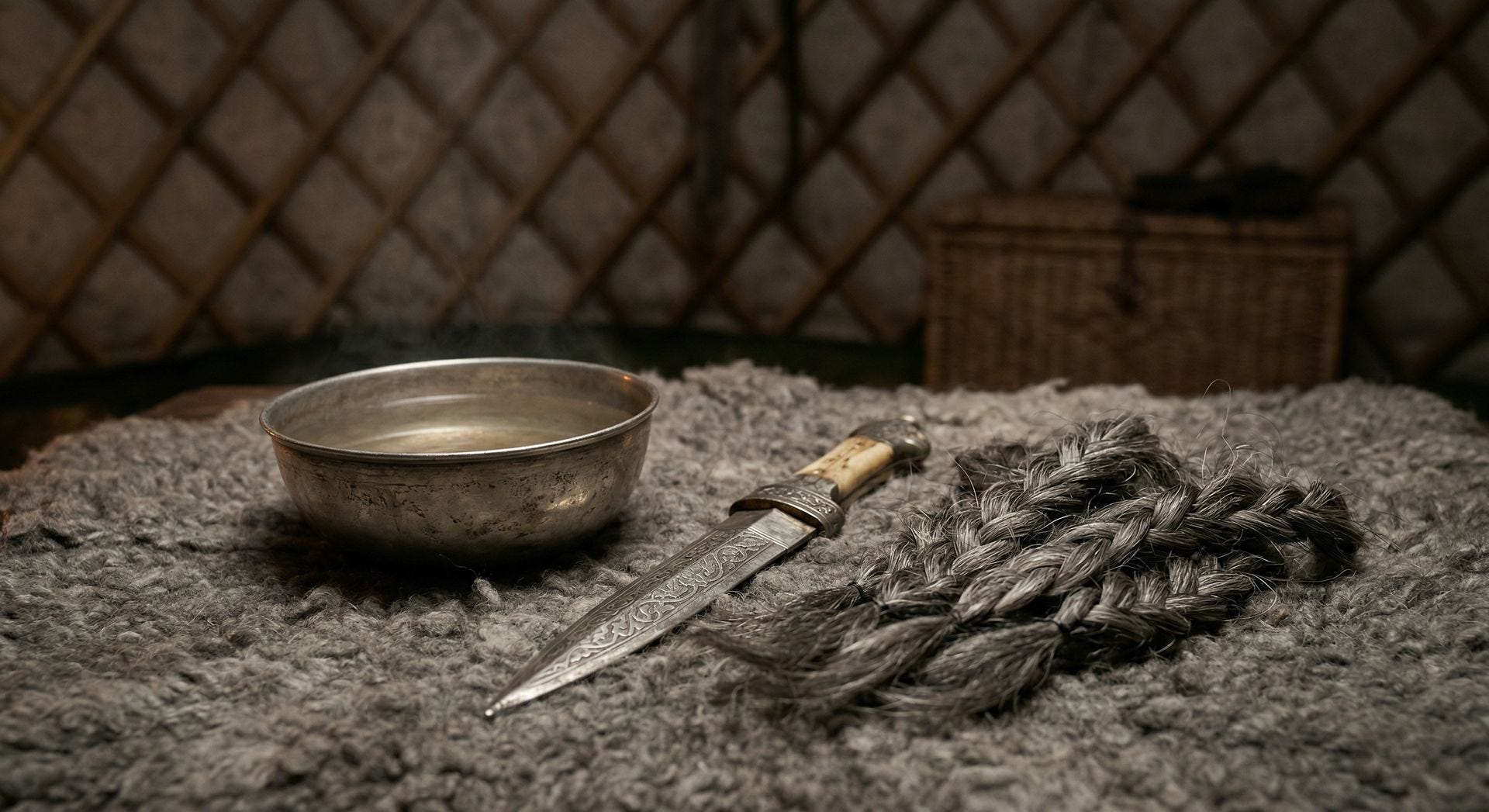
When the horse finally stopped, she was hauled down and led into a large, circular ger. The air was thick and humid, a pressurized atmosphere of woodsmoke, old grease, and the sharp, fermented tang of kumis. The walls were a circular lattice of willow wood, the “bones” of the house, covered in layers of thick, matted grey sheep’s wool that swallowed sound, making every word spoken inside feel intimate and heavy.
In the center of the floor stood the toghun: the hearth. It was the heart of the world. Dried dung and birch branches burned in a low, concentrated orange glow, the smoke rising in a thin ribbon toward the toono, the circular opening in the roof that revealed a glimpse of the cold, indifferent stars. Beneath Linde’s bare, chilled feet were layers of hand-woven rugs and pelts: wolf, fox, and thick-piled sheepskin: that retained the day’s heat. Around the perimeter, low chests of cedar and iron held the tribe’s wealth, and harnesses of etched silver hung from the lattice, catching the firelight like cat’s eyes.
“You may stand or you may kneel, but you will remain silent until you are addressed by one who has the right to judge you,” a woman’s voice commanded.
The dialect was startling; it was the polished, rhythmic Court-tongue of the Eastern kingdoms, spoken with the haughty, effortless precision of someone born to rule.
Linde squinted as the cloak was pulled back. A woman stood over her, looking to be of Linde’s own seasons, with sun-darkened skin and eyes like polished flint. She wore a tunic of embroidered silk over trousers, her dark hair braided with silver coins that chimed as she moved. Linde swayed on her feet, clutching her arms over her chest to stifle the throbbing pain, and looked at the woman with a scientist’s cold, analytical stare.
“Your dialect is nearly perfect,” Linde said, her voice a raspy whisper as she leaned into the same tongue. “You speak it with the grace of a princess, though your clothes smell of horse-hide and woodsmoke. Who taught a daughter of the Steppe to speak the tongue of my father’s court?”
The woman paused, a flicker of surprised pride crossing her face. She answered in the same dialect, her voice sharp as a blade. “My father, Kura, knows that to eat the world, one must first speak its secrets. I am Aykhan. And you are the woman who put my brother in the ground.”
Linde’s breath hitched. The mention of the boy brought a wave of heavy, crushing sorrow. She closed her eyes for a second, the image of the young Pecheneg falling in the mud haunting the back of her eyelids.
“I am,” Linde whispered, switching seamlessly to the Pecheneg tongue, her voice thick with a genuine, heavy grief. “And there is not a night where his face does not visit my dreams... I am a healer. I was born to mend life, not to steal it. But he would have taken my husband, and I... I could not let the world go dark.”
Linde stepped closer to the hearth, letting her arms drop. The damp circles of leaked milk had soaked through her fine linen tunic, stark and undeniable in the firelight.
“In two hours, this milk will turn to fire in my veins. I will be delirious. In four hours, I will be dying. If I die in this tent, my husband and my brothers will erase the memory of your people from the Steppe. Is your father’s justice worth the extinction of your tribe? Because he is already on his way, and he does not negotiate with the dead.”
Aykhan looked at the leaked milk, her flinty gaze softening into a recognition of the nursing pain that transcended borders. “You have a baby,” Aykhan whispered.
“I have a son who is currently screaming for the milk that is killing me,” Linde snapped, her voice breaking. “And unless you want to explain to Kura why his camp is burning because of a blood-feud that should have ended with the first snow, you will help me.”
Aykhan stood silent, then grabbed a wooden bowl of warm water and a clean cloth, setting them down with a decisive thud. “Clean yourself. Relieve the heat. We will talk while the moon is high. I also have a child in the next tent who would find the world very cold without his mother.”
As the steam rose from the bowl, Linde worked with shaking hands to relieve the agonizing pressure. The relief was almost as overwhelming as the pain had been. Aykhan sat across from her, watching with a guarded curiosity, her own posture softening as the shared reality of motherhood settled between them.
“You speak of my brother with a heavy tongue,” Aykhan said quietly, her voice barely rising above the crackle of the birch-fire. “My father says you took his life to boast of it. He says you are a witch who drinks the spirit of the fallen.”
“Your father sees what he needs to see,” Linde replied, her emerald eyes reflecting the hearth-fire with a weary intensity. “I did not kill for the sake of the hunt. Taking your brother’s life was a debt I never wished to incur, but he sought to take my husband’s light. Tell me... what was his name? The name his mother gave him before the world called him a warrior?”
Aykhan’s gaze softened. “His name was Temur. It means iron.”
“Temur,” Linde whispered, a single tear tracing a path down her cheek. “I am the woman who put Temur in the ground. But the price I paid for that choice was not just your brother’s ghost. It was the life of my own child, killed by your father’s own hand.”
Aykhan froze, her hand hovering over the coals. “What are you saying?”
“When the ambush began, it was Kura himself who rode me down,” Linde said, her voice dropping to a low, trembling vibrato of grief. “He swung his blade at me, he threw me from my horse like I was nothing but a pelt. I hit the earth ... I was pregnant with twins. My son, Bjorn, died in the dark before he could ever see the sun because your father’s steel struck me down. I spent weeks in a grey world, wishing I had gone into the earth with him. My husband... he was shattered.”
The silence in the tent became heavy and sacred. Aykhan looked at Linde and saw a mother who had paid a blood-price equal to her father’s own. The iron queen was gone, there was only a woman who knew the specific, hollow ache of a child-shaped hole in the heart, placed there by Kura himself.
“My father... he has never spoken of this,” Aykhan admitted, her voice trembling. “He spoke only of the witch who murdered his son. He did not say he had taken a life in return.”
“Because men like our fathers call it ‘war’ when they kill our children, but ‘murder’ when we defend our husbands,” Linde noted. She reached across the space, her damp hand finding Aykhan’s. “But you and I, we speak the tongues of many worlds. We know that mothers share a place that men cannot conquer. Help me return to my son, and I promise you, I will stay my husband’s hand. We can forge a peace that our men are too proud to find.”
Aykhan looked at Linde’s hand, then toward the tent flap where the shadow of her husband, Targutay, stood guarding the entrance. A new, fierce light entered her eyes.
“My father is returning from the Southern ridge. He is coming for his justice for Temur,” Aykhan said, her grip tightening on Linde’s hand. “But he has already taken his justice in your son’s blood. If we are to do this, we must do it now. My husband took you to win my father’s favor... but I will make him see that he has only won a grave for our own child if he stays this course.”
The escape was a ghost-dance through the camp. Aykhan had used her authority to send the perimeter guards to the horse-lines, claiming a wolf had been sighted near the foals. Together, they slipped through the shadows, Linde draped in the heavy Pecheneg cloak to hide her pale skin and the damp, tell-tale stains of her struggle.
At the edge of the camp, they found Targutay. He stood by two saddled ponies, his hand on his saber, his expression a mask of conflict.
“Aykhan,” he whispered, his eyes darting toward the camp. “This is treason. Your father will have my head for this.”
“If you stay, the Northmen will have your head, and mine, and our son’s,” Aykhan countered, her voice low and fierce. “They are coming, Targutay. Monsters of the ice, will not stop until this camp is ash. Help her, or you have already signed our death warrant.”
Targutay looked at his wife, then at the Queen. He saw the desperation and the shared maternal fire between them. He nodded once, a sharp, military motion.
“Ride East,” he commanded, handing the reins to Linde. “There is a path through the Black Oaks that leads... “
A sound of low bone-chilling horn shattered the night.
“Kura,” Targutay breathed, drawing his saber.
A troop of riders crested the ridge, their torches flickering like angry stars. At the head was a figure of pure, concentrated grief and iron. Kura. He spurred his horse forward, the beast skidding to a halt in a spray of dirt just yards from where they stood.
“Treason in my own house?” Kura roared, his voice thick with the gravel of age and rage. He looked at Linde, his eyes narrowing. “You would let the son killer go, Aykhan? You would spit on Temur’s spirit?”
Aykhan stepped in front of Linde, her chin lifted. “I would save your grandson’s life, Father! Look at her! She is not a trophy. She is a mother who has already paid the debt you claim she owes.”
Aykhan turned to her father, her voice cracking with a truth he hadn’t yet faced. “You told the tribe she was a witch who murdered Temur for glory. You did not tell us that when you rode her down at the river, your blade stole the life from her womb! You have already taken a son for a son! The blood is equal!”
Kura let out a jagged, broken growl, raising his whip. “The blood is never equal! My son was the sun of the Steppe!”
“Will you burn the world until there is nothing left but ghosts?” Aykhan shouted back, refusing to flinch. “If you kill her, her family will come for us, come for our extinction. Do you want your grandson to inherit a kingdom of salt and charred bone?”
Linde stepped forward, pulling back the heavy hood. She looked Kura directly in the eye, her emerald gaze steady despite the exhaustion and the cold. She spoke in her own tongue first, her voice a low, melodic chime of authority, while Aykhan translated with a fierce, rhythmic intensity.
Aykhan translated: “Great Khan, hear the mother of the North.“
“I know the weight of the salt you carry,” Linde continued. “I taste it every night when I think of my son your steel took from me.”
Aykhan’s voice grew thick as she echoed: “She carries the ghost of the son you slew, just as you carry Temur. She knows the taste of your mourning.“
Linde reached into the Pecheneg tongue herself for the final plea, her accent rough but her intent crystal clear. “I do not ask for mercy, Kura. I ask for wisdom. Take the hair cutting vow. Let the feud die with the children we have already buried. Let your daughter’s son grow up in a world where he does not have to sleep with a blade in his hand.”
Kura’s hand trembled on the reins. He looked at Aykhan, his only remaining child, and saw that if he struck Linde, he would lose his daughter’s heart forever. He looked at Linde and saw the damp linen of her tunic, the physical mark of a mother whose body was screaming for her child. He was a man of blood, but he was also a man of the Steppe, where balance was law. He had taken a son, he had lost a son. The scales sat heavy and still.
With a guttural cry that sounded like a wounded animal, Kura reached for the small, silver-etched dagger at his belt. With a swift, violent motion, he hacked off his long, grey-streaked braids, the ultimate sign of a warrior who has finished his mourning and closed the book of blood. He threw the hair at Linde’s feet.
“Go,” he rasped, his face a mask of ancient exhaustion. “Before the ghosts change my mind. Tell the Northmen that the debt is settled. Tell them the Steppe does not want blood... only peace.”
The ride back to King Artemij’s castle was a blur of physical exhaustion and the biting, pre-dawn wind. Linde rode the Steppe pony with her jaw set, the heavy Pecheneg cloak fluttering behind her like a dark wing. Behind her, Kura’s honor guard followed: a silent, somber escort that served as a living testament to the hair-cutting vow.
As the first bruised light of morning touched the massive timber battlements of the hillfort, the gates were already thrown wide. The courtyard was a hive of lethal, vibrating activity. Hundreds of torches flickered, illuminating the glint of mail and the sharpened edges of Dane-axes. King Artemij’s army stood in disciplined ranks alongside Gustav’s wilder huscarls; a combined force of such overwhelming magnitude that the air itself seemed to hum with the promise of a massacre.
In the center of the chaos stood the men of her life. Her father was a statue of silver and stone. Beside him, her brothers paced like caged wolves. They were distraught, their faces etched with the raw lines of men who had spent the night mourning a sister they feared was already a ghost.
And then, there was Gustav.
He looked like a creature of myth, a god of the frost who had forgotten how to be human. He was unarmored, his shirt open, his massive chest heaving with a rhythmic, tectonic fury. He held his great axe in a grip so tight his knuckles were the color of bone, his eyes fixed on the forest road with an intensity that kept everyone at a distance.
When the small troop of Pechenegs crested the rise, a roar went up from the gathered armies. Gustav started walking, each step was heavy, deliberate, and final. He was the monster of the North once more, a man who had already burned the world to ash in his mind.
Linde spurred her pony forward, breaking away from the escort. “Gustav! Hold!”
The King froze. His eyes, which had been pits of black ice, fractured. As Linde slid from the horse, her legs nearly buckling, Gustav dropped his axe. He reached her in three strides, his arms wrapped around her with a violent, shaking desperation, holding her so tight the pressure of his massive chest against her bruised ribs actually hurt, but she welcomed the pain: it was the weight of the world coming back into balance. He was trembling, a deep, visceral shudder that shook his entire frame. He smelled of cold air and the metallic tang of unsheathed iron. He began to kiss her everywhere, her forehead, her salt-stained cheeks, her matted hair, his breath coming in jagged, terrifying gasps that broke into open, unrestrained sobbing.
“I thought the world had gone dark,” he rasped, his voice a broken thing. “I was going to leave nothing but salt and bone, Linde...” As he pulled her closer, his hands moved over her body with a frantic, possessive need to ensure she was whole. He felt her trembling, her skin chilled by the ride, and he felt the heavy, rock-hard weight of her engorged breasts against his chest. The realization of her physical suffering, the biological agony she had endured for their son while in the hands of his enemies, ignited a fresh wave of protective fury.
“I am here,” she whispered, anchoring him. “The war is over, Gustav. The feud is dead.”
He pulled back, his hands framing her face with a terrifying pressure. He searched her eyes, looking for the trauma, the hurt, but he found only the fierce, luminous clarity of the woman who had negotiated with ghosts.
“Kura has taken the hair-cutting vow,” she said, her voice rising so her father, her brothers, and the gathered armies could hear. “The blood-debt for his son is settled by the debt of our son. There will be no more raiding. There will be peace.”
Gustav’s head snapped up, his eyes flashing toward the Pecheneg guard. The monster within him fought back. “Peace? They laid hands on the Queen of the North! I will have their heads for every hour you were gone!”
“No,” Linde said, her voice turning into the steel of a Queen. She took his large, shaking hand and pressed it over her heart, over the damp linen of her tunic. “Look at me, Gustav. Do not give Lykos a kingdom of ashes. Do not make him spend his life looking over his shoulder because you were too proud to stay your hand. Aykhan, Kura’s daughter saved me.”
Gustav’s chest heaved, his gaze darting between the enemies he wanted to slaughter and the wife who was the only reason he drew breath. He looked at her exhaustion, her pale face, and the fierce mother-right in her eyes. The monster slowly receded, leaving only the husband who worshipped her.
“For you,” he whispered, a vow more sacred than any Skald. “Only for you.”
He turned to the host, his voice regained its kingly resonance. “Sheathe your blades! The Queen has spoken! There is peace!”
They rushed inside to the solar. Laila was there, her eyes red with relief, holding Lykos. As Linde took him, the boy let out a small, breathless hiccup and latched with a desperate, frantic hunger.
Linde sat by the hearth, the warmth of her father’s castle finally seeping into her skin. Andrej, Vlad, and Miro stood in the doorway, their faces softening. Gustav, however, did not move. He sank to the floor at her feet, resting his heavy head against her knee, his hand covering both her and the child. He was silent, his fingers tracing the hem of her Pecheneg cloak, as if making sure she wouldn’t vanish into the mist again.

🧠 Behind the Saga: New Parent Paradox, The 10th Century Pechenegs vs Vikings, and The Ancient Female Power
In our modern world, we might label Gustav as distant or assume the romance is dead. But anthropologically, Gustav is struggling to transition from the Lover to the Father. He is terrified that his passion will break the fragile new world they have built. It is a profound, tragic disconnect that requires an entirely new language of intimacy to heal.
When Gustav is paralyzed by his own identity crisis, Linde does not shatter, because she is held by Zora. Zora represents the ancient Somatic Village. As clinical sexologist Dr. Stephanie Gamache and I discuss in our upcoming project, The Connection Paradox, our ancestors relied on these deep, communal networks of women to co-regulate their nervous systems. Zora offers friendship, support, but most importantly, she offers Linde physical presence, herbal medicine, and a shared space for grief. Zora is the cultural container that allows the Queen to survive.
In modern, Western society, the nuclear family is often isolated and mothers are expected to handle the grueling, physical transition of postpartum life—and the crushing weight of grief—entirely alone or solely with a partner. But historically, this isolation did not exist.
And here is another powerful female connection that changes everything: the encounter between Linde and Aykhan is rooted in the brutal, pragmatic reality of 10th-century Steppe warfare. The Pechenegs were a semi-nomadic Turkic people who controlled the lands north of the Black Sea. Their conflicts with the Rus (Eastern) and Norse (Northern) viking tribes were legendary, defined by quick, devastating cavalry raids and strict codes of blood-feud.
However, while Gustav and Kura are locked in an endless cycle of retaliatory violence, Linde and Aykhan (Kura’s daughter) find a solution through the shared, visceral reality of motherhood. It is a testament to how historical women often wielded immense diplomatic power, using empathy to sever the blood-feud and force the men to take the hair-cutting vow to preserve the peace of both families.