
Morning did not bring clarity. It brought the stale confirmation of a nightmare that had slept beside them all night and woke up hungry.
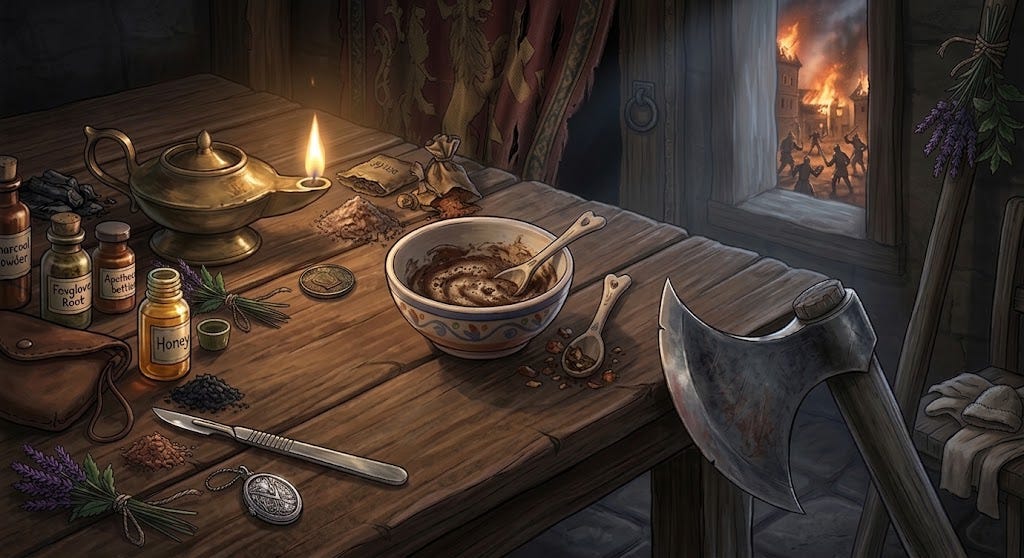
King Erik’s chamber was too warm for the cooling autumn air, the atmosphere thick with old breath and unwashed linen. The shutters had been drawn tight, sealing in the stink of sickness the way men sealed rot in a barrel and pretended it was preservation. Sweat soured the furs. A metallic tang haunted the back of Linde’s throat: not blood, not quite, but something sharp and wrong, like a coin held too long on the tongue.
Poison, her mind supplied, calm as a scalpel.
She stood over the bed and pressed her fingertips to the soft glands beneath Erik’s jaw. His skin was wet parchment stretched over bone; his pulse was not the slow ebb of a dying man but the frantic stutter of a body under siege. It leapt, faltered, leapt again.
Her heart sank, and then: hotter: something else rose. Fury.
“Copper-root,” she whispered.
Gustav stood at the foot of the bed with the stillness of an iron statue. He hadn’t slept; she could see it in the tightness around his eyes, the way his jaw held itself as if any movement might snap it. He didn’t carry a sword. Instead, his massive hands were wrapped around the long, ash-wood haft of his Dane-axe. The broad, crescent-shaped blade rested against the stone floor, a heavy weight of tempered steel that looked capable of splitting a horse in two.
Linde swallowed and forced her voice to stay clinical. “It’s a slow-creeping venom,” she said, more steadily now, turning to face him. “Weeks of it. In broth, in wine: small doses so the symptoms mimic wasting. A sickness of the gut. An old man’s decline.” Her fingers curled reflexively. “But it isn’t decline. It’s murder. Calculated. Patient.”
Gustav’s teeth ground once: quiet, rhythmic. It was the only sound he made, and it terrified her more than a shout.
Linde leaned over Erik again, pulling back the thin lids. The tongue was too dry. The kind of dehydration that didn’t come from illness alone, but from neglect. They didn’t just poison him; they had starved him of the very care he had once provided for the whole North.
She looked up at Gustav. “They’ve been hollowing him out while he slept.”
For a moment Gustav didn’t answer. Then, very softly: “Who.”
Not a question. A vow.
Linde cleared the small apothecary table with swift, practiced movements. Her mind narrowed into triage. Bind it. Draw it. Buy time. “If I can get him to swallow this,” she murmured, “we can bind the poison before his heart fails. But he’s so weak.” She felt Gustav behind her, close enough that warmth pressed faintly at her back. “My love... he’s so weak.”
“Then make him stronger,” Gustav’s reply came like a low edge of steel.
Linde nodded once. She lifted Erik’s head carefully. “Erik,” she whispered close to his ear. “Open your mouth. For Gustav. For the North.”
His eyelids fluttered. And then, impossibly, his gaze found her. It was only for a heartbeat, a thin slice of awareness cutting through the drug-haze, but in that heartbeat, he recognized Velena’s hands.
“Linde,” he rasped.
Her throat tightened. “Yes. I’m here.”
“Rot,” he whispered. “In... my... hall: “
“I know,” she said, fierce now. “Drink.”
He swallowed. Once. Twice. Linde exhaled shakily and reached for the second mixture when a dull vibration shuddered through the floorboards.
Boots. Hundreds of boots on stone.
Gustav’s head lifted sharply. The vibration grew louder. A march. A tide. Then a horn blast shredded the quiet. A woman screamed in the courtyard below.
Hugo slammed the doors open so hard the iron latch screamed. His blade was drawn, Northman blood striping his leather gambeson dark. “They’re in the keep! The West gate was opened from within, Council men. They’re cutting down anyone in a royal tabard!”
Gustav moved. The still statue vanished. He shifted his grip on the Dane-axe, the heavy blade catching the dim light.
“Linde,” he roared. “Take Lykos.”
Her breath caught at the name. Their son, hardly four months old, a tiny bundle of warmth and soft exhales.
Gustav’s eyes found hers, no softness now, only command and fear braided into one. “The tunnel. Behind the tapestry. It runs to the forest floor near the lake. Run for the cabin. Do not stop for anyone, not even if you hear my voice.”
Linde’s heart lurched. She crossed to the cradle, hands shaking only for a breath before instinct took over. She wrapped the infant in thick furs, pressing his four-month-old weight to her chest.
Another crash sounded in the corridor. Shouting. A wet, choking sound.
Hugo stepped closer. “Go. I’ll buy you...”
A thunderous impact shook the doorframe. Gustav shoved Hugo toward the corridor and stepped into the breach, his great axe held ready. “Hold.”
Hugo’s grin was all teeth. “Always.”
Linde dove behind the tapestry and pulled the iron ring. A hidden door yawned open. Behind her, the outer chamber doors splintered with a deafening crack. Gustav’s roar erupted, animal, furious, followed by the first terrifying crunch of his Dane-axe finding its mark.
Linde didn’t look back. She stepped into darkness and pulled the door shut.
The tunnel was a throat, wet stone and salt. Linde ran, one hand skimming the wall, the other locked around Lykos. Above her, the keep shuddered with violence.
She burst out into the trees. Behind her, the Heart of Stone burned, bright orange flame smudging the stars. She ran, needles slick beneath her boots.
Lykos squirmed against her chest. A small sound escaped him, thin, frantic. Linde’s blood iced. “Hush,” she whispered, pressing her mouth to his fur-wrapped head. “Please, my heart.”
She reached the edge of the Great Lake. Mist rose from it in ghost ribbons. Linde stopped. The forest went silent.
A figure stepped from behind a massive oak. Not a Northman. He wore dark foreign leathers and a curved shamshir hung at his hip. He simply watched her with a calm that made the hair at her nape rise.
Linde’s feet slid back, heel catching on the edge of the pier. She adjusted her stance, body angled to shield the infant. The man took one slow step forward. His hand lifted, empty, open.
“I will not let you have him,” she said.
The man’s accent was like a knife wrapped in velvet. “You do not decide.”
“Oh,” Linde whispered, a sharp edge of ice forming around each syllable, “I decide everything.”
She looked over her shoulder at the lake. Black. Freezing. Merciless. And clean.
The man lunged. Fast.
Linde didn’t scream. She took one final breath, tucked the baby tighter against her heart, and stepped backward into the void.
The freezing water rose up and swallowed them whole. The world became dark. The last thing Linde heard before the lake closed over her ears was her own pulse roaring, furious, alive.
🧠 Behind the Saga: The Anthropology of Poison, Isolation, and the Somatic Plunge
Chapter 42 shifts the Firebound saga from open warfare back into the claustrophobic, lethal politics of the court. The true danger in this chapter creeps in through the tea leaves and the barred doors.
In 10th-century courts, assassination was rarely a spectacle. The most effective poisons were those that mimicked natural biological decline. “Copper-root” is used here as a slow-creeping venom that induces symptoms of an old man’s wasting sickness—dehydration, erratic pulse, and a slow shutting down of the organs.
Notice how Linde diagnoses the King. She doesn’t rely on a single visual cue. Her hyper-systematized, neurodivergent mind processes the entire environment: the stale smell of the unwashed linen, the wet parchment texture of his skin, and crucially, the sharp, metallic taste in the back of her own throat just from breathing the air. Ancient healers relied heavily on these acute sensory inputs to detect the invisible chemical warfare of the era.
In The Connection Paradox, my joint collaboration with clinical sexologist Dr. Stephanie Gamache, we explore how cultural anthropology intersects with nervous system regulation. Ancient societies understood that human beings shatter under isolated trauma.
By sealing the King away under the guise of “holy rest,” the conspirators are actively starving his nervous system of communal co-regulation, family presence, and somatic safety. The lack of fresh air and touch accelerates his physical decline just as much as the venom does. It demonstrates a core concept of our collaboration: systemic isolation is an unnatural, lethal state for the human animal.
The sudden appearance of the man at the pier shifts the geopolitical landscape of the entire saga. He does not carry a broadsword or a Norse seax; he carries a shamshir—a curved blade native to the Southern and Eastern empires (like the Aurelian League or the Caliphate). He wears scale-leathers and speaks with a polished, “velvet” accent. This detail reveals that the coup in the North is not just a localized clan dispute. The deep, isolated fjords of Gustav’s kingdom have been breached by globalized, mercenary forces.
When cornered at the edge of the pier, Linde is faced with an impossible binary: surrender her son to the smooth, controlled threat of the assassin, or step backward into the violent, freezing chaos of the Great Lake.
Her decision to step into the void is an act of ultimate somatic autonomy. In a culture that tries to optimize away all friction, Linde actively chooses the brutal, unpredictable friction of the elements over the transactional captivity offered by the mercenary. She trusts the merciless, “clean” reality of the freezing water over the corrupted logic of men.