
The three-day siege of the North Castle ended not with victory, but with a hollow, ringing exhaustion. By dawn of the fourth day, the fires were beaten down and the last armed conspirators were dragged from cellars and hidden stairwells in chains. The castle had not fallen.
Gustav stood in the center of the courtyard, his Dane-axe hanging from a hand that felt like iron filled with sand. Smoke had burned his eyes into raw, red pits. Blood, and thick, belonging to men he had once called brothers, was crusted deep beneath his nails.
He fought because stopping meant thinking, and thinking meant asking the one question he could not survive: Where is she?
When the final flames were beaten down and the castle exhaled a jagged, uneasy silence, the answer did not come. No Linde. No cry of a child. Only the groan of wounded men and the rhythmic crack of settling, heat-blasted stone.
“Hugo,” Gustav said, his voice a hoarse, unrecognizable rasp. “Prepare the horses.”
Hugo turned, and the world tilted. His face was a mask of ash and pale terror, his jaw set in the way it only ever was before a slaughter.
“Gustav...” Hugo began.
Gustav took a step forward, his shadow looming long and predatory. “She’s at the cabin. She would have gone straight to the lake.”
“Yes,” Hugo said, his voice cracking. “That is what we believed. But the scouts... they found a man near the pier. A foreigner. Scale-leathers. Not Council.”
Gustav’s pulse began to hammer against his ribs like a trapped bird. “And?”
“He says he cornered a woman with a child at the water’s edge.” Hugo swallowed, the sound loud in the dead air. “He says... she took a single breath, tucked the boy to her heart, and vanished into the deep.”
Something inside Gustav tore loose: a silent, internal shattering. He did not speak. He mounted his stallion in a single, violent motion and rode.
He rode as if speed alone could undo the past three days.
The cabin door splintered beneath his shoulder. “LINDE!”
The hearth was cold, the bed untouched… and the air held no trace of her milk-and-pine warmth. The silence pressed in like a burial shroud.
“No,” he whispered, the word a ragged ghost.
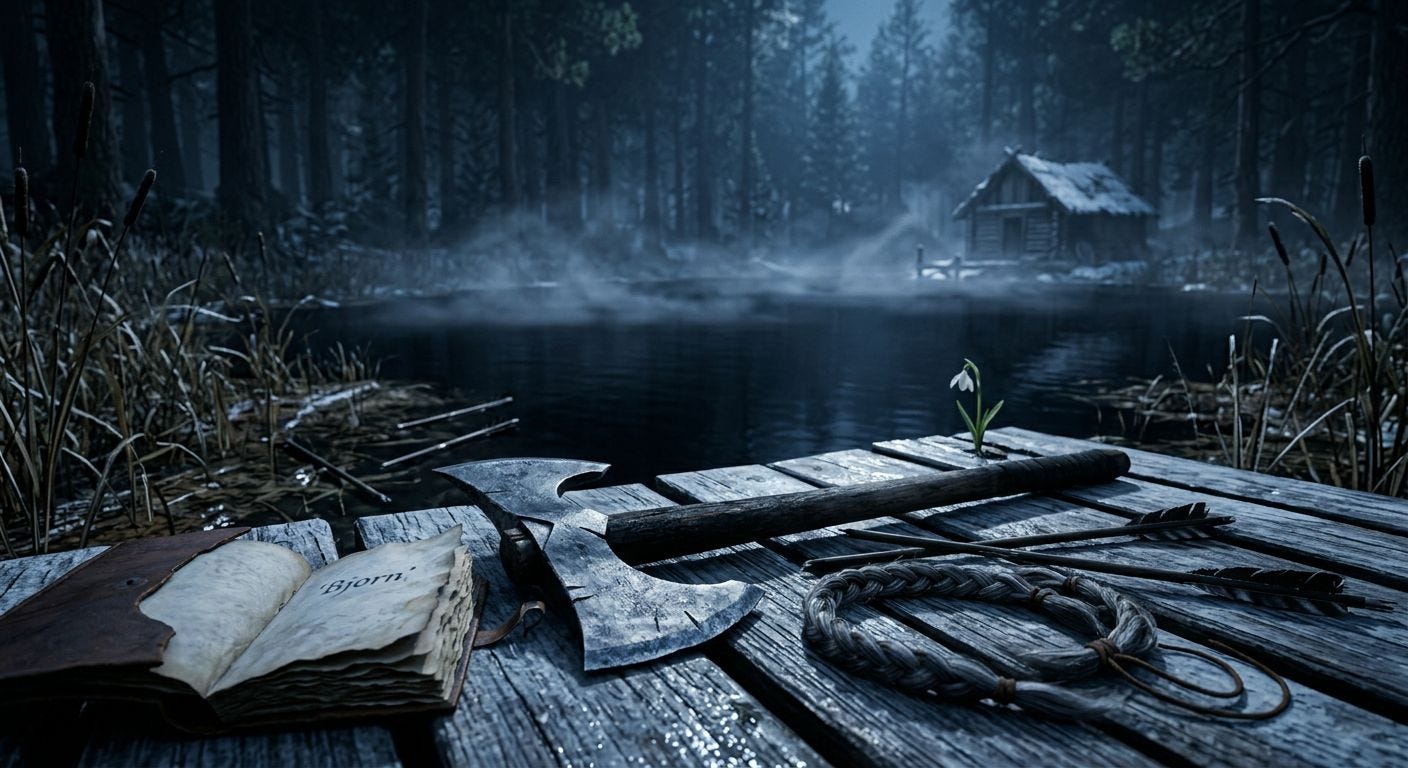
He rode back: past the staring, hollow-eyed soldiers, down the stone steps to the water-gate where the Great Lake spread black and endless. He walked to the edge of the frost-slick pier. The water stared back, unbroken, cold and silent. The urge to plunge into that black silk and never come up rose like a physical force.
A sound tore out of him then, a primal, shattered howl that echoed off the mountains.
“Gustav! Stay your hand.”
Sael stepped into the moonlight, their ancient eyes reflecting neither pity nor fear.
Gustav turned, his eyes wild and dangerous. “If she is in that water, I am going in after her.”
“She is not,” Sael said simply.
The words hit him like a physical blow.
“What?”
“She did not jump blindly,” Sael continued. “And she did not die.”
Linde had not surrendered to the lake.
As the stranger had lunged, her mind had split: the mother was screaming, but the healer was calculating. Current direction. Depth. Thermal shock. She had bound Lykos to her chest with shaking hands, the linen crossed and knotted with the precision of a field dressing.
Hold him above the water. Break the surface once. No more.
The cold struck like a thousand knives. Shock stole the air from her lungs as she hit the black void. For a heartbeat, her muscles locked in a death-cramp, and she thought she had murdered them both.
Then instinct overrode the pain. She surfaced once, gasped, and let herself sink again, angling her body, kicking weakly but deliberately away from the pier. The lake swallowed all sound. Time became a blur of freezing pressure. When her hands finally struck mud and reed, she dragged herself forward on raw will, collapsing on the bank, retching lake water and terror.
“Lykos,” she gasped, her fingers tearing at the wet wraps.
A tiny, furious, high-pitched wail answered her.
Alive. Cold, but alive. She pressed her forehead to his and laughed. It was a broken, breathless sound. She could not reach the cabin on her own, the Council’s scouts would be watching. Her limbs shook with the onset of ague. So she ran, staggering, half-blind through the pines, to the one place no traitor would think to look - the old midwives’ refuge in the rock.
And Sael was there, waiting as if the dark itself had delivered her.
When Sael finished the tale, Gustav was shaking. “She’s alive,” he said, testing the weight of the words. “You swear it on the earth.”
“The Queen is safe,” Sael said. “The Prince is warm. She vanished exactly as she intended. She is the moss in the fissures, Gustav. She endures.”
Relief hit him so violently his knees nearly gave way. “Take me to her. Now.”
Sael did not move. “The blades are quiet, The walls are ours. But the hands that opened the gates are still walking free... Nobody in that castle is to be trusted. They believe her dead. For her safety, let them believe it.
Gustav’s voice dropped to a snarl. “I don’t care what they believe. I want my wife.”
“And you will have her,” Sael replied, their massive presence unyielding. “But not as King. For now, the King must mourn in public so the vipers feel secure. While the man finds his heart in private.”
The cleft in the rock breathed warmth and the scent of burning mugwort. When Gustav stepped inside and saw her, something inside him collapsed and rebuilt in the same breath.
Linde slept curled around their son, her hair a wild, damp fan across the furs. Lykos’s small hand was latched onto her tunic as if he already knew the world was a place of shadows. Gustav sank to his knees. He watched her breathe, counting the rise and fall of her chest against the pulse of the earth.
When her eyes finally opened, she didn’t look surprised. Instead she smiled - soft, triumphant, and utterly exhausted.
“I knew you’d come to the water,” she whispered.
He laughed, his face wet with tears he hadn’t felt fall.
🧠 Behind the Saga: Subverting Ophelia, The Shamanic Neutral, and the Political Theater of Grief
In Western literature and art, a woman plunging into deep water is almost universally codified as a passive, tragic surrender to madness or despair—the quintessential Victorian “Ophelia” archetype.
Chapter 43 shows an entirely different side of that trope: Linde’s jump is a calculated move, in a moment of acute mortal peril, her neurodivergent, hyper-systematized mind splits into rapid triage: plunging into near-freezing mountain water abruptly triggers the “mammalian dive reflex” alongside an involuntary, gasping reflex. She survives not through poetic fantasy, but because her clinical training allows her to navigate visceral terror through pure systemic execution. She chooses the cold, clean element of the water over the corrupt certainty of an assassin’s blade.
When every institutional system fails, Sael is already waiting in the shadows.
Sael is one of the most vital figures in Firebound, serving as a living link to ancient, pre-feudal European and circumpolar shamanism.
In Chapter 21, Sael defines their nature: “I am neither man nor woman. I do not wear the body as a declaration. I tend the space between breaths.” Anthropologically, seers across early animistic societies (from Baltic Vaidilutės to practitioners of Norse seiðr) often existed outside or across binary gender categories. To walk between the worlds of the living, the dead, and the spirits, a seer could not be bound to the feudal contracts of men (warfare, dynastic lineage, territorial conquest) or women (domestic enclosure, arranged political marriages). Because Sael stands outside these social contracts, they cannot be bribed, intimidated, or integrated into the High Council’s schemes.
In early medieval Europe, feudal strongholds were institutional, patriarchal engines designed for siege warfare and dynastic control. However, outside these castles were older, liminal spaces—caves, thermal springs, and secluded birthing huts stewarded by herbalists and midwives. They functioned as clandestine sanctuaries for reproductive care, ancient knowledge, and political asylum during coups. Sael waiting in the cleft of the rock with burning mugwort—an herb burned for centuries in folk medicine to warm the womb, treat shock, and purify the air—represents the ancient “Somatic Village”: the decentralized, matrilineal safety net that catches women when stone thrones crumble.
