
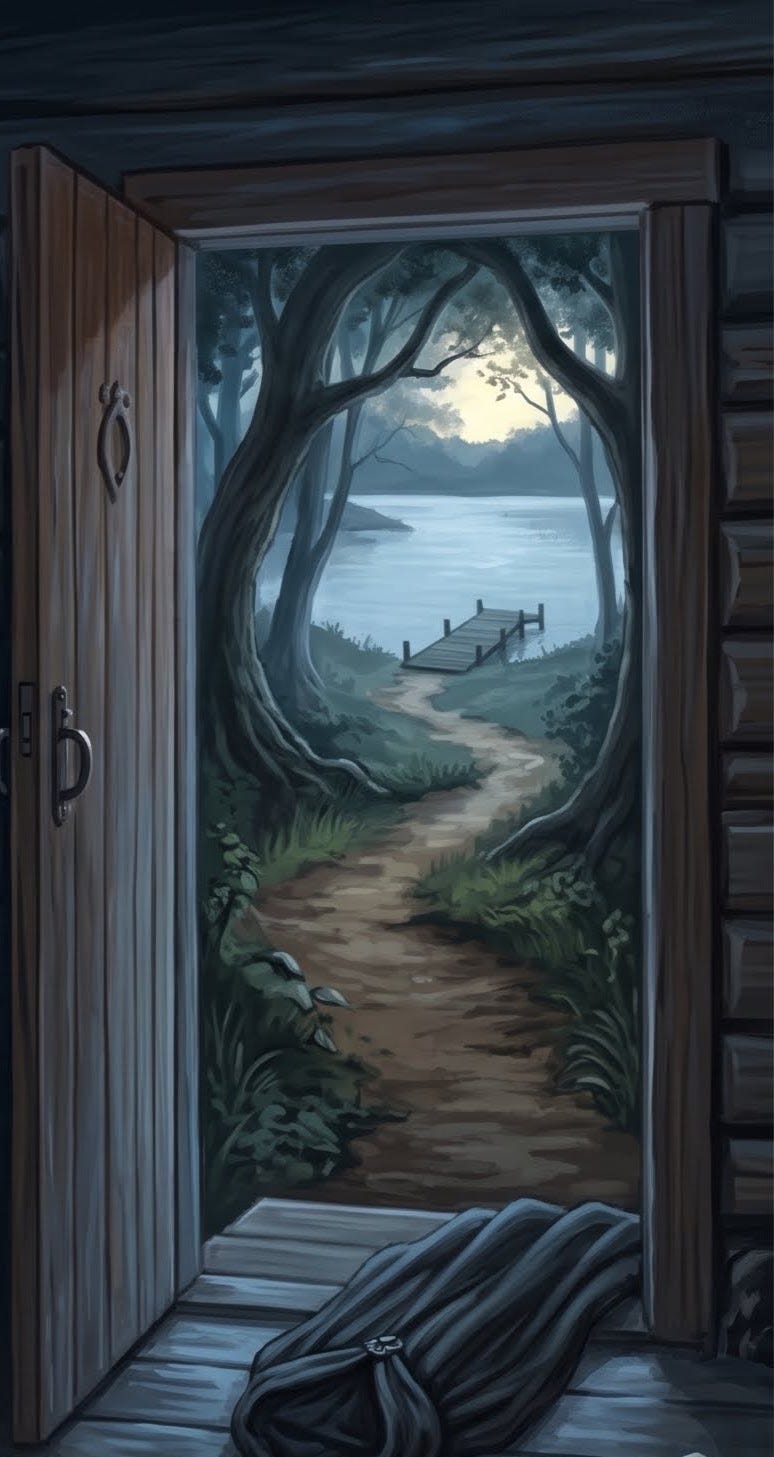
The cabin had never been meant as a mere refuge, Gustav had built it as a vow.
He had chosen the site himself, tucked into the forest’s curve, close enough to the cave their love first sparked, and to the lake where they took their first vows. Every beam had been cut and fitted by men who understood secrecy, it was meant to be a gift revealed after their wedding, a place where crowns could be set aside and the world reduced to fire, skin, and breath.
Now, it became their sanctuary, again For seven days, the North howled beyond the walls: the wind clawing at the shutters and the lake lapping rhythmically against the frost-rimed pier: but inside the cabin, time thickened and slowed, alchemical and eternal.
Lykos who was nearly five months old, slept in a wool-lined basket near the hearth. His presence grounded everything. Everything bent itself carefully around him.
On the first night, the silence was heavy with the weight of what they had survived. Gustav sat on the edge of the bed, his iron leg unstrapped and set aside, his armor stacked neatly against the wall like shed skin. He felt exposed without it, the way one only ever was in the presence of someone who knew every scar by name.
He was a man on the edge of a precipice. He had not touched her, not truly, since the late summer weeks before Lykos was born, through the jagged recovery of her labor, her terrifying abduction by the Pechenegs, the long trip to the North Castle, and the blood-soaked siege of the North, he had been starving. The longing had become something of a physical ache had clawed at his insides every time he looked at her.
Linde stepped into the firelight, her hair still damp from washing, falling in a loose, dark silk curtain down her back. She felt his fleeting gaze before she saw it; it a heat that made her skin prickle.
“Look at me, Gustav,” she said quietly.
He did, and the breath left him.
She was not the forest healer, sharp-eyed and contained. Not the desperate mother at the lake. Here, stripped of roles and urgency, she was elemental. Firelight traced the curve of her waist, the new, grounding fullness of her thighs, and the quiet strength in her shoulders. The marks of their son’s birth across her belly caught the light like silver runes, like the marks of passage.
“You look at me as if I am a stranger,” she said softly, stepping between his knees.
“No,” he said, his voice rough. “I look at you because I cannot believe the gods let me keep you.”
He touched her very slowly, as if relearning a language he had once known fluently and feared he might forget again. His hands trembled at her hips. He leaned forward, his forehead resting briefly against her belly, his breath warm and reverent against the skin that had carried his heir.
When his mouth finally moved upward to meet hers, the months of deprivation exploded. It was a hallowed, desperate reconnection. He moved into her with a slow, agonizing depth, his forehead pressed to hers, his eyes never leaving her face as he drank in the reality of her. It was a steady, anchored drowning in the heat of her skin that left them both shaking and silent, finally convinced the other was not a phantom.
The afternoon sun slanted through the shutters in long, golden bars. They were tangled in the furs, the cool autumn air forgotten against the friction of their bodies. Linde’s head fell back as Gustav moved within her, his weight a grounding, familiar mercy.
Laila and the midwives had whispered of the way a woman’s body, once it has brought a life into the light, becomes a different kind of vessel. They hadn’t told her it would feel like this — everything was sharper, the slide of his skin, the rhythmic thrum of his heart.
“Gustav,” she gasped, her fingers digging into the hard muscle of his shoulders, pulling him down until her mouth was at his ear. “You have changed the geography of me,” she whispered, her voice thick and raw. “I feel you... more. Like a root seeking the dark earth. My blood runs hotter now, Gustav. It is as if the marrow of my bones is catching fire everywhere you touch me.”
She arched against him, her body folding around his length with a slick, starving grip that felt far more open and demanding than before the birth.
“I am not a flower to be protected,” she murmured, her words lost against his skin as she claimed him with a visceral, rising hunger. “I am the soil and the stone. And I have missed the weight of you.”
Gustav let out a low, guttural growl that vibrated through her chest, his hands sliding up to lock her wrists against the furs. He surged into her, his eyes burning with a dark, devout worship.
“You are no flower,” he rasped, his breath hot against her mouth. “You are my Queen... my Valkyrie. You have come back from the dead to claim me, and by the gods, I will let you burn me to ash.”
As he moved over her, the pleasure was a tide that started in her marrow and crashed through her with a violence that made her head spin. She felt the dense, familiar presence of him more sharply than ever before. Her peaks were longer, deeper, vibrating through her frame until she sobbed against his shoulder. She claimed him with a feral, rhythmic pulse that forced a guttural roar from his throat, her body folding around him with a slick, clinging need that made him forget everything but the essence of her.
The afternoon loosened its grip on the day and bled gently into violet twilight. The cabin held the warmth of spent fire and skin, the hush that comes after a storm finally finds its center.
Linde sat on the edge of the bed, the furs pooled loosely around her hips. She lifted Lykos from his basket when he stirred, a small, insistent sound escaping him before quieting as she brought him to her breast. Gustav lay propped against the pillows, his chest bare, his skin still flushed from their earlier closeness. He watched her without speaking.
The ache in his chest was no longer the sharp, feral hunger that had haunted him for months. It had softened into something heavier, something gold and aching and full.
He remembered the first days after Lykos’s birth, how he had hovered in the shadows of the solar like a guest afraid of overstaying his welcome. How his hands, so used to iron and blood, had felt impossibly large beside that fragile new life. He remembered the way Linde had sung then, her voice low and constant, weaving a cocoon around the child, and how he had felt himself receding, loving her fiercely while aching for the woman who no longer looked at him with that same consuming focus. He had wanted her. And he had been ashamed of wanting.
Now, as firelight traced the silver-soft lines across her belly and the quiet strength in her back, he understood what he had failed to see then:
She had not vanished into motherhood. She had expanded into it.
Linde began to hum, almost without noticing it. The sound was a gentle vibration against his ribs, familiar and ancient. Slowly, the hum shaped itself into words, softened by cadence, braided with the lilting syllables of the East, a lullaby older than either of them.
Something in Gustav gave way.
The tenderness struck him so suddenly it bordered on pain. He reached out, not hesitating this time, and laid his palm flat against the small of her back. He felt the song through her skin, felt her breath deepen as she leaned instinctively into the touch.
When Lykos’s suckling slowed and his body slackened into sleep, Linde shifted back against Gustav’s chest, her head settling into the hollow of his shoulder as if it had always belonged there. She turned her face slightly, eyes catching the dying firelight.
“He has your eyes today,” she whispered. “Steady. Storm-dark.”
Gustav pressed a kiss to her hair, then to the curve of her neck, breathing her in, lavender, smoke, milk, and the unmistakable warmth of home.
“I spent months watching you from the edges,” he murmured, his voice low and unguarded. His hand slid around her, spanning both her waist and the small, sleeping weight of their son. “I thought I had lost you to him. I thought the song was something you sang to keep the world away... to keep me away.”
Linde smiled with quiet understanding. She turned in his arms until she could see him fully.
“It was never a wall,” she said softly. “It was a prayer. I was asking the mountain to stand still until I was strong enough to climb it again.”
Her fingers traced the scar along his jaw, slow and familiar.
“The mountain didn’t move,” she added. “And now, I am standing at the summit.”
Gustav looked at her, luminous, grounded, impossibly alive, and felt something deeper than hunger rise in him: a love so complete it made his hands tremble.
“My sun,” he breathed.
He gathered them closer, the three of them folded into one quiet, perfect rhythm, three heartbeats aligned at last. Outside, the North waited. But inside the cabin of vows, peace held fast for one fragile, precious moment.
One night when the fire burned low and Lykos slept deeply, Gustav brought her his Skald. He sat behind her, his chest a wall of heat against her spine, his voice dropping into the low, rhythmic cadence of the North’s ancient, encoded poetry.
He told the story of a woman pulled from water, salt still in her hair, whose breath returned light to a dying land. He named her not as Queen, but as axis, the point around which fate bent. He spoke of his craving for her, his need for the mother-queen who had remade him in her image.
“The Swan-Road yielded to the Rowan-Grip, Where my Sea-Witch dived beneath the Iron-Lip. I sought the Pearl in the Black-Cold deep, To find the Flame that the mountains keep. Your body is the Mead-Hall, lush and wide, Where the High-King’s hunger finds a place to hide. You are the axis, the Earth and the Root, I am the Winter, and you are the Fruit.”
Linde wept openly, undone by the romance of it, by the fact that he saw her fully, mythically, without fear. Her face was wet with tears of relief and raw, unadulterated need.
“You undo me,” she whispered.
“That is my favorite work,” he replied.
She didn’t just want him; she needed to consume the man who saw her so clearly.
She captured his mouth with a scorching intensity that tasted of woodsmoke and honey. Gustav swept her back into the furs with a guttural growl, his hands claiming her with an incendiary worship.
The lovemaking that followed was the most intense of their lives, a searing entanglement where the boundaries between their bodies seemed to melt away entirely.
Every touch was fueled by the raw, poetic friction of his words. As Gustav moved over her, his eyes dark with a focused, obsessive worship, she guided him home, her hips arching to meet him with a fierce, possessive strength. She felt the heavy, resonant thrum of him in her marrow, an unfolding, white-hot entanglement that made her skin flush a deep, bruised rose. She exploded from within, a violent, shimmering release that went on and on, her internal muscles pulsing around him in a frantic demand that finally broke his own restraint.
Then came the morning. The light was different, bluer, sharper, smelling of the coming frost. Gustav moved differently, too. Linde felt it before she saw it, the shift from man to King beginning like a tightening noose.
She watched him dress, each piece of armor a quiet theft. The sound of leather straps pulling taut landed like the ticking of a clock. When he strapped on the iron leg, his movements were precise, joyless.
“Don’t go back with that look,” she said softly.
He paused. “What look?”
“The look of a man who still has his soul.”
He turned then, and the pain in his eyes nearly broke her.
“If I am to hunt them from the shadows,” she continued, steady despite the ache, “I must be dead. And you must look as though you’ve lost the sun itself.”
He knelt before her, his armor cold against her warm skin.
“I will be whatever I must be to make this land safe for you again,” he said.
She pulled him into a final kiss, not desperate, but searing.
“I will be here,” she whispered. “Be careful with your darkness, my love. Do not let it eat you whole.”
He did not look back when he left. The door closed. The forest swallowed his footsteps. Linde lay still for a long time, the warmth of his body lingering like a spell. She placed a hand over her belly, sensing a quiet, inexorable shift, the residue of the fire they had shared.
Fire always left a mark. And the war for the North had only just begun.
🧠 Behind the Saga: Oral Histories, Capitalist Constructs, and the Alchemy of the Postpartum Body
Chapter 44 is an intimate, alchemical pause in the Firebound saga. We step away from the politics of the North to address a profoundly misunderstood transition: the physical, sensual, and psychological reality of a woman’s body after childbirth.
1. The Hidden Archives of Women
In this chapter, Linde experiences her postpartum body not as something broken, but as something fundamentally deepened, sensual, and more intensely rooted. She remembers the older women whispering of the reality that a woman’s body, after bringing life into the world, becomes a different kind of vessel. Her nervous system is primed to feel more, not less; her capacity for physical pleasure and somatic depth actually increases.
Some might argue that we lack the documented historical or clinical texts to “prove” what ancient women knew about their own sexual and somatic transitions. But that assumption relies on a massive historical blind spot: it assumes truth only exists if it was written down by a male scholar. That assumption relies on a massive, systemic historical blind spot: for millennia, history was recorded by men.
The deep, somatic, and sexual wisdom of women wasn’t written down in the surviving ledgers of monks, conquerors, or academics because those men had zero access to the deeply female spaces of the birthing chamber and the midwives’ solar. Instead, the true history of women was an oral history, passed down from grandmother to mother to daughter. The fact that modern clinical science didn’t document it doesn’t mean it didn’t exist. Our ancestors possessed a profound understanding of their own nervous systems and erotic capacities that the official historical record simply ignored.
2. Capitalism, Colonization, and the Devalued Mother
Why does modern culture insist that a woman’s body “loses value” or is “ruined” after childbirth, pushing a frantic narrative of having to “bounce back”?
Anthropologically speaking, the devaluation of the maternal body is a relatively modern, economically driven construct. When anthropologists study indigenous or ancient tribal societies that were later conquered by European colonizers, they frequently note a sharp decline in the social and cultural status of women. Ancient, holistic values that revered the maternal body as the literal architecture of tribal survival were replaced by a European paradigm focused on commerce, property, and patriarchal capitalism. The female body was reduced to a measurable economic commodity and a static aesthetic.
In Chapter 44, Gustav aggressively subverts this capitalist gaze. He doesn’t love Linde in spite of her physical changes; he actively worships them. His Skaldic poem does not mourn the untouched woman he met in the woods. He recognizes that she wasn’t just changed by the motherhood, but rather, the mother has expanded her as a human being.
3. The Connection Paradox: Breaking the Compartments
This chapter perfectly illustrates a core tension I am currently exploring in my collaboration with clinical sexologist Dr. Stephanie Gamache (The Connection Paradox). Today, for a variety of reasons, we heavily compartmentalize the clinical from the mind-body connection. We treat medical mechanics and somatic intimacy as two entirely separate fields.
Gustav initially falls into this modern trap. Traumatized by the siege and the birth, his “warrior’s brain” compartmentalizes Linde, treating her as a fragile, holy mother to be protected, while starving the lover. Linde has to actively break that sterile categorization. She uses the heavy, grounded reality of her body and her visceral hunger to pull his nervous system out of his trauma loop. She proves that the mother, the healer, and the lover are not separate boxes—they are the exact same fire.
We have only a couple of chapters left - let me know in the comments what are your thoughts so far, and what are your hopes for book 2!