
Gustav rode back into the North Castle like a man already half in the ground.
He let his shoulders sag under his cloak, his fingers slack on the wet leather of the reins as if the stallion were carrying a corpse home from the water. Before leaving the trees, he had worked cold hearth-ash into the lines around his eyes and across his cheekbones until his skin took on the tallow-grey cast of a sleepless mourner. The wind off the fjord had done the rest, splitting his lower lip so a crust of dried blood cracked whenever he swallowed. Three days of siege still clung to his wool—wet char, horse sweat, and the sour-copper stench of men who had died convinced they were buying the North’s future.
From the battlements, he looked spent. Underneath the grease and soot, he was counting.
Grief makes predators sloppy, he thought, the phantom heat of Linde’s skin still burned into his palms. They wanted a widower emptied of fire. He would set the table for them himself, and watch closely to see who reached first for the carving knife.
The main gates dragged inward over frost-heaved mud, iron hinges shrieking. Beyond them, the ward lay hushed. Servants hugged the timber walls with their chins tucked to their chests. Near the well, four men-at-arms stood a fraction too close together, their low murmur snapping shut the instant his stallion’s shadow crossed them. High above, the banners of the Oak and the Raven hung sodden in the freezing mist. Someone had left the royal standard crooked on its pole—a small, careless insult no steward had bothered to set right.
Gustav kept his eyes down, counting seven slow beats of his heart before Jarl Hakan, watching from the upper gallery, finally stepped back into the archway. There had been no sorrow in the man’s face. Only arithmetic.
Gustav swung down from the saddle. When his oak-and-iron leg struck the cobbles, he let his hip hitch—just a fraction of an inch on the slick frost, caught immediately by a white-knuckled grip on the pommel. Not enough to fall. Enough to be seen. Thirty paces away by the West Barracks, a guard shifted his weight, and his cloak parted over a brooch that had never seen a Northern forge. Southern gold, soft-yellow and bright, without a scratch of winter on it.
So it begins.
Heavy boots fell into step beside him.
“You look like hell,” Hugo murmured, matching his stride without looking over.
“That’s generous,” Gustav said.
Hugo let out a short breath through his nose. “I spent three days cutting down men who swore you couldn’t be killed. I resent the effort you’re making to prove them wrong.”
“If I rode in whole, they’d keep their heads down.”
“Ah. Strategy, then.”
“If it were despair, Hugo, you’d already be carrying me.”
“True. And complaining the whole way up the stairs. You’re heavier when you sulk.”
Gustav cut his eyes sideways. “If I stumble, let them call it grief.”
“If you stumble,” Hugo said flatly, “I’ll haul you upright by your collar and tell them you meant to inspect the stones.”
“Good. That’s why I keep you.”
They turned into the cold stone throat of the inner keep, climbing toward the King’s wing.
“The Jarls are already circling,” Hugo said, pitching his voice beneath the draft in the stairwell. “Whispering about a regency. They think the lake took everything you had left.”
“Let them reach,” Gustav rasped. “The further a man stretches over the table, the clearer he leaves his throat. My father?”
“Breathing clean an hour ago. Linde’s purge held. But the copper-root chewed holes in his memory, Gustav. He asks after people ten winters dead. Doesn’t know the month.”
Gustav gave a single nod and pushed open the chamber door.
Shutters barred out the grey afternoon, trapping the sour, tallow-heavy warmth of a sickroom. Under the guttering candleglow, Erik looked whittled down to bone and damp linen, his chest rising in shallow hitches as his body sweated out the last of the venom.
Gustav lowered himself to one knee beside the mattress, leather harness creaking against oiled wood. When he closed his fingers around his father’s hand, it felt like a bundle of dry reeds.
“Linde?” Erik croaked, his pale eyes tracking toward an empty corner. “Did the girls get the lavender in? Your mother said the frost would ruin it before supper.”
The words slid straight between Gustav’s ribs. Freya. Anna. Signy. Women whose footsteps and laughter had once warmed every timber of this keep, pared away season after season until only the stone was left. Gustav bowed his head, pressing his father’s papery knuckles against his forehead.
“She’s hidden, Father,” he whispered, too low for the door-guards to catch. “Deep in the timber. To this hall, you are dying, and my wife is at the bottom of the lake.”
Erik’s brow creased. “Drowned,” he murmured. “No. That sits wrong.”
“It’s a lie. A useful one.” Gustav lifted his chin, letting the warmth drain back out of his voice. “We’re ghosts for a few days longer. Ghosts get to watch from the dark.”
A thin, crooked smile tugged at Erik’s dry mouth. “Ghosts,” the old man breathed. “Aye. They don’t beg, and they don’t shout. They wait.” For one sharp heartbeat, the fog cleared from his eyes. “And when living men forget their oaths... they collect.”
Gustav went very still. “Do you know me?”
Erik squinted into the soot on Gustav’s face, the effort costing him. “You’re...” His breath snagged. “...the one who holds. The boy who doesn’t yield the door.”
Erik had lost his name, yet he had kept the measure of him.
“Yes,” Gustav whispered.
Erik’s fingers went slack. His lids fluttered shut. “Then the wall still stands.”
Gustav stayed on his knee until his father’s breathing smoothed into sleep. When he hauled himself upright, whatever softness remained in his chest had been hammered flat.
“Hugo.”
His captain straightened by the hearth.
“No moot. No speeches in the yard,” Gustav said. “I want the hands. Who steeped the mash. Who carried the flagon. Who drew the bar on the water-gate while we were bleeding in the snow.”
Hugo’s jaw set. “You’re going to burn them out.”
“No,” Gustav said, looking down once more at his father’s sunken ribs. “Fire is too quick.”
That night, Gustav called the four Jarls of the High Council to a Mourning Meal in the small solar. He sat slumped at the head of the oak board, leaving his trencher of salted mutton cold in its grease. In his lap, almost lazily, he drew a small whittling blade down a stripped branch of rowan, pale curls of wood dropping between his boots.
“The Southern ports have already sent word of their sorrow,” Jarl Hakan offered, his voice oiled and a beat too eager. “They propose a trade envoy before the sea-ice closes. Coin and grain to steady the folk while the Crown recovers its strength.”
Gustav didn’t lift his eyes from the stick. “How generous of the South, to mourn my wife before her clothes are dry.”
A young cupbearer leaned in to fill his goblet. Gustav’s hand shot out and locked around the boy’s narrow wrist. The lad yelped, jerking back; dark red wine splashed across the scrubbed oak like an open artery.
Every knife at the table stopped scraping.
“Tell me, boy,” Gustav said softly, turning the trembling wrist slightly in the candlelight. “Which sits sweeter on the tongue—rowan, or copper?”
Hakan’s fork paused halfway to his beard. In the flare of the tallow lamps, his pupils swallowed the grey of his eyes.
“My wife was fond of lectures,” Gustav murmured, letting the boy’s arm drop so the servant stumbled backward toward the wall. “She used to tell me the deadliest draughts taste like clover honey going down. I’ve been sitting here wondering just how much honey it took to grease the bolt on the West Gate.”
He shoved back his chair and stood, letting the iron heel of his leg ring hard against the flagstones. At the threshold, he looked back over his shoulder at four men sitting around a puddle of spilled red.
“Ghosts don’t roar, gentlemen,” Gustav said. “They wait. And I have the whole winter to watch you lose your appetites.”
He walked out and left them to the candles.
Down behind the great kitchens, the passage smelled stubbornly of yeast, boiled turnips, and wood-ash, indifferent to dead queens or circling lords. Wind worried at the high flues overhead, making the masonry moan; outside in the sleet, a solitary raven croaked once and went quiet.
Hugo found Marta at the scullery trough, sleeves shoved past her elbows, wrist-deep in grey washwater. She was scouring the inside of an iron cauldron that already shone bare metal.
“You’re going to rub right through the bottom of that,” he said quietly.
She didn’t look up. “It offends me.”
He came closer, boots gritty with courtyard salt. “The pot?”
“The notion that anything in this keep is clean,” she muttered. “Feels like lying.”
Hugo reached past her shoulder, lifted the heavy pot out of her hands, wiped it down with a coarse linen clout, and set it upside down on the rack. “You missed supper.”
“So did you.”
“I was invited to mine.”
“That makes yours worse.”
One corner of her mouth crooked upward. She shook the grey water from her red knuckles and leaned her hips back against the chopping table, finally letting her eyes travel over him—the crusted gash near his hairline, the guarded hitch in his left shoulder.
“You’re leaking again.”
“Old cut.”
“Old man,” she countered, though her thumb came up gentle beneath the bristle of his jaw. “Sit on the bench.”
“I can stand.”
“Humor me, Hugo. Half the reason I wed you was because eventually you stop arguing and sit down.”
He sat. She fetched clean linen and a pot of pine-resin salve without fuss, working by touch while a second raven answered the first across the dark ward.
“How is he?” she asked, dabbing away dried blood.
Hugo watched her wrists. “Upright. Which is good. And terrifying.”
Marta hummed low in her throat. “Gustav always stands straightest when the floor drops out from under him.”
“Aye.”
“And our girl?”
Hugo’s mouth twitched. “Still drowned, so far as this castle knows.”
“Keep her that way,” Marta said fiercely, pulling the linen knot snug with her teeth before biting off the thread. “This place doesn’t deserve her breathing in it.” She stepped back and wiped her palms on her apron. “Go raid the pantry before the barracks men find the rye loaves.”
Hugo sighed, rolling his stiff shoulder. “Too late. I’ve already heard three separate tales of ‘heroic rationing’ by the gatehouse.”
“There’s no such thing.”
“There will be by dawn. If we don’t lock the bins, we’ll be holding the North with pocket-lint and crusts.”
Marta almost smiled, then her face sobered. “Stay breathing,” she told him, the way a commander issues watch-orders.
“I intend to. Somebody has to make sure Gustav eats.”
“Somebody has to make sure you eat.”
As she turned back for the trough, Hugo caught her rough hand and pressed his forehead briefly to her knuckles, breathing in lye-soap and pine pitch. “Thank you.”
“For what?”
“Holding the walls from the inside.”
Her fingers tightened once on his. “That’s what kitchens are for.”
Five miles deep in the birch woods, the cabin smelled of sour vinegar and crushed bark.
Linde stood over the heavy plank table, working with the brisk, pared-down economy she had learned in her mother’s Eastern wards. Bound tight against her breastbone in a woven sling, Lykos puffed warm, damp breaths against her collarbone, a steady little pulse beneath her chin while her pestle ground dried rowan-gall into pale dust.
Observation: The conspirators were lazy thinkers. They had stolen her own winter notes—the very warnings she had shared regarding how copper-root slows a fevered heart—and used them clumsily on an old man’s porridge. Aside from treason, it was shoddy apothecary work.
“You’re making the face again,” a dry voice rasped from the open doorway.
Sael leaned against the timber jamb like a heap of wet lichen and old bones, frost dusting the shoulders of their layered wool.
“Which face, Sael?” Linde didn’t break the circle of her pestle.
“The one where you’re reckoning how much river-silt it takes to stop a man’s windpipe,” Sael said. “Unsettling thing to watch over a sleeping baby.”
The corner of Linde’s mouth pulled tight. “I’m doing alchemy, Sael. They thought copper-root leaves no tracks because the gut mimics age. They didn’t bother learning how tannins bind to metal.”
Using a horn funnel, she measured pale vinegar steeped with rowan-gall into three thumb-sized vials, corking each with beeswax. “One purge for Erik—tell Marta to stir it into his morning mash while it’s hot. The second is willow-draught for Hugo’s shoulder; I saw how he was carrying his shield arm before I went over the wall. And the third...” She wrapped the last vial in buckskin. “Have Hugo pour three drops into the dregs of the Council’s wine cups after they leave the board. If anyone at that table has copper-root clinging to their fingers or their flasks, the gall will turn the lees black as pitch.”
Sael tucked the bundle inside their furs, silver bells giving a muffled clink. “And if Hakan’s new guards catch me on the goat-path?”
“Tell them you’re a marsh-wight come to curse their teeth out,” Linde said dryly. “Men who hire mercenaries are always superstitious.”
Sael snorted—a dry scrape like two river-stones knocked together. “Less trouble sticking to the brush.” They turned into the mist, pausing once on the threshold to squint at the bundle on Linde’s chest. “That boy already scowls like his father. Looks three breaths away from taxing the pine trees.”
“He has my lungs,” Linde answered, resting a palm over Lykos’s warm skull. “Which means if you let the cold draft in much longer, he’ll wake up and tell every scout on the ridge where we are.”
Sael slipped into the trees without leaving a footprint in the slush. Linde blew out her tallow dip and went back to the hearth. The trap had teeth now.
For three nights, nobody inside the North Castle slept clean.
Gustav walked the upper galleries after midnight just so the flagstones would carry his stride—the muffled thump of leather and oak, followed by the sharp iron scrape of the heel, slow and unhurried down dark corridors. He wanted the men behind bolted oak doors staring at their ceilings, sweating into their furs, unable to tell whether they were listening to a mad widower wandering his grief or an executioner counting bedchambers.
Linde would have told him to stop grinding his jaw and draw a deep breath. Linde wasn’t there. He let the suffocation build until the stone itself felt tight.
Before third watch, Hugo stepped out of an armory alcove and held up a thumb-sized vial against a wall torch.
The vinegar inside wasn’t pale anymore. It sat thick and ink-black against the glass.
“Sael came through the postern,” Hugo murmured. “Marta tested the rinsings from the Council cups after evening meat. Two stayed clear. Varick’s cup turned cloudy, and Hakan’s wine-flask went black before she’d counted to three.”
Gustav took the glass between scarred fingers. Even through wax and cold ash, it felt like Linde reaching across five miles of freezing timber to lay a scalpel directly into his palm.
“Varick first,” Gustav said softly. “Thin ribs. Loud oaths. He’ll break before Hakan knows the door is open.”
An hour later, Lord Varick came up the back stair from the privy humming off-key behind his tallow candle, stepped into his bedchamber, and dropped the brass holder onto the rushes.
The flame sputtered once and died, leaving only the dull red of the turf brazier—just enough light to catch the crescent edge of Gustav’s Dane-axe leaning beside the bedpost, and Gustav himself sitting motionless in Varick’s high-backed chair.
“My—my King!” Varick choked, backing into the closed oak panels. “I didn’t—the watch didn’t call you—”
“Guilt puts wool in a man’s ears, Varick.” Gustav lifted the blackened vial between thumb and forefinger so the red coals gleamed against it. “Tell me about the copper-root. Tell me how my father looked across the board while you ate his salt and watched his mind rot out.”
“Poison?” Varick’s voice cracked high. “By the gods, Gustav, I have three daughters in this keep! Why would I touch poison? I’m your man!”
Gustav didn’t raise his voice. He turned the black glass slowly. “Funny. Jarl Hakan swore an hour ago that you bought it off a Frisian trader. Told Hugo you were the weak timber in the gate.”
“Hakan—Hakan lied!” Varick’s knees went out from under him; he hit the rushes hard, scrambling forward on shaking palms. “He told me the grey powder was for Erik’s gout! A sleeping draught from the Southern chirurgeons so the old King wouldn’t fret over the siege! I swear on my mother’s bones!”
“A gout-remedy that turns gall-vinegar black as pitch?” Gustav leaned forward, elbows on his knees, bringing his ash-smeared face into the red glow. “Hakan claims your wax seal is stamped on the water-gate parchment.”
“The parchment was his!” Varick sobbed, spit flying from his chin. “All I did was set one tallow lamp in the East turret! One lamp! Hakan met the foreigner with the curved blade down by the boathouse—he swore if I didn’t light the sill, those Southern dogs would burn my girls in their beds! Mercy, Gustav, for pity’s sake—”
Gustav stood up, leaving the axe untouched against the bedpost. “Hugo.”
Hugo shoved the heavy oak door inward, four huscarls crowding behind him with iron shackles.
“Put him in the Cold Hole,” Gustav said, stepping past the weeping lord without looking down. “Then wake Hakan’s household. Tell the Jarl the King wants to go over the border maps.”
Once Varick cracked, the rest came apart before the torches burned down to their sockets.
Gustav moved through the keep with Hugo at his shoulder, dragging sleepy men out of featherbeds into the iron-grey sleet of false dawn. Only Hakan refused to kneel. When they hauled him into the courtyard, he snatched a short-sword from a hesitant guard—until Gustav swung the Dane-axe once, two-handed, snapping the Southern-tempered steel four inches above the crossguard and driving Hakan onto his knees on the frosted cobbles.
Hakan spat blood onto Gustav’s boot, grinning through broken teeth. “Cut my head off, cripple! The South has already taken the measure of your little emerald! They’ll burn this frozen wasteland to ash just to put her in a cage!”
By sunrise, four heads sat beside the chopping block, dark blood steaming as it melted little craters into the white rime.
Gustav stood above the yard on the timber gallery, wind tugging at his soot-stained cloak. On the road out from the cabin, Linde had warned him to watch his darkness—not to let it eat him whole. Looking down at the red slush, what unsettled him wasn’t fury. It was how quiet his pulse felt inside the slaughter. This wasn’t vengeance; it was clearing brush before winter.
He turned his back before the ravens dropped down from the gables.
“Hugo,” Gustav said, walking back under the stone arch. “Have the yard scrubbed before my father wakes. Double the coast-watch, saddle my horse, and take crowbars to Hakan’s private solar. Tear up every floorboard down to the joists. I want to know who paid for that brooch.”
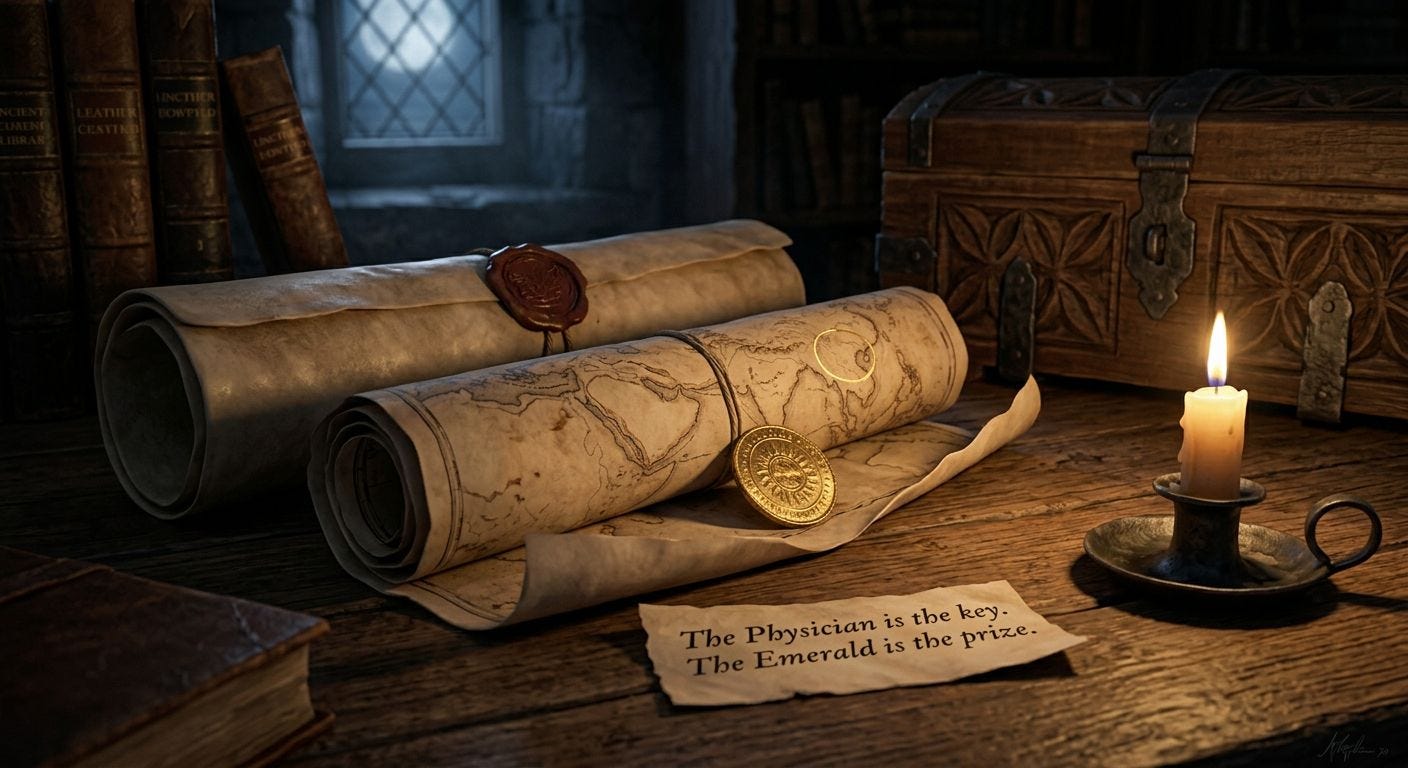
Three hours later, before Gustav had even washed the hearth-ash from his face, Hugo walked into the library and set a heavy lead-capped cylinder on the oak table.
Inside lay a sheet of supple, pale vellum that carried no smell of Northern tallow or brine. Even in the cold room, a ghost of crushed jasmine clung to the skin.
Gustav unrolled it, weighting the corners with his dagger and an inkhorn. It wasn’t a letter. Red and gold inks traced the great river-arteries running down from the Baltic forests to the Silk Road ports—and right at the crossroads, King Artemij’s Eastern stronghold sat ringed in hammered gold leaf.
Something heavy slid from the roll and struck the oak with a soft, dull chime. A single coin, thicker than Northern silver, stamped with a blazing sun-disk in gold so pure a man could dent it with his teeth: the mint of the Southern Caliph Al-Ta’iate.
Across the bottom margin of the vellum, a neat, clerkish hand had inked two lines in trade-Greek:
The Physician is the key. The Emerald is the prize.
Gustav stared down at the sun-disk glinting in the candle-grease. Hakan hadn’t been the hunter. He had only been the hound sent ahead to flush the woods.

🧠 Behind the Saga: Behind the Saga: Ash, Iron-Gall, and the Shadow of the Southern Sun
We have one chapter left in Book 1 (Emerald to Steel), and the discovery beneath Jarl Hakan’s floorboards just laid the first stone of Book 2: Salt and Gold.
If you’ve been tracking the breadcrumbs since Chapter 2—where merchant-princes of Caliph Al-Ta’iate stood in silks on the docks of Hedeby—the larger architecture of the Firebound world just snapped into focus. Hakan’s coup was never an isolated Northern squabble; he was a paid hound for a Southern superpower that stretches from the Silk Road arteries to the warm seas.
As we prepare to cross into Salt and Gold, the frost of the North gives way to a vastly more dangerous chessboard:
Sun, Silk, and Intellectual Empire: What happens when the enemy isn’t a barbarian at the gate, but a glittering, hyper-cultivated Caliphate that treats medicine, science, and Velena’s bloodline as ultimate weapons of state?
Open Water & Uneasy Crowns: Gustav can hold any stone corridor with an axe—but how does an iron King protect his family across exposed caravan trails and treacherous seas, forced to broker alliances with charismatic maritime rulers who see Linde’s brilliance all too clearly?
New Voices in the Fire: The world is expanding southward, bringing fierce new perspectives, deadly courtly etiquette, and the collision of two completely different civilizations.
(Impatient? If that jasmine-scented map left you needing answers tonight, both Book 1: Emerald to Steel and Book 2: Salt and Gold are available right now on Kindle —otherwise, buckle up for next week’s Book 1 finale here on Substack!)