
The North Castle no longer looked like the carcass Linde had fled weeks before. As the royal party crossed the valley, the keep rose out of the frost with stubborn defiance. The soot had been scrubbed from the stone. The shattered ribs of the Great Hall had been replaced with fresh pine beams, their honeyed sap still bleeding faintly where winter had not yet sealed them.
The castle had healed. And healing, Linde knew, could be deceptive.
Returning was not a relief. It was an adjustment of the senses. After a few weeks of forest quiet, the sound of servants, footsteps, doors, and distant voices pressed in on her like weather.
Observation: The human mind adapts to silence with terrifying speed. In the woods, a snapping twig is an alarm. Here, the noise is constant enough to hide intent.
King Erik awaited them in the strategy room. He rose when they entered, though the effort cost him. He was thinner now, his skin drawn tight over bone, his hands faintly unsteady. Whatever poison had been fed to him had not killed him, but it had left doubt behind.
He did not address Linde as Queen.
“You have your mother’s hands,” he said quietly, taking hers. His grip was careful, deliberate. “Freya used to say Velena could pull a man back from the brink simply by refusing to let go.”
Linde swallowed.
“I trusted men I should have watched,” Erik continued, not meeting Gustav’s eyes. “I mistook familiarity for loyalty.”
His gaze dropped to Lykos. He brushed the child’s fingers with one knuckle.
“I am sorry,” he said simply. “To you. To this child. To the North.”
The days that followed settled into a cautious calm. Repairs continued, guards doubled, and little Lykos spent his afternoons on a thick fur rug in the solar, a whirlwind of energy as he mastered the art of the frantic, belly-down crawl. He moved with a relentless curiosity, babbling happily in a language only he understood to anyone who passed. Gustav spent hours on the floor with him, showing him the blunt carvings on a practice dagger and laughing softly when the boy’s only interest was trying to gum the hilt.
It was a fragile peace, a borrowed one. It shattered on a Wednesday afternoon.
A single rider arrived from the border outpost near the Whispering Woods. He dismounted without removing his helm. When he finally did, his face was grey with exhaustion.
The Great Hall seemed to contract around him.
“Prince Vlad was surveying the southern fence,” the scout said. “King Artemij and Prince Andrej are still a month’s ride east for the Silk Road negotiations. The Prince remained behind to treat the village fever. He took three men to investigate a breach.”
The hall went silent.
“They found the horses tethered. The camp undisturbed, and a fire still warm.” The scout hesitated. “There was aromatic smoke lingering in the air. Frankincense, maybe. Myrrh.”
“And the men?” Gustav asked.
“Gone.”
Gustav did not move.
“What was left behind?” he asked evenly.
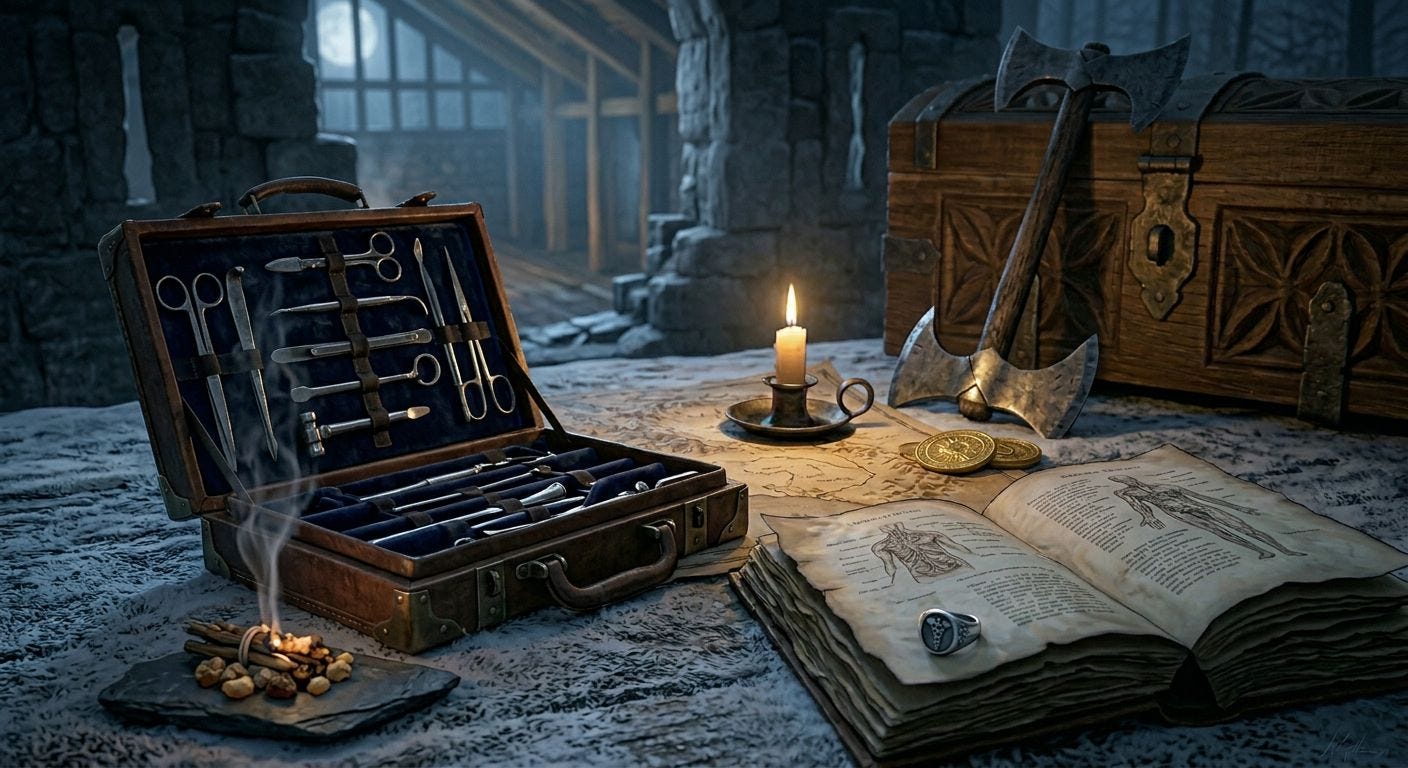
“The Prince’s instruments, his gold, his books... All untouched. Even his medical kit was open by the fire.”
Gustav’s jaw tightened. “Then this was not a raid. It was procurement.”
The word landed like iron.
“They did not take what could be spent,” he said. “They took what could be used.”
He turned to Linde. “The man who opened the water-gate was not acting alone. He was a scout.”
“For someone who collects rare things,” Linde said quietly. Her mind raced, cataloguing the smoke, the precision, the absence of violence. “Vlad is not valuable as a hostage. He is valuable as a mind.”
The decision was made without ceremony. With King Artemij and Andrej months away in the far reaches of the Orient, the North was a body without its primary allies. To reach them, a messenger would have to survive the Steppes and find passage through the Iron Gates, a journey that consumed seasons, not days. By the time word reached them across the Silk Road and they turned their horses back toward the frost, Vlad would be a ghost, vanished into the machinery of the South.
There was no one else to go. To wait for the father was to bury the son.
That night, in their chamber, Gustav packed with the efficiency of a man who had done this too many times. He did not speak until the last strap was tightened.
“I will bring him home,” he said.
Linde stood by the window, one hand resting against the wool at her waist. The knowledge had been with her for days now, quiet, unmistakable.
“Gustav,” she said.
He turned.
She stepped through the amber light of the hearth-fire and took his hand, guiding his palm away from the cold steel of his hilt to the soft, living warmth of her kirtle.
“You sail with a heavier cargo than you know, my King,” she murmured, pressing his scarred hand against her. “You are leaving even more of us behind this time.”
Gustav stilled, the breath catching in his throat as the iron of his resolve met the sudden, fragile truth beneath his fingers. “How long has this seed been sown?” he asked, his voice a low vibration of wonder and dread.
“Since the cabin,” she whispered, leaning into him until their foreheads touched. “A moon’s turn. A child of our hidden fire.”
He sank to his knees as if struck. He pressed his forehead to her, breathing her in as though memorizing the shape of her.
“I should stay,” he said hoarsely.
“You cannot,” she replied, her voice steady even as her hand trembled in his hair. “If you stay, Vlad is lost.”
He looked up at her, eyes fierce and bright. “You are my anchor.”
“And you are my storm,” she said, smiling faintly. “Go.”
He rose abruptly, command snapping back into place. “Hugo!” he called. “Unroll the Southern Pass maps. Send the signal. Nobody leaves the castle walls without my seal.”
He did not look back at Linde. To hesitate was to give them time.
The door closed with a heavy, final thud. In the silence that followed, the castle listened. Linde stood alone in the center of the room, the amber light of the fire dying down into glowing embers. She looked at her hands, the hands of a physician who had learned that some wounds could not be stitched, only endured.
Observation: A bone that has been broken and reset is stronger at the fracture point.
She turned back to the window, looking out over the dark, vast expanse of the North she was now tasked to protect.
I am the fracture point of the North.

Dear reader,
Thank you—truly—for walking all forty-six chapters of this road with me!
Sharing Emerald to Steel week by week, reading your theories, and watching you live inside these walls alongside Linde and Gustav has meant more to me than I can put on a page.
Tonight closes the curtain on Book 1, yet as you can feel in the silence of that chamber, the map has just cracked wide open.
Gustav may ride out first toward the Iron Gates, but the North will not hold Linde behind stone walls. In Book 2: Salt and Gold, the frost gives way to treacherous steppes,contested seas, and the blinding sun of the 10th-century Middle East—a world of staggering imperial wealth, towering medical traditions, and fierce new voices that will test everything Linde knows of science and mercy.
Out on the caravan roads and inside glittering Southern courts, the Raganė—the ancient healer-witch buried in her lineage—begins to stir beneath her clinical armor. And at the exact moment their world expands, her marriage enters its deepest, most volatile reckoning yet, strained by relentless pursuit, clashing philosophies of war, and a brilliant maritime ruler whose fascination with the Northern Queen challenges Gustav’s claim head-on.
If you aren’t ready to stop at that closed door tonight, Book 2: Salt and Gold is waiting for you right now on Amazon: 👉 Salt and Gold on Amazon
Keep scrolling for tonight’s Behind the Saga breakdown on the real 10th-century geography and anthropology behind that border camp—and thank you for sitting by this fire with me!
🧠 Behind the Saga: Through the Iron Gates — Intellectual Plunder, Caravan Corridors, and the 10th-Century Middle East
Book 1 closes on an abandoned camp smelling of frankincense and myrrh, and The Fracture Point pulls the camera back from snowbound Northern keeps to reveal what the 10th century actually looked like on a global map—and sets the stage for the vast journey of Book 2: Salt and Gold.
1. “Procurement, Not a Raid”: The Superpower History Class Skipped
Western storytelling loves to center the 10th century on Viking longships raiding monasteries for silver. Yet if you traveled down the great river arteries through the Steppes and past the Iron Gates—the fortified mountain and coastal choke points guarding the threshold between Northern wilderness and Southern empires—the center of gravity flipped completely.
In the 900s, while Northern Europe built in timber and turf, the Caliphates and Silk Road metropolises of the Middle East had paved, lamp-lit avenues, vast libraries, alchemy laboratories, and bimaristans—monumental teaching hospitals organized into specialized wards. Gold was already abundant in Caliph Al-Ta’iate’s vaults. What Golden Age empires ruthlessly competed for, patronized, and occasionally kidnapped across borders was human capital: physicians, pharmacologists, engineers, and translators.
2. The Geography of Salt and Gold: Why Northern Iron Fails in the Sun
The title of Book 2 names the two lifebloods of pre-modern transcontinental empire: Salt (the currency of maritime survival, desert caravans, and preservation) and Gold (the soft, high-purity dinars that greased every port from the Baltic to the Southern seas).
Moving this story out of the Northern woods onto exposed caravan trails, sea lanes, and Southern courts changes every rule of survival: Gustav is unstoppable in a narrow stone corridor with a Dane-axe. You cannot swing an axe at a trade empire, outrun Northern traitors across open terrain without allies, or brute-force your way past naval blockades. Survival in Salt and Gold demands painful alliances with calculating maritime kings who treat war like chess rather than slaughter.
Also, it is one thing to love fiercely inside a hidden forest cabin when the enemy is at the gate, but it is another thing entirely to hold a marriage together across unfamiliar empires—carrying new life, shadowed by grief and tactical divides, when charismatic foreign rulers look at Linde not as Gustav’s sheltered wife, but as a sovereign intellect in her own right.
3. Wolff’s Law and the Fracture Point
Linde’s closing line—“A bone that has been broken and reset is stronger at the fracture point”—is grounded in both orthopedic biology (Wolff’s Law, where healed bone lays down a denser mineralized callus right over a clean break) and 10th-century pattern-welding, where a reforged blade thickens at the seam.
Book 1 broke them open and welded them together in the cold. Book 2 tests whether that weld holds when plunged straight into the furnace of the South.