
They did not slow. The horses plunged into the forest at a pace that stole breath and thought alike, hooves tearing through leaf litter and roots, branches snapping back against skin and leather like the lashes of a whip. Linde clung to Gustav with both arms, her cheek pressed hard against the broad expanse of his back. Through the thick wool of his tunic, she felt the rhythmic, powerful play of his muscles, a living engine of escape that vibrated through her very bones.
Behind them came the sounds she feared most. Shouts. Horns. The thunder of pursuit.
Hope flickered, sharp, dangerous, but relief did not follow. Not yet. She had learned better than that.
They rode hard until the forest thickened and the light failed, until paths narrowed into nothing and the horses’ breaths came ragged and loud. Gustav leaned forward in the saddle, guiding them not by speed alone but by instinct, veering suddenly, cutting into undergrowth where tracks dissolved and sound turned treacherous.
Linde felt the shift before she understood it. They were no longer fleeing blindly. They were being taken somewhere.
Hours blurred together. Her thighs burned. Her fingers ached from holding on. When night finally loosened its grip, the sky lightened into that pale, uncertain edge of early dusk, and Gustav slowed them at last.
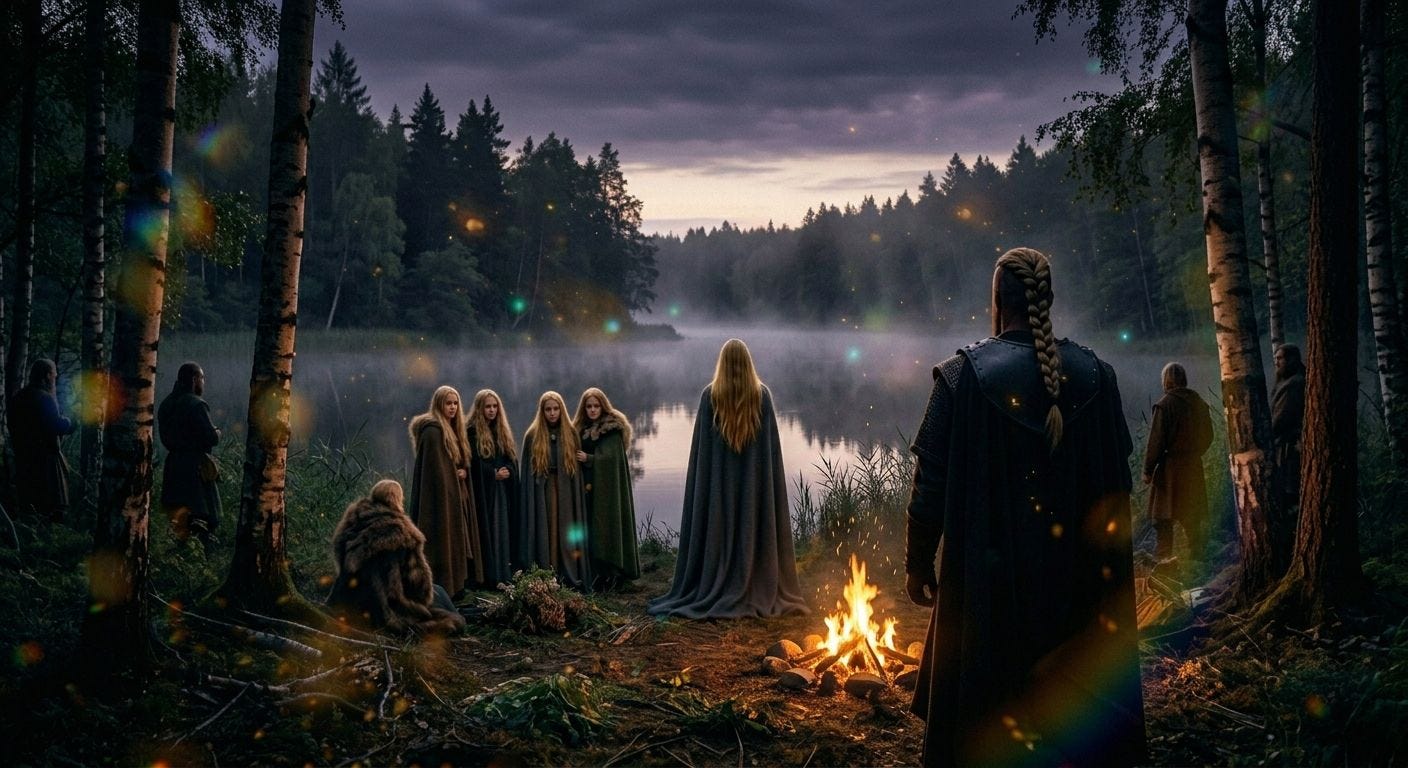
A lake lay hidden between the trees. Dark. Still. Ringed by reeds and birch.
They dismounted quickly. The men spread out without being told, listening, watching. Gustav scanned the tree line once, twice, then nodded. They were safe, for now.
As Linde hit the ground, the “cobweb” dress finally surrendered. A seam along the hip ripped with a pathetic pop of thread. Linde clutched the fabric to herself, her face burning with a mixture of exhaustion and fury.
“By the laws of the Physicus,” she muttered, trying to pin the cloth together with a sharp twig, “the tensile strength of this linen is an insult to the weaver’s craft. It’s held together by nothing but hope and bad intentions.”
Gustav was already there. Without a word, he unbuckled his heavy traveling cloak, lined with thick, dark bear fur and smelling of cedar and cold iron, and draped it over her shoulders. The weight was immense. Linde disappeared into it completely, her head peeking out from the massive fur collar like a very small, very annoyed owl in a hollow tree.
“Cover yourself,” Gustav commanded, his voice a low rumble. He turned to his men, his eyes sharp. “Cloaks. Give them your outer wools. Now.”
The Northmen obeyed, stripping off their heavy mantles and handing them to the other girls. Galina vanished into a cloak three times her size, offered by a young, broad-shouldered warrior named Rolf. As their fingers brushed, Rolf turned a shade of red that Linde noted was roughly the same color as a bruised beet.
Interesting, Linde thought, her eyes narrowing even as she shivered. A clear case of localized blood-flow increase triggered by proximity. I’ll have to observe if his pulse remains elevated.
“Rolf,” Gustav barked, snapping the young man out of his daze. “Take the swiftest mare. Ride east. Avoid the trade routes. Find King Artemij’s scouts and tell them his daughter is safe. Tell him she is under my protection and we ride for the North Castle.”
Rolf nodded, his gaze lingering on Galina for a heartbeat too long before he vanished into the trees, the rhythmic thunder of his horse’s hooves fading into the dusk.
The girls stepped forward then, moving as one. They bowed, not the quick bob of a servant, but the deep, formal eastern greeting of the high courts, their foreheads lowering toward the warm earth, hands open to the sky.
“They thank you,” Linde said, her voice a soft bell in the twilight. “For the iron that held the line.”
The men stilled, caught in the gravity of the gesture.
As the sky deepened into a bruised violet, the girls slipped toward the lake’s edge. It was a couple of weeks after Midsummer, the time of the Kupolė, and the air was thick with the scent of pine resin and damp moss. They returned with damp hair and armfuls of the earth’s secrets: sharp-scented yarrow for strength, willow bark for the pain, and roots that tasted of survival.
They began to sing. It wasn’t a song for an audience; it was a low, steady undercurrent of hope that wove through the trees like mist. It was an ancient, earthy melody, the voices of the girls harmonizing in a way that seemed to pull the very mist from the water. Linde’s voice was a clear, soaring soprano that climbed higher and higher, vibrating with a resonance that seemed to shiver the very surface of the lake. It was a voice of glass and light, possessing a technical power that felt almost divine, hitting notes that hung in the air like stars, pure and unwavering. The song was an ancient hymn of the mountains,a yearning melody that spoke of a heart finally awakening.. They sang of the moon’s pull on the tides and the fire that lives inside the stone.
Gustav sat like a statue, his eyes fixed on her. He felt the music not in his ears, but in his blood. He had always been captivated by her voice, but this melody was a visceral lure.
Linde stayed near the flames, her movements fluid and practiced. She crushed the herbs, her mind far from the market and the ropes. She was a daughter of Velena now, a weaver of health. Gustav sat a few paces away, a silhouette of iron against the flickering amber light. He watched the forest, but his stillness was focused entirely on her.
When the venison was shared and the others had begun to drift into a shallow sleep, Linde approached him. She carried a small horn cup, the steam rising in a thin, fragrant curl.
He took it from her, his fingers brushing hers. The contact was electric, a jolt of awareness that made her pulse skip.
“What is this?” he asked, his voice a low vibration.
“”It is an infusion of crushed Rhodiola and winter-berry to restore the vital pneuma. For strength,” she said, her eyes meeting his. “And for the clarity a leader needs when the path is dark.”
He drank, his eyes never leaving hers. “You have your mother’s hands,” he murmured. “And her certainty.”
Linde felt a sudden, sharp ache in her chest. “You speak as if you knew her.”
“She saved my life,” Gustav said, his gaze softening until the “Steel” was replaced by something far more vulnerable. “Seven years ago, when the world was fire and ash, she was the light that brought me back. I have carried the debt of that light every day since.”
Grief and a strange, shimmering pride tangled in Linde’s throat. “I am following her path,” she whispered. “But I did not think the path would lead to you.”
“Perhaps the path knew the way better than we did,” he replied. He looked at her then, and for the first time, Linde didn’t feel like a princess or a prisoner. She felt like a woman being seen by a man who had waited a lifetime to recognize her.
“I’m sorry,” he added softly. “I know she is gone.”
“She still guides my hands,” Linde said, her voice steady.
“I believe that,” he said, and the conviction in his voice felt like a vow.
A signal passed quietly through the camp: a low whistle like a night bird. It was time to move. As they mounted, the world felt different. The fear was still there, but it was being pushed back by a new, silent alignment.
“We’re going north,” Gustav said as his horse stepped into the trees. “To the lakes and the deeper forest. My lands. No one hunts there without my permission.”
The words carried no threat, only a deep, protective certainty. Linde looked back at the girls, then at the man leading them.
“They will follow you,” she said.
“No,” Gustav replied, looking over his shoulder at her. “They follow you. I am merely the shield you carry.”
They rode on into the deepening night, the forest closing behind them like a door. Ahead, the Great North waited: pale, cold, and full of a destiny that had begun seven years ago in a house of healing.
🧠 Behind the Saga: The Anthropology of the Heavy Cloak and the Power of the Apothecary
The Somatics of the Heavy Cloak In the aftermath of a deeply dysregulating event, the body’s autonomic nervous system requires profound, physical intervention to signal that the threat has passed. When the sheer, flimsy “cobweb” dress finally rips, it represents the ultimate failure of a garment—it offers neither physical protection nor psychological safety. Gustav’s response is immediate and structural: he provides his heavy, bear-fur cloak.
This is not merely a romantic gesture of a knight offering his coat; it is a physiological reset. The immense weight of the thick wool, fur, and iron acts as deep pressure therapy. For a neurodivergent mind whose sensory input has been dialed up to a dangerous extreme, the heavy cloak provides vital proprioceptive feedback, grounding Linde back into her own body. She disappears into it “like a very small, very annoyed owl,” effectively re-establishing the social skin and physical boundaries that the market attempted to strip away.
(If you want to dive deeper into how our everyday wardrobes act as sensory regulation, I recently explored this exact phenomenon in my essay, Fashion Is a Nervous System Problem).
Ethnobotany and the Reclaiming of Agency When the group finally reaches the safety of the lake, the girls do not simply collapse into exhaustion. Instead, they immediately engage with their environment, gathering yarrow, willow bark, and rhodiola. This is a critical behavioral shift.
Historically, botanical medicine was overwhelmingly the domain of women. In power structures where men exerted control through iron, swords, and physical force, herbalism provided an alternate, almost subversive axis of power. Because this botanical knowledge operated invisibly—understanding the chemical properties of a root or the analgesic effects of a bark—it was frequently mythologized or feared by outsiders as witchcraft. To the uninitiated, pulling survival from the dirt looked like magic. But for women like Linde, it was a rigorous, clinical science.
Crucially, this moment of foraging is about regaining control. For days, these women had their physical agency completely stripped away by their kidnappers. They were bound, displayed, and commodified. The absolute very first thing they do upon reaching safety is reassert their autonomy by practicing their craft. By mixing the rhodiola infusion to restore vital pneuma and treating their own wounds, they are declaring that they are no longer victims waiting for a warlord to manage their survival. They are active participants in their own recovery. The apothecary is their counter-measure to the trauma of the market.
Furthermore, their singing at the edge of the lake is a highly functional behavioral ritual. Harmonizing together creates a shared, sustained resonance in the chest cavity, activating the vagus nerve to physically shift their bodies out of the fight-or-flight state. It is an ancient, collective technology for trauma recovery, blending the chemical restoration of the herbs with the neurological regulation of sound.
💭 📬 Over to You: Linde uses the apothecary to reclaim her agency after a traumatic loss of control. I am always fascinated by the small rituals we use to get back in the driver’s seat. If you have a specific grounding action you rely on, leave a comment or message me directly, I read every single reply.
🔥 Step Deeper into the Pattern Thank you for reading Chapter 5! If you want to experience the full breadth of the world Linde and Gustav are moving through without waiting for the next chapter, you can read ahead right now. Books one and two of the Firebound Saga (Emerald to Steel and Salt and Gold) are fully available on Amazon Kindle.