
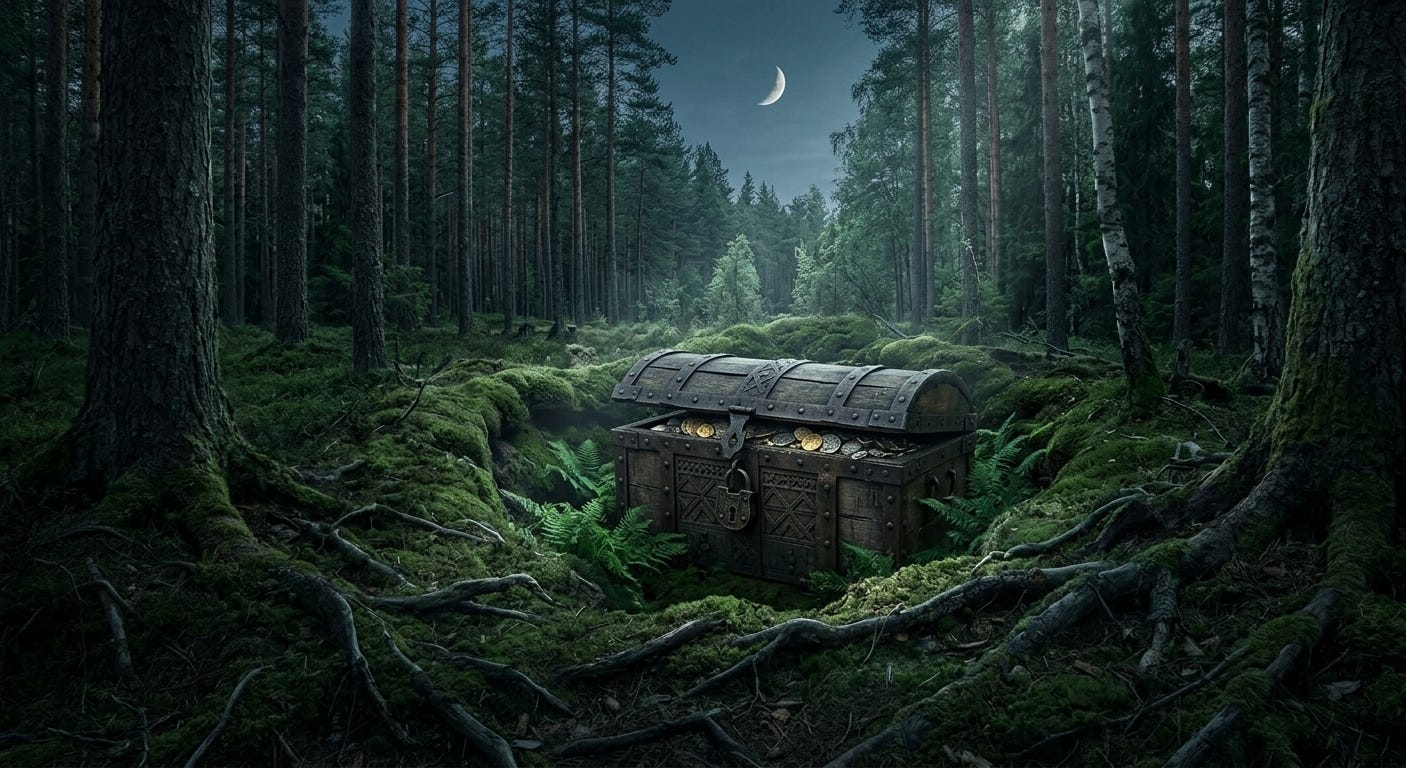
They rode until the forest lost all sense of time. The pace slowed as Gustav led them deeper beneath the ancient canopy, choosing ground where hooves left little mark and the damp moss swallowed the sound of their passing. They avoided the established trade paths, cutting through waist-high fern and tangled undergrowth, crossing shallow, stone-bottomed streams that erased their scent and trail. When night fell, they did not stop. When the moon rose, a pale sliver of bone in the sky, they rode beneath it, silent and intent.
By the time they made camp in a hidden hollow beneath a ring of weeping birches, exhaustion pressed down on Linde like a physical weight, thrumming in her marrow.
The girls dismounted with stiff, trembling limbs, helped by Gustav’s men, who moved with the quiet efficiency of ghosts. No one spoke. Fires were kept so low they were mere orange eyes in the dark. Food was shared without ceremony: dried meat that tasted of salt and woodsmoke.
Linde sat near the edge of the dying light, her body finally surrendering to the fatigue. She was half-asleep, her head nodding against her chest, when she noticed Gustav kneeling near the embers, his back turned to the camp.
He loosened the heavy leather straps of his left boot and pulled it free. Then, reaching beneath his cloak, he unfastened a series of thick, reinforced buckles. The sound: a heavy, metallic clink-thud: made Linde open her eyes fully.
What he removed was not flesh.
It was a leg: shaped and jointed with masterful precision, crafted of dark, seasoned oak reinforced with bands of cold-wrought iron. The leather straps were worn soft, cared for with the devotion a knight gives his primary blade.
Her breath caught, the sound hitching in her throat. The physician in her saw the stump: the clean, scarred lines of an old amputation. Memory rose, not sharp like a blade, but warm and inevitable, like a fever breaking. She saw a darkened room in her father’s castle. She smelled the tang of vinegar and the iron scent of blood.
His name. The leg. The song. The hand she had held for three days while a nameless boy drifted between worlds. Everything connected now.
Gustav...I... I know who you are,” she whispered, her voice barely audible over the crackle of the wood.
Gustav stiffened, his hands pausing on the leather straps. He turned slowly to face her, the low firelight catching the sharp, scarred planes of his face.
“I remember,” she said softly, her voice trembling with the weight of seven years. “You were so still. I thought you were a statue that had forgotten how to breathe. I used to sing to you because the Southern masters taught us that silence lets the rot win: that the soul needs a thread of sound to find its way back to the body.”
Gustav’s steel-blue eyes softened with a look of profound, quiet recognition. For a moment, the hardened Commander vanished.
“You were the child with the ink-stained thumbs,” he murmured, his voice a low rumble that vibrated in the air between them. “I woke up in a haze of fever and heard a voice that didn’t belong in a house of pain. I truly believed a Ljósálfar: a little light elf: had come to guide me out of the fire. I have carried that melody in my head through every winter since.”
Something like relief crossed his expression.
“My brothers will be so grateful,” she said softly. “My father too. Knowing I’m traveling north with you... they’ll sleep easier.”
The fire crackled between them.
She felt her eyes closing again, sleep finally pulling her under.
Before it claimed her fully, she murmured “You were very brave.”
The words were the same.
He felt it immediately, the lightness, sudden and unexpected, as if some old wound had loosened its grip. They slept not far from one another.
The scream tore him awake.
Gustav was on his feet before the sound finished echoing.
Arrows hissed through the dark.
“Up!” he shouted. “Move!”
The forest erupted into chaos: hooves, shouts, steel flashing in firelight. Gustav drove forward, blade meeting blade, forcing space where there had been none. Pain flared as something struck his chest, not deep, but enough to stagger him. He pushed through it.
Linde stumbled as an arrow grazed her shoulder, heat blooming across skin. She bit back a cry, forcing herself to keep moving.
“They’re after her!” someone shouted from the darkness.
The words carried with them a terrible clarity. “They’ve put a price on the girl,” another voice called. “A reward fit for kings! Share it with us, give her back!”
The Varangian leader, Marek, stepped into the flickering light of the campfire, surrounded by a dozen men with drawn steel. “Gustav!” he shouted, his voice thick with greed. “Stop this madness! We have a chest of Byzantine gold for that girl. We’ll split it with you and your men. Think of it! You can retire to the halls of the South, drinking wine while someone else fights your battles. Why die for a girl who belongs to a dead alliance?”
Gustav stood, his prosthetic leg locked firmly into place, his Dane-axe singing as it was unslung from his back.
They broke through the trees at last, horses screaming with effort, arrows falling behind them.
When they finally stopped, breath ragged, blood drying, the decision was already forming.
“We split,” Gustav said. “Now.”
The men did not argue.
“If they’re hunting her,” one of them said grimly, “they’ll follow the largest trail.”
Gustav nodded. “I’ll take her north. Alone.” Linde looked at him sharply.
“The mountains,” he continued. “Hard ground. Dangerous. But I know it. They don’t.”
The girls cried out in distress, voices breaking, but Linde shook her head.
“This is the only way,” she said. There was no time for farewells.
They mounted quickly, Gustav swinging into the saddle with practiced ease, Linde behind him, arms tightening around his waist as the others scattered in different directions, vanishing into the trees.
“Hold on,” he growled.
“I am holding on so hard I may actually become part of your armor,” she informed him, her heart hammering against his back.
The forest closed again.
Ahead lay deeper woods, rising ground, and the wild places where maps failed.
Gustav did not hesitate. He turned north.
🧠 Behind the Saga: The Silk Road of the North and the Global 10th Century
When we picture the 10th-century Northern Europe, popular culture often gives us isolated, snow-battered villages cut off from the rest of the world. But Chapter 6 highlights a very different reality: the medieval world was deeply and inextricably connected. When the Varangian mercenary, Marek, offers Gustav a “chest of Byzantine gold” to hand Linde over, it isn’t an empty boast.
The Varangians were the linchpins of a massive, transcontinental trade network. Using the vast river systems of Eastern Europe, they connected the deep forests of the North directly to the sprawling, wealthy metropolis of Constantinople (which they called Miklagard) and the Abbasid Caliphate. The North exported furs, amber, and captives; in return, they brought back silk, spices, and literal chests of Byzantine gold and Islamic silver.
This global interconnectedness was economic but also intellectual. When Linde recognizes Gustav’s amputation, she recalls the teachings of the “Southern masters.” During this period, the Byzantine Empire and the Islamic world were the epicenters of advanced medical science, preserving and expanding upon classical Greco-Roman texts. The fact that a healer in a Northern castle is applying Southern medical philosophy (”silence lets the rot win”) to treat a Northern warrior demonstrates how ideas flowed along the very same trade routes as silver and steel.
Gustav’s leg is a perfect synthesis of this cross-cultural survival. Although his life was saved by the advanced surgical knowledge of Linde’s mother, the prosthetic crafted of dark oak and cold-wrought iron, is an artifact of pure Northern engineering. It is practical, resilient, and cared for “with the devotion a knight gives his primary blade.” It is a vital piece of somatic technology that allows him to remain an apex predator in a harsh world.
🌱 Room for Thought: In Chapter 6, we see how the flow of global trade impacts Linde’s personal safety, turning her into a prize for distant empires. We often think of globalization as a modern concept, but our ancestors were deeply influenced by invisible international networks. When you look at your own daily life, how much of your routine, or the tools you rely on to survive, are shaped by systems operating thousands of miles away?
🔥 The Story Doesn’t Stop Here
Thank you for reading Chapter 6! If you are hooked and don’t want to wait for the next serialized drop to see how Linde and Gustav survive the Northern mountains, the journey continues right now. You can dive into the complete first two books of the Firebound Saga: Emerald to Steel and Salt and Gold on Kindle.