
They rode deep into the mountains before Gustav finally slowed.
The land rose sharply now, pine giving way to rock and narrow paths only those who knew them would dare take at speed. Linde felt his breath change beneath her arms, measured, tight, and only then did she realize the warmth soaking into the cloth she pressed to his chest.
“You’re bleeding,” she said urgently.
“I know,” he replied, voice steady. “A little farther.” She did not argue : but when the ground finally leveled into a narrow shelf above a ravine and he reined in, she slid down before the horse had fully stopped. Her legs were still shaky, but her mind was already focused on the dark, spreading stain on his tunic.
“Sit,” she ordered, the soft woman from the furs replaced instantly by the sharp-eyed daughter of Velena. “You have emptied enough of your life into your boots to turn a waterwheel. Even a man of iron cannot walk when his veins are hollow.”Gustav grunted, easing himself down against a gnarled pine. “I’ve had worse.”
“Men always say that right before the blood-rot takes their mind,” she muttered, her fingers already flying over the buckles of his armor.
She built the fire with clinical efficiency, her hands moving like a blur. While the flames caught, she began laying out her tools: a needle, silk thread, and a pouch of pungent herbs.
Gustav leaned back against a tree, watching her with something between amusement and awe.
“You don’t hesitate,” he said.
“There’s no time for it,” she replied. She moved close, her fingers nimble as she cut away the bloodied wool of his tunic. As the fabric fell away, revealing the broad, scarred expanse of his chest, Linde felt a strange, internal jolt, a sudden rush of heat that had nothing to do with the fire.
Note for the scrolls: she thought, desperately trying to anchor herself in the safety of her mother’s teachings. The proportions of the warrior are formed here in a hard, unyielding symmetry... His pulse is a rapid thrumming beneath the skin, suggesting a dangerous excess of sanguine humor. My own pulse: identical. Analysis: A mutual quickening of the spirits brought on by the shadow of combat... or perhaps a localized fever caused by the sheer, staggering proximity to so much unclad King...
She reached for her bag, her fingers searching for the dried yarrow or the poppy-syrup. Then, she froze. Her face went pale in the amber firelight. “The valerian. The yarrow. It was in the secondary satchel. We left it at the camp during the ambush.”
She looked at the needle, then at the jagged, angry tear in his chest. Without the herbs to dull the nerves, she would have to be brutal. Her hands trembled, not from fear of the blood, but from the clinical horror of causing him pain.
“I don’t need the plants, Linde,” Gustav said. His voice was a low, steady anchor in the dark. “Just stitch. I can hold a breath for a needle.”
“This will hurt,” she warned, cleaning the wound with a cloth soaked in strong spirits. The scent of sharp alcohol rose between them.
“I trust you,” he said. The words were a low, gravelly vibration that she felt in her own teeth.
Linde paused, the needle poised. “That is a very dangerous thing to say to a woman who is currently holding a sharp object and is... annoyed with your lack of self-preservation.”
She moved closer, needing the light of the fire to see the deep ragged edges of the skin. To reach the straps of his remaining armor, she had to press her body nearly flush to his. Her chest brushed his heaving chest; her breath ghosted over the frantic pulse point in his neck.
“I need light,” she muttered, her own breath hitching. She found a bit of resinous pine and struck a spark. The tiny flame illuminated the ruins of his skin: and the staggering, rugged beauty of the man beneath the scars.
He was a map of violence and survival. White lightning-scars from old campaigns crossed the ridges of his muscles. Linde’s fingers moved over him with a reverence she couldn’t hide. She was a daughter of Velena; she had seen a thousand men’s bodies, but none that felt like this: none that felt like a landscape she wanted to get lost in. Each touch sent a jolt of awareness through her that made her vision swim.
She began the stitching, her face inches from his. The heat coming off his body was intense, smelling of woodsmoke, rain, and the wild, metallic scent of a warrior. To distract herself from the ripple of his muscles beneath her hands, she spoke.
“Your mother,” she said softly. “My mother spoke of her.”
His expression shifted. “She’s gone too.”
Linde’s hands stilled: “I’m sorry.”
“They wrote to each other,” he continued. “Long letters. About herbs. About birth and death and everything between.”
Her throat tightened. “They would have liked this,” she said. “Us keeping each other alive.”
A faint, pained smile touched his mouth. When the stitching grew deeper, his breath grew heavier, his fingers digging into the earth to stay still. She worked carefully, counting her stitches under her breath. Each time the needle pierced the skin, his muscles jumped, a violent, beautiful ripple of power. To steady herself, her left hand rested against the uninjured side of his chest, her thumb accidentally brushing over a dark, intricate line of ink near his collarbone.
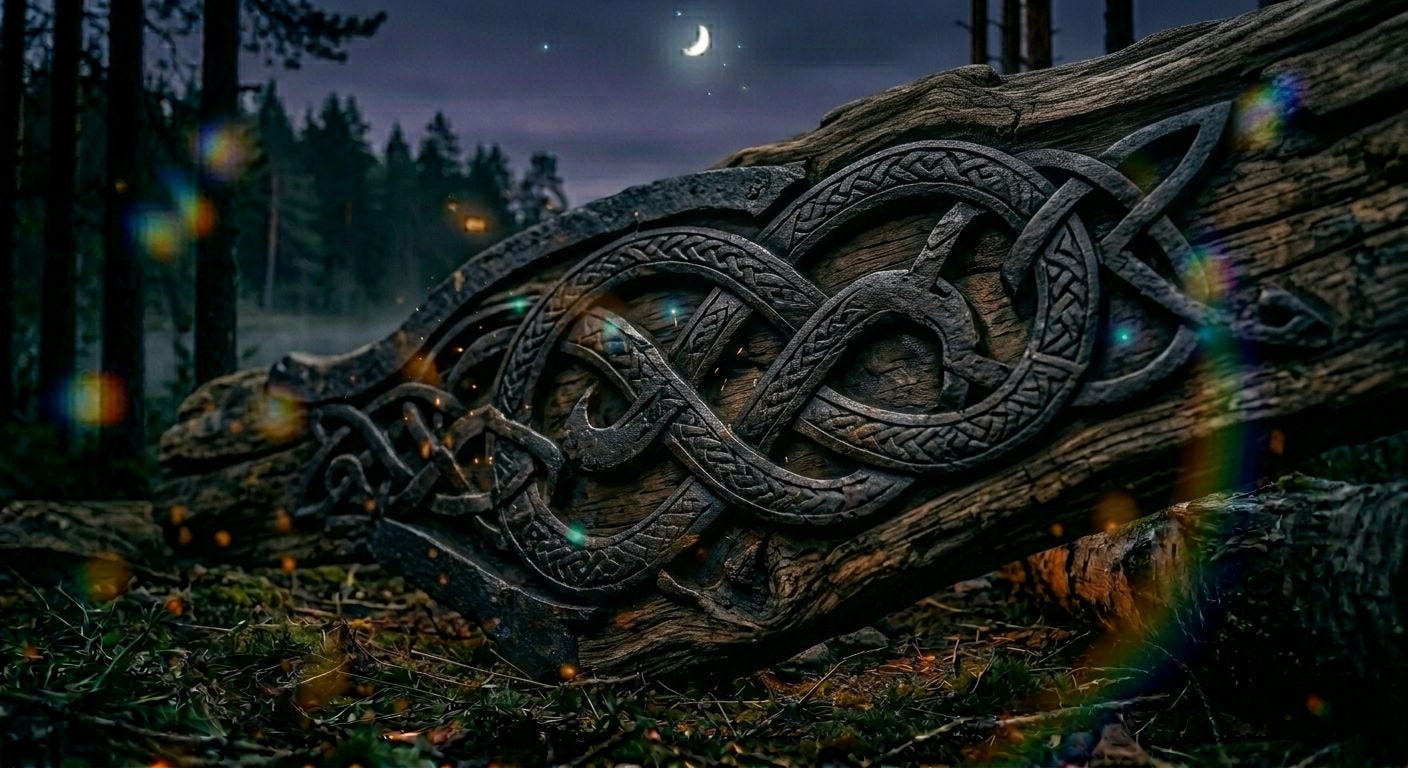
It was a knotwork design of two serpents, their bodies intertwined in a complex, flowing dance, but the pattern stopped abruptly at their necks. The heads were missing; the serpents were blind, drifting into empty skin.
“This mark,” she murmured, her thumb tracing the dark ink to break the stifling silence. “Is it a work in progress? It looks as though the needle-master was interrupted mid-thought.”
She didn’t look up, keeping her focus on the silk thread, trying to sound as though she were merely commenting on the weather.
Gustav’s jaw tightened. He looked down at her small, pale hand resting against the unfinished vow on his chest.
“It is a Marriage-Bind,” he said, his voice a low, jagged rasp. “Or it was meant to be. In the North, we start the pattern when the contract is signed. We finish the heads, the eyes, only when the hall is shared.”
“But you left it unfinished?” - she asked, softly.
“She left before the ink could be finished. Now it is just a broken thread. She decided life with a wounded man would be... quieter than she wanted. She didn’t want a King who had to be put back together with iron and wood.”
“That was foolish,” Linde said without hesitation.
He glanced at her, startled. “You really think so?”
“I do. A bone that breaks and knits is stronger at the point of the fracture than it was before. The same is true of the spirit. A man who has survived his own undoing is the only one I would trust to lead me through a storm.”
Gustav looked at her, and for a moment, the iron in his gaze softened.
He thought of Andrej, her brother. They had stood back-to-back against the Pecheneg hordes, two men who understood the language of sacrifice. He knew of the life Andrej had found with Laila: a partnership of fire and wit that seemed like a legend whispered in the dark. Gustav had always respected it, but he had never expected it for himself.
He had spent his years since his betrothed’s departure focused on the survival of his people, holding the borders with the same grit he used to hold his breath now. He was no monk; he knew the heat of a woman’s body. He had sought the arms of village girls when the silence of the North grew too loud, relationships without the burden of crowns or contracts. He had become a man of considerable skill in those shadows, proving to himself that his vitality remained even if his body was scarred. But those encounters were mere distractions.
He had never imagined a woman like Linde, possessed of a light that rivaled the sun, would ever look at his scars and see strength instead of a tragedy.
She tied off the last stitch, her fingers lingering against the warmth of his skin. As she finished, her eyes drifted over the older silver lines nearby, jagged marks from past battles that looked as though they had been closed in haste, perhaps by his own hand in the dark of a camp.
When she looked up, her cheeks were flushed, not from the effort of the needle alone. She looked at the unfinished serpents on his chest, then back to his eyes, her brow furrowed with a gentle, baffled concern. In her world, the scales of life were meant to be balanced; a warrior who had stood as a brother-in-arms to her own kin should not be left to mend himself in the shadows.
“I have done what I can,” she began, her tone tilting into a dry, playful lilt. “But a wound like this requires a different kind of mending in the nights to come.” She arched an eyebrow, her gaze dancing between his eyes and the unfinished serpents on his chest. “Surely there is someone to take over where my hands must leave off?”
He shook his head. “There are women. But no one who stays.”
Linde frowned slightly, as if the idea confused her. “That seems... lonely.”
He didn’t answer.
Instead, he shifted his weight against the pine tree, and Linde caught the subtle, sharp hiss of his breath. He tried to adjust the heavy leather harness that buckled high above his knee, his jaw locking in a grimace. Even with the joint intact, the hours in the saddle had been brutal; the constant vibration of the horse and the weight of the oak dragging on the stump of his calf had turned the muscles of his thigh into knots of iron. She saw how his hand clamped over his upper leg, his knuckles white as he fought a deep, grinding cramp that the ride had finally brought to a head.
Without a word, she moved from his chest to the floor by his feet.
“The wood is pulling at your stride, Gustav,” she murmured, her voice stripped of everything but steady kindness of a healer. “The muscles are fighting the iron.” She looked up at him, her hands hovering over the thick, iron-buckled straps that secured the leather sleeve to his calf.
“May I?” she asked.
He nodded, his throat working as he swallowed. He felt a rare, dizzying sensation of being truly seen, not as a warrior king or a symbol of power, but as a man whose very foundation was aching.
Her hands were warm as she unfastened the laces. She set the heavy oak-and-iron limb aside, but she didn’t stop at the calf. She moved her hands higher, to the heavy muscles of his thigh that were vibrating with exhaustion. She began to knead the flesh, her thumbs finding the deep, hard knots of the “good” muscle that had been overcompensating for the missing foot.
Gustav’s jaw tightened, not from pain, but from his own agonizing effort of staying still. She was close now. Very close. He was acutely aware of the scent of her, crushed herbs and rain, and the way her capable, gentle hands were reclaiming the territory of his body that he had long ago surrendered to the cold.
When she finished, his eyes tracked a dark, irregular shadow on the heavy wool of the cloak he’d wrapped around her. On the indigo-dyed weave, it was a damp, ominous black.
“Your turn,” he said, his voice sounding like it had been dragged over gravel. He reached for her shoulder, where the arrow had grazed her through the gap in her original dress.
“I can manage,” she said, her voice an octave higher than usual.
“Sit,” he commanded, mimicking her earlier tone with a ghost of a smirk.
He reached for his belt and pulled out a leather skin, the surface worn smooth by his palm. “I have no poppy to dull the sting, but I have this. It’s a Northern mead, fermented with wild thyme and aged in the dark since the last Great Frost. It is strong enough to strip the rust off a shield and make a man forget he has a name.”
Linde took the skin, and took a cautious sip, then a much larger one. It hit her stomach like a swallow of liquid sunlight.
“Oh,” she gasped, her eyes watering. “I can feel the vapors rising to my head already.”
She turned back to the fire and slowly opened her fingers, easing the heavy wool down herself. It slid pooling around her elbows and baring her shoulders and the elegant line of her neck to the amber firelight.
Gustav didn’t look away. He had spent the last hour with her hands on his heart and his thigh; he was intimately aware of her. But as the firelight caught the slope of her shoulder, a heavy, airless stillness settled between them, the kind that precedes a storm. It wasn’t the sight of her skin that arrested him, but the sudden, startling fragility of her. In the dancing light, she looked less like a clinical physician and more like a line of poetry written in a rough, forgotten tongue.
He began cleaning the graze with agonizing slowness. His large hands were unexpectedly gentle, his thumb grazing the sensitive cord of her neck as he worked the cloth. Linde felt a shiver run down her spine that had absolutely nothing to do with the cold.
“And you?” he asked quietly, his voice vibrating against her skin. “A husband waiting for you? A suitor who has been promised your hand? Some prince who is currently sharpening his sword?”
“No,” she breathed, the mead making her tongue heavy and honest. “I am... un-contracted.”
His hands stilled for just a moment. She flushed, the warmth rising in her again, deeper now, familiar and unfamiliar all at once.
She hesitated, the firelight dancing on her bared shoulders. “We have a coming of age ritual, it helps us see the one we might choose. That night,” she said quietly, staring into the embers, “the night they took us... it was the Dew Night.”
He did not respond, only inclined his head slightly, his fingers finishing the cleaning but lingering on her skin.
“It’s a midsummer rite,” she continued. “Only women. We dance, we sing, we drink a potion of herbs meant to open the body and quiet the noisy mind.” She leaned back slightly, her head light, the cloak caught precariously at her waist.
Gustav leaned in, his breath hot against her ear as he took the mead back from her. “And did you? Did the ritual show you a face? A name?”
“It’s not meant to show you a name,” she said, her voice dropping to a whisper. “My mother said it was meant to teach you how recognition feels. So you wouldn’t mistake the noise of the world for the knowing of the soul.”
The fire popped softly. She swayed, the mead and the exhaustion pulling at her, and Gustav caught her by the waist to steady her. The contact was electric, his calloused palm against the bare skin of her side, holding her with a terrifying, steady strength.
Linde swallowed hard. “She said you would know... because your body would answer first. Because being near him would feel... steady. Like warmth spreading where you didn’t even know you were cold.”
She stopped, her breath hitching. Her medical mind was struggling to categorize the fact that her heart was currently trying to beat its way out of her chest.
“That’s all,” she said, too fast. “It’s not something meant to be explained.”
Gustav’s hands never faltered. He didn’t pull away, but he didn’t press further. “I understand,” he said quietly.
She exhaled, relieved and oddly flustered, letting the silence close gently around them.
“I’m tired,” she said quickly. The mead and the exhaustion finally won. Sleep took her almost at once, her cheek finding the hollow of his shoulder. The scent of the mead was sweet on her breath, and her body, finally warmed and mended, went limp with the total surrender of exhaustion.
Gustav sat motionless, his arm around her waist, acting as the anchor she didn’t know she needed. He watched the firelight play across her features, noting how the fierce healer-princess had softened into something fragile and precious in her sleep.
Just as the embers began to gray and the first pull of sleep reached for him, Linde stirred. She didn’t wake, but she shifted closer, her small hand curling into the fabric of his tunic, right over the unfinished serpents on his chest.
“Gustav...” she whispered. The name was a soft, melodic breath, sounding more like a prayer than a title.
He held his breath, his heart skipping a beat.
“Don’t... don’t be alone,” she murmured, her voice sounding small and tender, lost in the hazy golden world of the mead. “You’re too... too good for the dark.”
She let out a long, contented sigh and fell back into a deep, rhythmic silence, her forehead resting against his pulse point.
Gustav stared into the dying flames. He pulled the edge of the heavy cloak higher, tucking it around her bared shoulder to keep the morning chill away. He felt a strange, terrifying ache in his chest, a mending of a different sort.
“Sweet dreams, my little light elf,” he whispered, his voice barely a vibration.
And for the first time in seven years, the King of the North slept without the ghost of pain, his hand resting protectively over hers, guarding the only fire that mattered.
🧠 Behind the Saga: The Anatomy of a Wound and the Psychology of Survival
In Chapter 7, the title “The Wound” carries a deliberate double meaning. While Linde is physically stitching Gustav back together, the scene also unearths the deep, invisible psychological and cultural scars they both carry. When we look at their interactions through an anthropological and psychological lens, we see how ancient people navigated trauma, social contracts, and their own nervous systems.
Culturally, Gustav’s unfinished “Marriage-Bind” tattoo is a vital anthropological detail. In many ancient Northern societies, body modification wasn’t merely decorative; it was a binding social contract. An unfinished tattoo is a permanent, public marker of an aborted promise. His former betrothed left him because (according to him) he returned from war as an amputee, desiring the pristine symbol of a warrior over the scarred reality. Linde is unburdened by these neurotypical social constructs. Raised by a witch-physician, she operates on a completely different paradigm. To her, a healed fracture isn’t a deficit; it is proof of superior biological and spiritual resilience. Her autistic, highly pragmatic worldview operates on literal truth. She doesn't care about the societal stigma of an amputation; she sees the biological reality that a healed fracture is stronger at the break.
When Linde explains the “Dew Night” ritual to Gustav, she reveals a profound piece of somatic psychology, we touched upon in Chapter 1. The ritual isn’t meant to conjure a magical vision of a future husband’s face; it is designed to teach women how to read their own physiological responses. In a 10th-century world where women were frequently traded as political currency, a ritual that anchored young women to their bodily autonomy and taught them to recognize the markers of safety—that feeling of being “steady”—was an incredibly powerful tool for survival. For Linde, the ritual also reveals a profound tool of somatic psychology. Autistic individuals often struggle with interoception—the ability to perceive and interpret internal bodily signals like stress, hunger, or arousal. Because Linde’s brain naturally over-analyzes the world to survive it, the ritual is an essential neuro-affirming tool. It was helpful to teach her to bypass her hyper-analytical mind and read her own physiological responses.
🌱 Room for Thought: The “Dew Night” ritual was designed to teach women to trust their somatic responses—to rely on their body’s physical cues to recognize safety and connection rather than intellectualizing their choices. In our modern world, we often do the exact opposite. We outsource our intuition to data, swipe on meticulously curated profiles, and use pure logic to talk ourselves out of our gut instincts. In an age where we are constantly encouraged to live entirely in our heads and screens, how often do you actually allow your body’s physical response to guide a decision before your mind has a chance to overthink it?
🔥 The Story Doesn’t Stop Here
Hope you enjoyed Chapter 7! If you don’t want to wait for tomorrow’s drop you can dive into the complete first two books of the Firebound Saga: Emerald to Steel and Salt and Gold on Kindle.