
Linde dreamed of her hands, but they were no longer her own. They were stained with the juices of crushed nightshade and the salt of a warrior’s skin. In the dream, her mother stood by a window that looked out onto a forest made of emeralds and steel: the High Forest as it had been before the raids.
Velena was as Linde always remembered her: young, vibrant, her hair a river of gold untouched by age. She had died bringing life into the world, leaving behind only the scent of dried herbs and the weight of her scrolls. She was sorting yarrow now with a rhythm that sounded like a heartbeat.
“You think you were stolen from your life,” Velena said, her voice like the rustle of dry parchment. “But you were merely being decanted into a larger vessel, Linde. A narrow jar cannot hold the wine of a Healer.”
“I was kidnapped, Mama,” Linde corrected, even in her sleep. “There was a wagon. It was very poorly sprung. I have bruises in places that have no anatomical name.”
Velena smiled, that knowing, infuriatingly calm smile. “The path to one’s destiny is rarely paved in silk. Trust your senses, Linde. Not just the ones you find in your books. Trust the heat of the blood.... And do not drift: not all predators announce themselves with a roar. Some wait in the quiet for the heart to open.”
Linde woke with a gasp, the mountain air sharp and cold in her lungs. The sun was barely a suggestion on the horizon, a bruised purple line bleeding into the gray.
Something moved in the dry leaves beside her bedroll. A dry, rhythmic scritch-hiss.
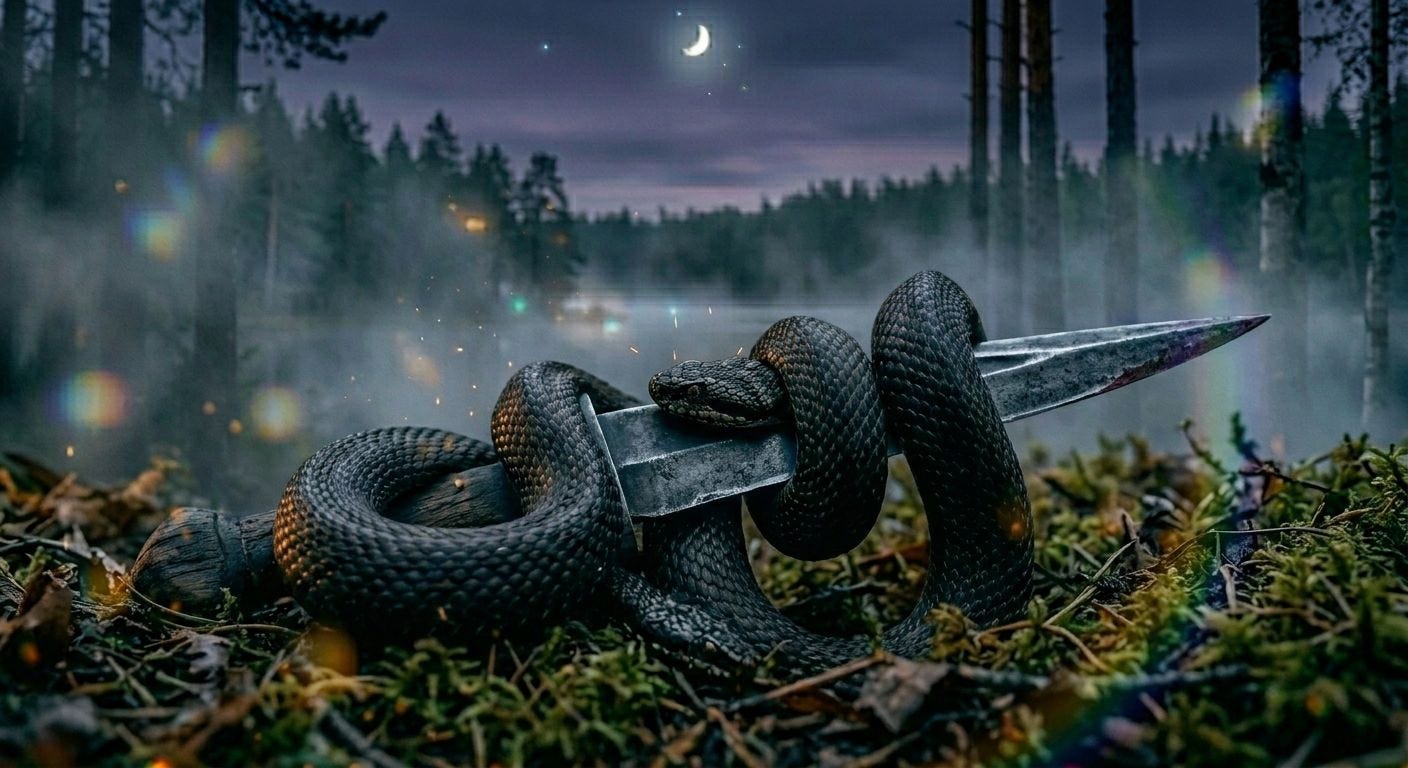
Before her brain could even categorize the sound as a threat, a flash of steel hissed through the air. Gustav’s arm came down with the speed of a striking hawk, pinning a thick, dark-scaled adder to the earth with his seax. The snake coiled violently around the blade, its body a frantic whip of muscle, then it stilled.
Gustav didn’t look at the snake; his eyes were fixed on the pale curve of Linde’s ankle, so close to the fangs. A cold sweat, more bitter than the morning frost, broke across his neck. I owe Andrej my life, he thought, the memory of his brother-in-arms dragging him from the Pecheneg mud a decade ago burning behind his eyes. I will not be the man who lets his sister’s blood spill because I was too busy staring at the way the light catches her hair.
Linde sat up, her heart performing a frantic percussion against her ribs. She stared at the dead serpent, whose head was inches from where her bare ankle had been, then at Gustav. He was already scanning the treeline, his weight balanced on his good leg, looking as if killing venomous reptiles was merely a morning chore, like banking a fire.
“Breakfast,” he smirked, wiping the blade on a clump of moss.
Linde let out a shaky laugh. “Oh, brilliant. I’ve always wanted my morning meal to be something that was actively trying to murder me seconds ago.” She crouched beside the snake, her healer’s instinct overcoming her shock. “Don’t toss the head. The venom sacs, if dried correctly, can be used to treat heart-tremors..”
“I suspected you’d find a way to make a lecture out of an assassination attempt,” Gustav replied, his eyes glinting with a genuine, warm amusement she hadn’t seen before.
They moved on as the land began to change, the soil thinning into jagged granite. By midday, the slope steepened into a treacherous climb. Gustav mounted, then reached down, his large hand swallowing hers as he hoisted her up behind him.
Linde settled against his back, her arms wrapping around his waist. Through the thick wool and leather of his tunic, she felt the massive, rhythmic machinery of his muscles. Observation: she noted, her internal monologue shifting into its protective, analytical gear. The man’s blood runs at a furnace-heat compared to the mountain’s breath. Every word he speaks travels through his spine to my own chest-bone, making my marrow shiver. Verdict: This is a perilous way to journey for a woman trying to keep her wits about her.
She rested her cheek against his shoulder, just for a moment, to steady herself as the horse navigated a narrow ledge. The scent of him, smoke, rain-washed wool, and something fundamentally male, filled her senses. A slow, persistent heat began to uncurl in her lower belly, a sensation she found difficult to map to any known digestive ailment.
“This trail,” Gustav said, his voice carried back by the wind, “was shaped by mountain goats long before men found it.”
“It’s not a trail; it’s a vertical suggestion,” Linde murmured into his shoulder. “If we fall, I would prefer to land on something soft. Like a very large, mossy meadow. Or perhaps a pile of discarded furs.”
Gustav huffed a quiet laugh. “A reasonable preference.”
“Can you guarantee it?”
He glanced back, and the intensity of his gaze made her breath hitch. He wanted to tell her he would catch the world for her if it fell. He wanted to tell her she was the first thing in a decade that felt more important than his borders. But he saw Andrej’s face in the set of her jaw. She is a guest, a treasure to be returned, he reminded himself harshly.
“No. But I can promise I’ll fall first. You’ll have a very expensive, very solid cushion.”
Linde squeezed his waist, her fingers brushing the hard line of his ribs. “Well,” she said, her voice dropping an octave, “in that case, I suppose I’ll trust the cushion.”
The word lingered between them, heavier than the mist. As they climbed higher, the air grew damp, clinging to Linde’s skin and making her thin shift translucent. She was acutely aware of the way her breasts pressed against his back with every jolt of the horse, and she could feel the tension in Gustav’s frame tightening like a drawn bowstring.
Hypothesis: she thought, her face flushing. He is aware of the proximity. The rigidity of his spine suggests a heightened state of alert. Or perhaps he’s just enjoying the view of the ravine.
Gustav felt as though he were losing his mind. Every time the horse stumbled, she pressed closer, and he had to fight the primal urge to rein in and simply hold her until the sun went down. His duty felt like a spiked collar, chafing against the raw desire roaring through his veins. He had known many women, but none whose simple weight against his back felt like a conquest.
By dusk, they reached a hidden sanctuary. A waterfall cut through the rock in a relentless white sheet, crashing into a pool hidden by shadow and spray. The air was thick with silver mist, making the world feel secluded, as if they had stepped out of time.
Gustav dismounted and reached up to help her down. His hands stayed at her waist a second too long, pulling her flush against him. Linde looked up, her lips parted, her emerald eyes searching his. The heat between them was no longer a slow simmer; it was a flashpoint.
Linde’s foot slipped on a wet stone, and she instinctively gripped his forearms. “The earth here is... remarkably unstable,” she whispered, her heart hammering.
“It isn’t the earth that’s unstable, Linde,” Gustav rasped. His gaze dropped to her mouth, his thumb grazing the damp fabric at her waist. He felt himself falling, not off a mountain, but into the depths of her gaze. Break the contact. Walk away. He knew if he kissed her now, he would be claiming her.
The silence of the mountain pressed in on them, loud and demanding. Linde felt a frantic, sweet ache in her chest. According to every scroll she had ever read, she should be retreating. But her body was conducting its own research, and the results were unanimous.
“We stop here,” Gustav said, his voice strained with a restraint that looked painful.
“Yes,” Linde breathed, her eyes never leaving his. “I believe... a thorough examination of the perimeter is required.”
Gustav’s jaw tightened. He released her, but the air where he had touched her felt cold. As he moved to tend the horse, Linde stood by the roaring water, her skin tingling. She knew the North Castle was still miles away, but as she watched the “Bear” move through the mist, she realized that the most dangerous part of the journey hadn’t been the Varjags or the vipers. It was the way her own blood sang whenever he said her name.
🧠 Behind the Saga: The Epistemology of Destiny and the Somatics of Survival
In Chapter 8, the narrative opens with a profound clash of paradigms, set entirely within the landscape of Linde’s subconscious. By dedicating the opening dream sequence to the tension between the mythos of destiny and the blunt reality of trauma, we see exactly how Linde’s neurodivergent, fiercely empirical mind processes the world.
In the dream, Velena utilizes the romanticized language of divine purpose. She tells Linde she was not stolen, but rather “decanted into a larger vessel” because a “narrow jar cannot hold the wine of a Healer.” Linde, operating as a strict empiricist, immediately rejects this mythological framing. She counters her mother’s spiritual metaphor with somatic data: citing the “poorly sprung” wagon and the physical bruises that “have no anatomical name.” To Linde, trauma cannot be painted over with destiny; it must be mapped, categorized, and understood literally.
But Velena’s warning to trust the “heat of the blood” and remember that “not all predators announce themselves with a roar”sets the thesis for the entire chapter. It is a warning that Linde’s intellectual armor is about to fail her.
When Velena uses the language of “divine purpose,” she is not speaking of the comforting, modern concept where “everything happens for a reason.” In the 10th-century pagan worldview destiny is not a benevolent, guiding hand. It is ecological, immutable, and often brutal. Fate is not meant to keep you safe; it is meant to test your structural integrity.
Anthropologically, Velena is tapping into the ancient, cross-cultural concept of the “Shamanic Sickness” or the necessary initiation of the Healer. This is the profound, unapologetic truth hidden in Velena’s metaphor. A “narrow jar” represents Linde’s sheltered, academic life before the raids. It was safe, predictable, and intellectually stimulating, but it was too small to forge true resilience. To hold the “wine of a Healer”—the crushing burden of treating shattered warriors, bearing witness to true agony, and making split-second, life-or-death choices—Linde had to be “decanted.” She had to be violently exposed to the elements, to physical peril, and to the unpredictable terror of the open road.
Linde’s empirical mind wants to categorize her kidnapping as a logistical injustice, to reject the romance of “destiny.” But Velena is forcing her to confront a harsh biological and psychological reality: a tree grown inside a greenhouse will snap in the first real storm.
We see this play out the moment she wakes up. Faced with the visceral terror of an adder strike, Linde doesn’t succumb to shock; she immediately categorizes the snake’s venom sacs as a treatment for heart-tremors. Her autistic brain uses scientific categorization as an intellectual buffer against the trauma. This buffering continues during the harrowing mountain ride with Gustav. As she experiences acute physical arousal from his proximity, she refuses to process it simply as desire. Instead, she retreats into a formal internal monologue, framing her physiological reactions as an “Observation” and a “Hypothesis.” She uses clinical language to maintain a safe distance from the reality of her own biology.
Meanwhile, Gustav is fighting an entirely different battle: the collision of biological imperative and fictive kinship. In ancient warrior societies, a life-debt was a binding social contract stronger than blood. Gustav views Linde not just as a woman, but as a “treasure to be returned” to Andrej, the brother-in-arms who saved his life. He is bound by a strict masculine code where the debt to the brother places a powerful taboo on the sister. His rigid spine and painful restraint are the physical manifestations of a man trying to honor a societal structure while his primal instincts roar in the opposite direction.
Ultimately, the isolation of the waterfall strips both of their shields away. Gustav realizes the “unstable earth” is just an excuse, and Linde realizes her mother’s dream was right: the most dangerous predator wasn’t the Varjags or the viper. It was the quiet, terrifying vulnerability of opening her heart, something no medical scroll could ever prepare her for.
🌱 Room for Thought:
Anthropologically speaking, every human society develops rituals and frameworks to protect itself from the unpredictable chaos of the natural world. In the 10th century, those cultural shields were woven from myth, rigid kinship laws, and literal armor. Linde’s personal shield is her empirical categorization, she treats her own nervous system like a foreign landscape to be mapped rather than inhabited.
Today, our societal rituals of control look different, but they serve the exact same function. We track our sleep cycles on wearables, optimize our routines with algorithms, and reduce our physiological responses to data points on a dashboard. We use data as a modern cultural talisman to ward off the terrifying vulnerability of simply being a biological creature. When we encounter a visceral somatic response, fear, gut intuition, or desire, our instinct is to immediately measure and intellectualize it, domesticating the experience before it can threaten our illusion of control.
If you strip away the screens, the metrics, and the analytical armor, what is left? When was the last time you allowed a biological instinct to guide a decision without requiring a data set to justify it first?
🔥 The Story Doesn’t Stop Here
If your brain is currently looping on that waterfall scene and you refuse to wait for tomorrow's chapter, I have good news. You can skip the daily drops entirely. Dive into the complete first two books of the Firebound Saga: Emerald to Steel and Salt and Gold ready to read on Kindle right now.