
In today’s chapter, we explore the myth of historical modesty and the tactile reality of 10th-century survival. The anthropological breakdown follows at the end of the chapter.
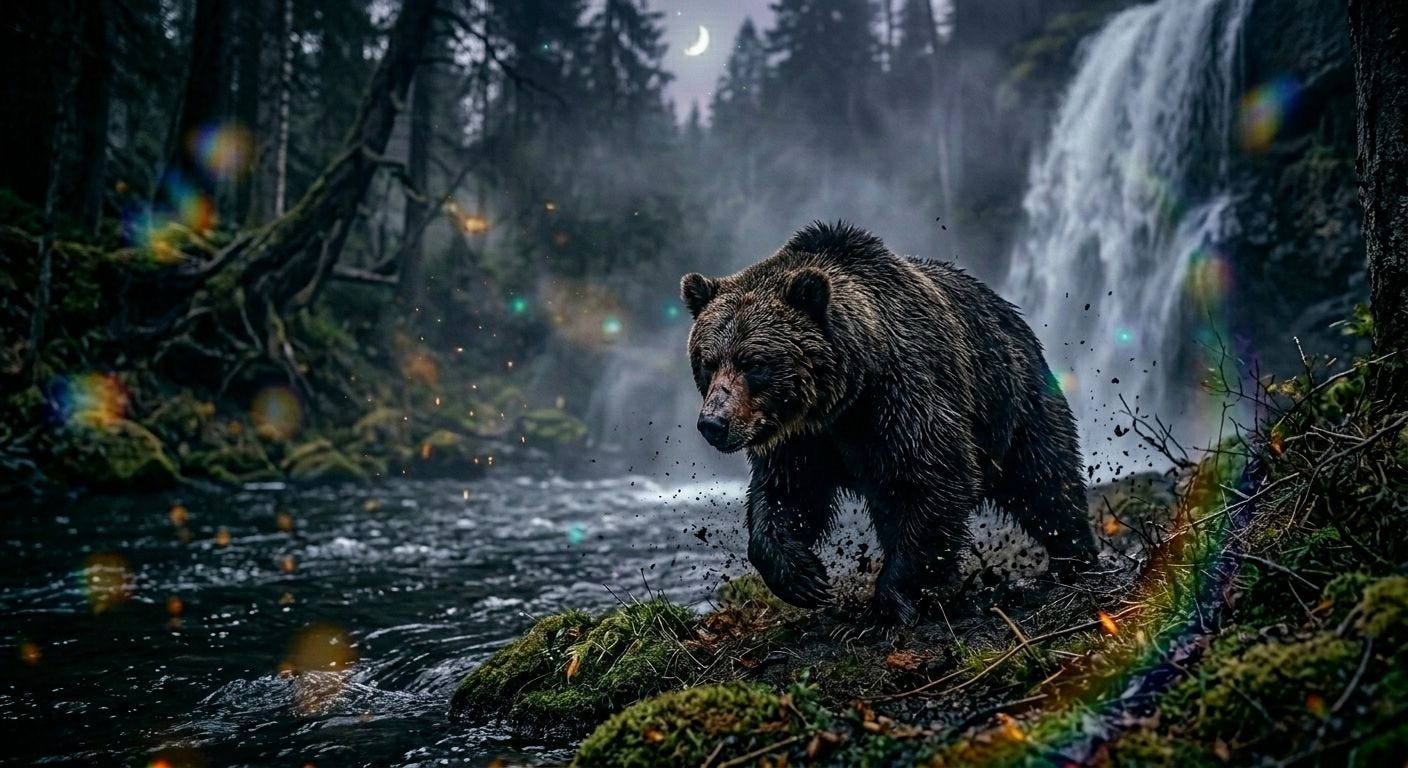
The waterfall revealed itself only when they were nearly upon it, a silver scythe cutting through the ancient mountain-bone. Mist drifted outward in a cool veil, clinging to skin and hair, swallowing the world inside its roar.
“This place is hidden from the eyes of men,” Gustav said, his voice a low vibration. “We can rest. Briefly.”
They separated without ceremony, the unspoken need for cleansing a palpable thing between them. Linde found a pool shielded by a natural screen of jagged granite. She shed the heavy bear-fur cloak and the tattered, pathetic remnants of the Varangian silk, her fingers fumbling with the fastenings. She felt the heavy, humid weight of the air against her skin: the animal heat of the climb still radiating from her limbs like a fever. Her entire body throbbed with the lingering tension of the pursuit.
When she finally stepped into the water, the cold was a physical blow, a sharp, exhilarating correction to her internal furnace. She gasped, her chest tightening as the frigid water slid over her shoulders and between her breasts, prickling her nipples to hard points.
Observation: she thought, closing her eyes as she stepped into the frigid water. The cold should, by all laws of the Greeks, dampen the ‘pneuma’ and cool the blood. Yet, the friction of the current against my skin is producing a diametrically opposed result. My internal temperature is rising. Hypothesis: I am no longer a physicus observing a fever; I am the fever.
Then she heard the rhythmic strike of water against a larger form.
She opened her eyes, her breath catching, and looked through a narrow cleft in the stone. Gustav stood directly beneath the main cascade, his back to her. He was naked, his form carved from the same granite as the mountain itself. Water traced the heavy ridges of his shoulders, the dark, intricate ink-work that spiraled down his spine, and then pooled in the deep valley of his lower back before coursing over the powerful curve of his buttocks and thighs. He was a monument of male strength, utterly untamed.
Her breath caught in her throat. According to her mother’s anatomical scrolls, the male form was a marvel of utility, designed for strength and procreation. But the scrolls had failed to mention the sheer, staggering, primal weight of it, the way it could take her breath away.
Heat, sudden, thick, and undeniably potent, bloomed in her lower abdomen. The cold water felt like oil on a fire. She watched the way his hands pressed against the stone, the muscles in his arms coiling like heavy cables. He wasn’t relaxed; he was fighting a state of profound ‘tonos,’ his jaw set as if he were trying to outlast the mountain itself.
Linde watched through the cleft in the rock, her breath hitching as the water hammered against him. He wasn’t just bathing; he was in a state of violent internal war. His hands were splayed against the granite, his knuckles white, his arms vibrating with the effort of staying still.
She saw the way the water cascaded over the hard, flat planes of his stomach, down to the heavy, dark hair at his groin. As he shifted, turning slightly to catch the full force of the falls against his chest, she got a staggering glimpse of him, the beautiful masculinity the scrolls had never dared to illustrate. He was fully, powerfully aroused, his body reacting to the same magnetic pull that was currently unraveling her. He wasn’t touching himself; he was doing something much more difficult. He was standing there, jaw clenched until the tendons in his neck stood out like cords, letting the icy mountain runoff punish his skin in an attempt to drown the fire in his blood.
He looked like a fallen god trying to reclaim his divinity through pain.
Linde realized then that the “internal battle” he was fighting was the same one she was losing. He was trying to protect her from his own hunger: to remain the “Shield” she needed: even while his body demanded he be the “Bear.”
Clinical Verdict: her mind whispered, though the words felt like ash. The humoral imbalance is no longer theoretical. The ‘vital heat’ has reached a point of potential combustion. If he turns... if he sees me... the pneuma will not merely shift. It will shatter. And I... I find I am no longer afraid of breaking.
She watched the way his chest heaved, his nipples dark and tight against the cold, and she felt an almost irresistible urge to step through the stone, to press her own heat against that shivering, powerful back and see if the mountain would truly survive their collision.
Linde felt a pulse in her marrow, a localized thrumming in the soft tissues between her thighs that her medical training had never quite prepared her for. Her fingers slipped over her own skin, trailing through the water to the sensitive folds that felt swollen and aching. A low, involuntary moan escaped her, lost in the roar of the falls, as she arched her back against the cool stone.
She let her head fall back, her throat exposed to the spray, surrendered to the heavy, sweet ache.
The water around her rippled, not from the fall, but from a displaced mass. Linde turned, her eyes snapping open, and her heart felt as though it had turned to ice.
The bear was a mountain of dark fur and ancient hunger, emerging from the brush just ten paces away. It was a Great Forest Bear, its muzzle scarred and dripping, its eyes two beads of black malice fixed directly on her.
Linde’s scream was a sharp, high-pitched fracture in the roar of the falls.
The beast rose. It didn’t just stand; it ascended, looming over her, its massive shoulders rolling with a strength that could crush stone. It huffed: a deep, wet sound that smelled of rotted meat and pine: and its claws gouged into the mud as it prepared to claim her.
Gustav was there before the sound had even faded. He broke through the mist like a vengeful god, naked and glistening. He didn’t hesitate; he snatched his seax from the rock and caught Linde by the arm, his grip bruisingly firm, hauling her out of the pool and thrusting her behind the iron shield of his back.
“Stay!” he roared.
The bear lunged. Gustav met it not with a retreat, but with a primal, bone-shaking shout. He advanced, making himself a towering silhouette of Norse fury. He struck the steel of his blade against the granite rock, creating a shower of sparks and a terrifying, metallic clangor that rang through the canyon.
The bear reared, swiping a paw that could have decapitated a horse. The wind of it whistled past Gustav’s naked chest, but he didn’t flinch. The sheer, concentrated aggression of the man: his absolute refusal to show fear: broke the animal’s momentum.
The bear snorted, its head swaying in confusion, before it dropped back to all fours and retreated into the thicket, the crashing of its flight sounding like falling timber.
Silence returned, save for the roar of the water. Gustav stood there for a long moment, his chest heaving, his body still vibrating with the pneuma of the fight.
He turned to her then, his movement slow and heavy. Linde was still pinned against the stone, her skin pale and glistening with the silver spray. She was shivering, silent tears tracking through the water on her face, her eyes wide with a profound, terrifying awe. She looked at him: at the man who had just stood unarmed and naked against a mountain-demon to shield her: and she felt her old world of logic and books simply dissolve. He wasn’t just a man; he was a force of nature, whose beauty in that moment was almost too much to bear.
Gustav stepped into her space. To him, she was a vision of staggering grace, her slender form and the soft, feminine curves of her body striking him with more force than the beast had. He wanted nothing more than to pull her against him.
He reached out, his large, wet hands, still shaking with the waning adrenaline, coming up to cup her face. His palms were rough and scorching against her cold, wet cheeks. He leaned in, his pupils blown wide, searching her eyes with a desperate, protective intensity.
“Are you with me?” he rasped, his voice a low, jagged rumble. “Linde. Look at me. Are you all right?”
Linde couldn’t find her voice. She was utterly undone by him. She looked into his eyes and saw a fire there that was older than the mountain. She reached up, her fingers trembling as she touched the wet skin of his wrists, her touch light as a bird’s wing. The air between them became thick, heavy with the scent of wet earth and the raw, animal proximity of their bodies. They stood inches apart, the mist swirling around them, the heat of their breath mingling in the cold air, as a total, silent surrender to the gravity of what they were to each other.
For a heartbeat, the world ceased to exist.
She finally exhaled, her gaze drifting downward before meeting his eyes again. “I... I must say, Gustav... you certainly know how to intimidate a Bear...”
Gustav froze, following her gaze to his own nakedness. A low, surprised laugh broke from his chest, rich and genuine. He shook his head, the tension in his jaw finally snapping.
“You’re fine, little elf,” he chuckled, though his face hardened again as a sharp, shrill whinny cut through the mist. Jacob was still rearing at his tether, his hooves thundering against the earth, fighting the scent of the predator.
Gustav let out a sharp, pained exhale and pulled his hands away, the warrior’s mask sliding back into place.
“The horse,” he whispered, his voice gaining its edge of command. “We leave. Now. Jacob is half-mad with the scent, and I’d rather not meet the rest of that bear’s family.”
He waded out of the pool and reached for his furs, leaving Linde standing alone in the spray.
The cold hit her instantly, but the inner fire remained, a deep, unquenchable longing that had shifted from the fear of the beast to a desperate need for the man.
They dressed with clumsy haste, the silence between them heavy and vibrating like a struck bell. Linde’s hands shook so violently that she could barely pull the heavy wool of her cloak over her damp, shivering skin. The fabric felt abrasive against her heightened senses, every nerve ending still screaming from the proximity of the beast: and the man.
Observation: she thought, her internal voice sounding distant, as if she were reading a scroll from a great distance. The threat of imminent predation appears to cause a violent surge in the vital spirits. When coupled with the sight of a Norse king in his primal state, the result is a total insurrection of the blood.
Conclusion: she added, her mind dazed. The Greeks never wrote of this. They spoke of the heart as a pump for the pneuma, but they never mentioned that the pneuma could feel like liquid fire. I must... I must write this down.... If my heart ever returns to a rhythm that allows for penmanship.
She looked over at Gustav. He was already cinching his belt, his movements jagged and efficient, his face a mask of iron once more. But she saw the way his pulse still thrummed in the hollow of his throat.
They mounted Jacob, Gustav pulling her up behind him with a force that made her ribs groan. He didn’t speak. He pushed the horse into a relentless, punishing pace, fleeing the scent of the bear and the ghost of the stillness they had shared in the water.
Linde pressed her forehead between his shoulder blades, her arms locked around his waist. The heat from the waterfall hadn’t vanished; it had merely been tempered by the cold iron of survival. As the forest blurred past in the fading light, she realized that the “Great Beast” hadn’t been the only thing that had lunged at her by the water.
And next time, she wouldn’t want him to drive it away.
🧠 Behind the Saga: The Anatomy of Desire and the Myth of Historical Modesty
In Chapter 9, the narrative reaches a physical and psychological flashpoint. By stripping Linde and Gustav of their physical armor and exposing them to the raw elements of the mountain waterfall, we witness a collision not just of bodies, but of historical paradigms.
To understand the intensity of this scene, we must step out of our modern, puritanical filters and look at it through a strictly anthropological lens: specifically, how the 10th-century pagan world viewed sexuality, language, and the human body.
Many modern readers assume that historical eras were universally shrouded in a modesty resembling Victorian prudishness. Anthropologically, this is a profound misunderstanding. In the pre-Christian North, the human body was not inherently shameful or sinful; it was an ecological reality.
Sexuality was tied to vitality, fertility, and survival. The Norse pantheon itself is rife with raw, un-sanitized desire, from Freya’s untamed autonomy to the visceral, tactile imagery used in the Eddas.
When Linde looks through the cleft in the stone and observes Gustav’s form, her internal monologue shifts from her training under the Christianized Greek medical tradition to a raw, pagan awareness. Her medical mind notes a state of tonos (tension) and a “humoral imbalance,” but her body recognizes what her books sought to sanitize: that human desire is an ancient, necessary furnace. Gustav’s internal war is not a fear of the flesh itself, but a battle against breaking a rigid societal contract, his life-debt to Linde’s brother, Andrej.
In our modern “fast dopamine” society, experiences are hyper-mediated. We swipe, we optimize, and we consume content designed for immediate gratification. Sexuality is frequently reduced to a sanitized transaction or an algorithmic data point.
Chapter 9 acts as an intentional disruption to this economy of speed. The tension between Linde and Gustav is a “slow burn” built on proximity, mutual trauma, and sensory acute awareness. When the bear disrupts the pool, the sudden spike in adrenaline triggers a primitive neurobiological cascade. The threat of imminent predation doesn’t kill their desire; it amplifies it. In evolutionary biology, the line between the fight-or-flight response and reproductive urgency is razor-thin.
For Linde, an autistic woman who uses scientific categorization as an intellectual buffer against the world, this scene represents a total “insurrection of the blood.” Her typical defense mechanism is to translate her feelings into clinical data. But as she stands shivering in the spray, watching a naked Norse king stand down a mountain-demon, her hyper-analytical armor completely fails her.
She cannot index this experience. She cannot fit the pneuma of Gustav’s protector instinct into a neat medical scroll. For an ND individual, the transition from overthinking to pure, unmediated somatic experiencing can be terrifying, but as Linde notes, she is “no longer afraid of breaking.”
🌱 Room for Thought:
Anthropologically speaking, modern society has domesticated the wildness of human experience. We track our biological metrics on screens, isolate ourselves from predators, and treat intimacy as something to be scheduled and analyzed. We have traded the terrifying, liquid fire of real somatic presence for the safe, predictable comfort of a digital existence.
When was the last time you allowed your environment to strip away your intellectual shields? When was the last time you let your body conduct its own research, without requiring a data set or a societal rule to justify the result?
Leave a comment below: How do you think Linde’s clinical mind will survive the shift from Northern iron to the suffocating luxury of the South in Book 2?
🔥 The Story Doesn’t Stop Here If your brain is currently looping on that waterfall scene and you refuse to wait for tomorrow’s chapter drop, you can skip the queue entirely. Dive into the complete first two books of the Firebound Saga: Emerald to Steel and Salt and Gold are ready for immediate binging on Kindle right now.