
Every other animal on this planet is born finished: a tiger never wakes up thinking: “Is this stripe too aggressive for Q2?” A bird doesn’t stand frozen in front of a closet at 7:43 am wondering whether this jacket communicates “approachable authority”.
Humans are born completely unfinished. We emerge into the world screaming and naked and then spend the next several decades building a person out of fabric, rituals, caffeine, and vibes.
Anthropologically speaking, clothing is one of the oldest technologies humans ever invented.
Clothing serves as much more than a mere shield against the cold; it is a profound tool for manifesting identity, signaling belonging, navigating hierarchy, and expressing the raw complexities of seduction, grief, and transformation.
Before we wrote laws, we were already communicating through adornment.
There is nothing random about a linen wrap, a fur cloak, indigo dye, silver rings, embroidery, a cut of wool. Clothing told the tribe who you were before you even opened your mouth: whether you were the warrior or the mother, the widow or the bride, the outcast, the leader, the dangerous person or the one to trust.
Fashion has always been social code disguised as aesthetics. A ritual we participate in every morning before entering society, and maybe that’s why getting dressed has never felt “shallow” to me (because it isn’t). It’s the ultimate ritual of identity construction.
I think this is also why fashion is absolutely not trivial for neurodivergent people.
People imagine “getting dressed” as this effortless, decorative thing. Meanwhile my brain treats it like a high-stakes systems operation. Because a Tuesday morning can already be a lot, like, children shrieking + animals whining, construction drilling + ambulance sirens + twenty-seven overlapping conversations + wind tunnel between buildings + someone breathing directly on your nervous system
- kind of way. And I don’t even take the subway. I walk everywhere, like miles and miles.
Which sounds romantic until it’s July and you’re navigating a sidewalk that feels like a literal kiln, trapped behind a tourist drifting at a glacial pace who somehow occupies the exact center of the pavement, making it impossible to overtake them while the stagnant, 100-degree air turns your professional composure into a slow-motion meltdown.
By the time I actually sit down to work, my brain has already spent hours processing texture, sound, temperature, movement, social cues, eye contact, and whether my sweater is itchy in a psychologically destabilizing way. And an itchy sweater can absolutely become the final domino before the system collapses.
This is where brilliant Alyssa Beltempo completely rewired how I think about fashion and consumption. If you haven’t fallen into her corner of the internet yet, start with her YouTube channel, it’s less “buy this” and more “why do we keep buying versions of ourselves in the first place?”
Because sustainable fashion isn’t just about “buying better fabric and saving the turtles”, it goes much deeper than that. She talks about clothing as a creative relationship instead of passive consumption, which sounds logical and kind of obvious until you realize most of us shop like emotionally unstable raccoons.
We panic-buy identities and fantasy selves, chasing a hit of dopamine in the form of the woman who definitely drinks lemon water and answers emails with a calm, unshakeable composure.
Meanwhile the actual clothes we genuinely love are sitting in the closet waiting for us to stop cheating on them with polyester nonsense from Instagram ads.
What Alyssa taught me is that style isn’t about the performance of a trend; it’s about the integrity of the signal. It’s the search for the specific fabrics that allow my nervous system to finally unclench and the silhouettes that let me move without the constant, exhausting static of self-consciousness.
That realization changed everything. I stopped trying to curate an “impressive” image and started building a wardrobe that acts as a sanctuary, one that lets me exist in the world without the distraction of physical discomfort or the weight of a social mask.
People talk about “decision fatigue” as a minor inconvenience, but my brain experiences it like an Olympic sport. In the sensory gauntlet of New York, predictability isn’t just a preference, it’s peace. This is why a practical capsule is a functional necessity: the long wool coat that acts as a mobile perimeter, the oversized sweater that provides a soft buffer against the world, and fabrics that don’t make me want to peel my skin off by 3:00 PM. But building this capsule isn’t about shopping; it’s about a radical practice of observation. We have been conditioned to shop for an aspirational fiction who possesses a different nervous system, a different life, and the luxury of existing only in the abstract. Alyssa and I explored some of this on my podcast months ago.
Understanding your personal style through the clothes you actually wear, rather than the ones you keep for a “better” version of yourself, is an act of self-kindness. It’s moving away from the fantasy of who you should be and finally settling into the reality of who you are. When you stop dressing the fictional woman, you realize the real one is much easier to care for.
And here is the blind spot where AI completely misses the mark: it can predict a trend, it can generate a “look,” and it can calculate a statistical average, but a human being is not an average.
An algorithm can never comprehend the weight of the sweater you reach for when you need courage, nor can it map the silent relief of a fabric that feels like safety when the world is too loud. It cannot quantify the moment an outfit makes you feel, quite suddenly, capable of existing inside your own life.
That isn’t a problem to be solved by optimization. That is the soul of anthropology.
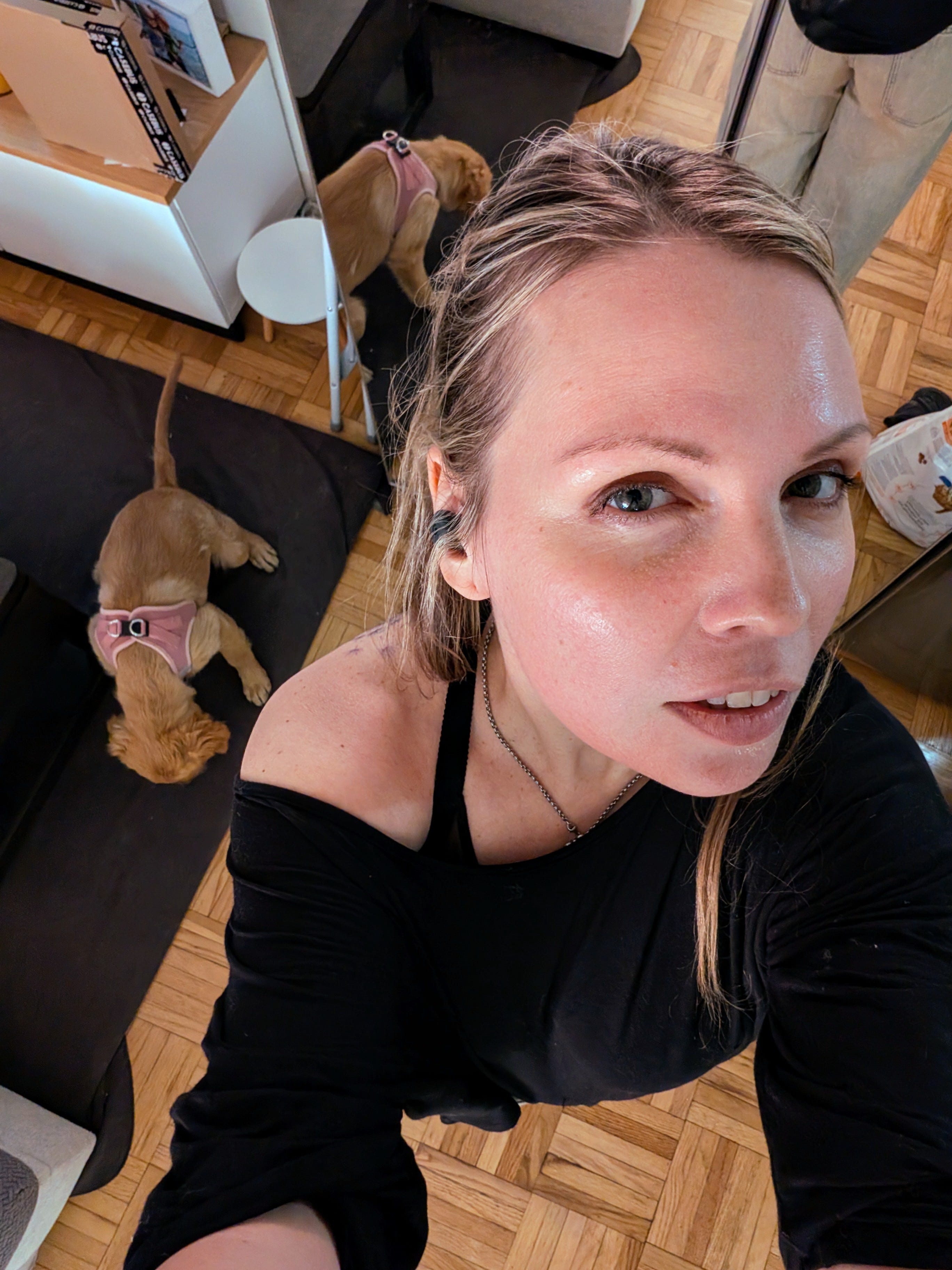
Lately my life has felt like a constant loop of cleaning puppy accidents, reheating the same coffee four times, trying to finish a book, remembering to eat protein, and attempting to maintain the illusion that I’m a very organized person.
This weekend I’m doing a full closet reset, not because I’m becoming a minimalist influencer (relax), but mostly because I need less noise, less artificial urgency, less random impulse purchases that solved an emotional problem for approximately five minutes. I want more human signal, more breathing room, more clothes that feel like me.
This weekend, the chaos goes laboratory-grade. I’m kicking off an experiment with Alyssa: “AI vs. AB”, where in the next few days we’re pitting algorithmic prediction against human intuition to see how we can actually build a uniform that survives the 15-hour NYC gauntlet. We’re using AI for what it’s actually good at, calculating wind-chill-to-conference-room ratios and mapping precipitation windows, while Alyssa will be doing something much harder: interpreting the human signal. Style has never been a matter of mere aesthetics. It is anthropology in motion, a complex web of ritual, identity, belonging, and communication.
It is the second skin humans invented to survive the friction of existing alongside one another.
And perhaps that is the ultimate goal: not to optimize ourselves into machines, but to delegate enough of that friction to the machines so we finally have the bandwidth to feel human again.