

Let me tell you about the “first pancake” principle, because it’s the only framework that makes sense of the last two weeks of my life.
We spend so much time hiding behind the illusion of optimization, waiting for the perfect plan, querying the algorithm, running the model.
Nothing actually happens when you plan because execution eats planning for breakfast.
So I partnered with one of the most brilliant people I always learn from and we ran an experiment.
And here is something I need to confess immediately, before we go any further: I’ve been calling this an “AI experiment” for two weeks. I LIED. Sort of. We’ll get to that.
The Setup
A few weeks ago, I handed the keys to my wardrobe (and by extension, my nervous system) to two very different intelligences.
The first: AI. Tasked as my Tactical Logistics Officer. Weather analysis, calendar optimization, outfit recommendations. Pure efficiency. (Remember I’m not promoting any particular apps, these insights are my own. (I do not represent Google in this experiment).
The second: Alyssa Beltempo. Slow fashion stylist, educator, and the person who will make you realize that your overflowing wardrobe and your total lack of outfit confidence are not a coincidence. She built an entire philosophy: creativity over consumption, shop what you have, dress the woman who actually exists, promoting the very un-fast-fashion idea that a good life is rich in experiences, not units.
The question: which intelligence would actually survive a week in my life: a 15-hour NYC gauntlet involving two kids, a golden retriever puppy who treats my furniture like a subscription service, and a nervous system that treats an itchy sweater like a Category 3 incident?
Day 1: AI vs. The Laundry Bin 🤖🧺
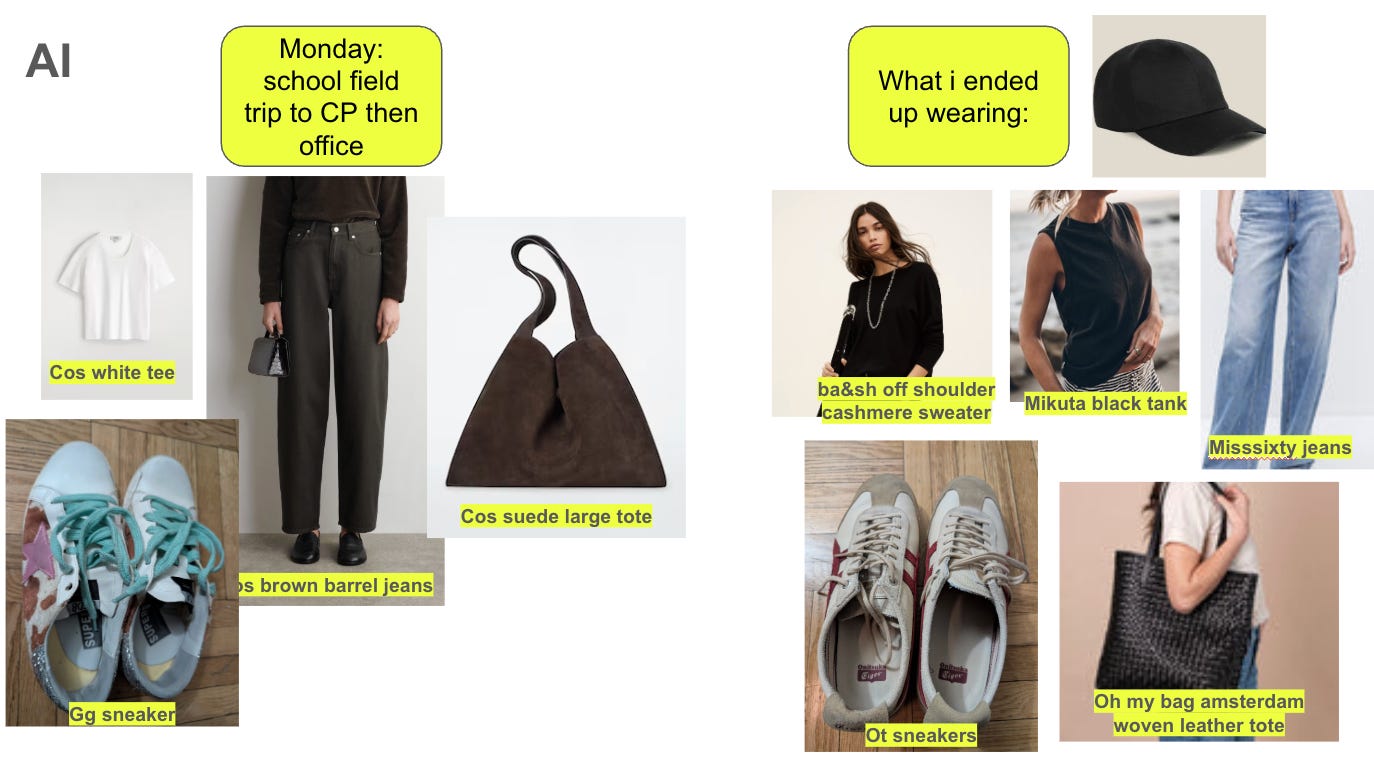
The AI delivered a flawless recommendation. COS white tee, COS brown barrel jeans, suede tote, also COS. (Yes, lots of the same brands in my capsule: it’s partly because I’m autistic, so when I like something, I lock in intensely and loop). The suggestions were logical, consistent and seasonally appropriate, by the way.
However, all of it was in the laundry.
Also: my son Teddy had a morning school field trip to the Central Park reservoir, which is a beautiful place but there is a lot of mud. White tees and Central Park with a bunch of third graders in the mud - do not mix. This is not a variable the algorithm had accounted for. This is also not a variable I thought to mention, which is, frankly, on both of us.
I abandoned the entire plan, wrapped myself in baggy jeans, an oversized black cashmere sweater I honestly wear non stop, and spent the morning in the dirt while nine-year-olds built water pipes and learned that New York City has the world’s largest municipal water supply network which was genuinely fascinating and entirely random (go New York though!).
I was late for all my afternoon meetings. I remembered to eat because I walked past the café with an awesome view and was like, let me enjoy this view one last time before I totally get fired.
First nagging thought: the system I’d just called “AI” had retrieved weather data and matched it to calendar events. This is machine learning. Possibly just a very confident spreadsheet. But we’ll get to that.
🏆 SCOREBOARD: AI 0 — Alyssa 0 — Valerie 0 — Laundry Bin 1

Day 2: The Vulnerability Hangover, Featuring My Face 🍷🦞
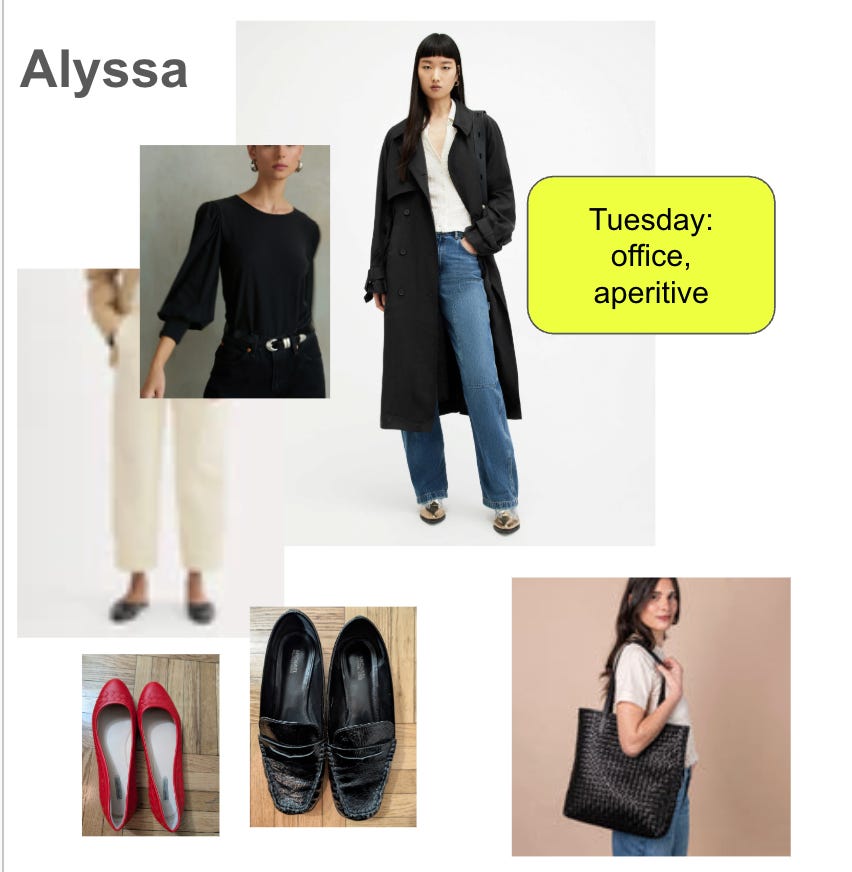
It was Alyssa’s turn. She pre-styled me for the day at the office followed by an elegant happy hour: black Nation LA blouse, cream Everlane trousers, my favorite long black trench, options for shoes. The kind of outfit that says “I have considered this” without trying too hard. Human intuition, fully deployed.
Naturally, the happy hour was canceled. A surprise team event appeared on my calendar instead.
I should explain the team event. A few weeks ago, I moved from an Engineering team into the Office of the CIO, so I don’t know everyone on the team. Also, they’re all business strategy people, program managers, stakeholders who speak in frameworks rather than APIs. I am, in this context, a tech nerd.
And so the fun part is that I did (gasp) microneedling the night before (yes, I know). My face was, clinically speaking, the color of a fire hydrant, and of course you’re not allowed a drop of makeup, not that it would have helped, to be honest.
So: new team, and I walked in glowing like a radioactive tomato wearing Alyssa’s perfectly calibrated human-intuition outfit. Enter Brené Brown’s vulnerability hangover that nauseating wave of regret that hits right after you’ve exposed your unpolished self. Every instinct screamed: fake an emergency, reschedule until your face stops looking like it lost an argument with a waffle iron.
I walked into the room anyway. And guess what? Nobody gave a shit. Even if they did, nobody said anything or even looked at me weird. And after that it hit me: professional peers don’t connect with optics, they connect with value. Whether you show up, solve the problem, move the needle. That’s it: zero ego, zero interest in your skincare situation.
Alyssa won this one decisively.
🏆 SCOREBOARD: AI 0 — Alyssa 1 — Valerie 0 — Laundry Bin 1 — My Face: Undefeated
Day 3: I Will Not Wear The Skirt 👖
The AI suggested a skirt.
A skirt?
What? NO.
I am balancing early school pickups (no regrets, by the way), a golden retriever puppy actively engaged in psychological warfare against my furniture, and a work calendar that pivots roughly every forty-five minutes.
Tech-stack logic does not compute survival mode.
I said no thank you, put on denim and a black top, and the canceled happy hour transformed into a gorgeous rooftop breakfast at the Google terrace. I picked up the kids early. I played with the dog. I let the schedule slide.
The AI had the right aesthetic instinct for the original plan. The original plan no longer existed. It had no way of knowing that.
Second nagging thought: the system that recommended the skirt had simply analyzed data and matched patterns. It did not understand that my schedule had changed, that my nervous system needed ground-level comfort, or that denim is basically armor. This is not intelligence. This is a very well-trained lookup table.
🏆 SCOREBOARD: AI 1 — Alyssa 1 — Valerie 1 — Laundry Bin 1 — My Face: Undefeated — The Skirt: DNF
Day 4: Surrender 🐱
Alyssa had planned a killer outfit. Comedy show in the evening. But my nervous system formally went on strike.
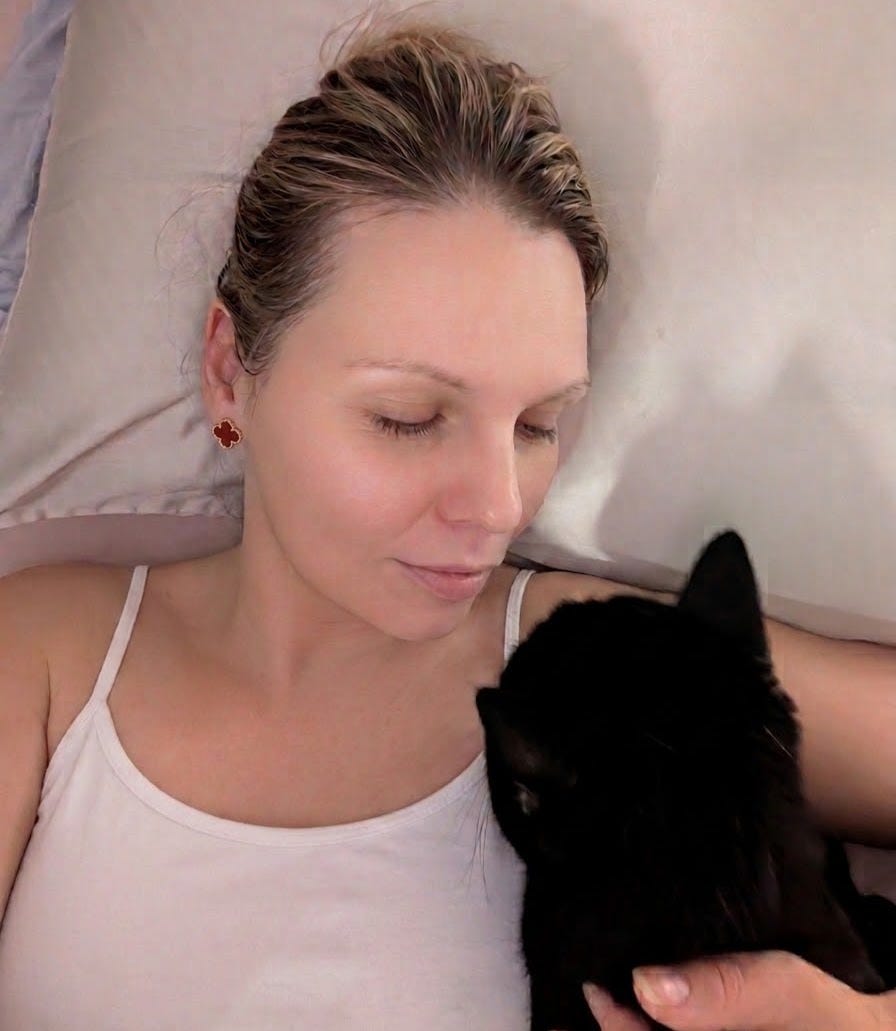
I worked from home in basics, canceled the comedy club, and spent the evening being groomed by my cat Phoebe. She pets me, not the other way around. I have accepted this dynamic completely.
Here’s the thing about winging it: it also means trusting yourself enough to know when the only correct move is the couch. No algorithm was going to give me that permission. That required being a human animal who knows her own limits.
🏆 SCOREBOARD: AI 1 — Alyssa 1 — Valerie 1 — Laundry Bin 1 — My Face: Undefeated — The Skirt: DNF — Phoebe: Won without trying
Day 5: Walking Through The Door
I threw together an outfit using a mix of Alyssa’s recommendations, and a friend grabbed last-minute tickets to an off-Broadway play: What Happened Was... a searingly intimate two-hander about attraction, secrets, and the desperate cost of letting someone in.
Sitting in that theater watching Cecily Strong and Corey Stoll dismantle each other brought the entire experiment into sharp focus.
We use data and planning to map every variable because we are terrified of the unknown. We want the frictionless guarantee. But a truly human experience requires the counterintuitive, terrifying leap of faith to walk through a door when you don’t know what’s on the other side.
No tool can take that leap for you.
🏆 FINAL SCOREBOARD: Alyssa 2 — AI 1 — Valerie 1 — Laundry Bin: Undefeated — My Face: Undefeated — The Skirt: Still DNF — Phoebe: Won without trying
Okay. Now For The Thing I’ve Been Waiting To Tell You.
I’ve been calling this an “AI experiment” this entire time.
Here’s the problem: most of what I was describing as “AI” is not, technically, AI.
When you ask a system to retrieve information, match patterns, or make a prediction based on historical data, that’s machine learning.
Machine learning (ML) has been running quietly in the background of your life for well over a decade, doing pretty cool things, getting almost no credit, and requiring approximately zero of the hype it’s currently receiving:
Spotify Discover Weekly = ML. It doesn’t feel the music. It noticed you listened to sad songs at 2am three Tuesdays in a row and drew its own conclusions.
Netflix telling you “because you watched Succession...” = ML. Collaborative filtering. It doesn’t understand drama. It just knows you watch things at 11pm when you should be sleeping.
Google Maps calculating your ETA in real time = ML. Traffic data and math having a very fast conversation.
Google Meet generating real-time captions with live translation = ML. Been doing this since 2017. Saved approximately one million meetings from total chaos.
Your bank flagging a suspicious transaction = ML anomaly detection. Statistics noticing you’ve never shopped in Bulgaria before.
Autocorrect changing “duck” to something unprintable = an n-gram language model from 2008 that has never once learned from its mistakes.
Smart Reply in Gmail (”Sounds great!”, “Happy to help!”, “I’ll look into it!”) = a sequence-to-sequence model that has never had a feeling about anything, ever, in its entire existence.
Actual generative AI is when the system creates something that didn’t exist before, like writing a draft, generating an image, building code from a description, synthesizing across documents to produce novel output.
Uploading photos of your closet and having an algorithm mix-and-match an outfit based on the weather forecast? Still just Machine Learning. It is just filtering a database of your clothes.
This matters because we’ve collectively agreed to call everything “AI” right now, which does two things: it makes the mundane sound revolutionary, and it obscures the very real environmental cost of actually running generative models at scale.
Using a massive, energy-intensive generative AI stack to figure out whether to wear a sweater is the technological equivalent of using a forklift to move a houseplant. The compute cost of a complex generative query versus a simple lookup is not trivial. You do not need a neural network to tell you it’s raining, you can look out the ducking window. A window has operated at zero energy cost for several thousand years and has never once hallucinated.
And if we call everything AI, we stop asking what it’s actually good for. ML is extraordinary at pattern recognition, retrieval, prediction, and classification all of which has been quietly revolutionizing your life since before your kids started school. Generative AI is extraordinary at synthesis, creation, and novel output. They are not the same thing, and pretending otherwise just makes it harder to use either of them well.
Three Things The Experiment Actually Proved
1. Style is somatic, not algorithmic
Alyssa’s entire philosophy is built on this. Shopping your closet isn’t a mood board exercise, it’s a physical, tactile practice. You have to touch the fabric, wear the thing, feel it on your body at hour six of a New York Tuesday. The AI built a perfect outfit in theory. It had no access to the laundry schedule, the mud situation, the nervous system report from 7am. The body knows before the model does.
2. Use the right tool (seriously)
Not every problem requires the most sophisticated tool available, in fact, most problems don’t. Matching the right tool to the right task, and refusing to over-engineer the rest, is both more efficient and significantly lower impact. This applies to fashion consumption and to compute.
3. Predictability is an illusion, execution is the point
The AI gave me a perfect plan on Day 1. The laundry laughed. Alyssa gave me a beautiful outfit on Day 2. Reality threw microneedling and a team event at me. Good planning is about direction and vision, but execution is what actually happens. And execution requires a human who can feel the room shift, notice the happy hour has been canceled, and decide, in real time, to wear the jeans.
The “Market Finder”, The Pancake, And Why None Of This Is New
Before I pivoted into AI/ML, I spent eight years on Google’s Global Expansion Team where one of the many things we did was, we helped build a beautiful tool Google Market Finder, I think it’s still well and alive (and free) on Think with Google, a mathematical marvel that could pinpoint the perfect market for international growth and theoretically automate most of what our team did.
It didn’t replace us.
Here is why:
(Quick demo): you enter your website URL OR your product category, your industry → It will synthesize search demand, purchasing power, competitive signals, consumer behavior patterns, digital infrastructure scores (and thousands of categories across hundreds of markets) and will surface where your product has the highest growth potential.
What you get is, in the most flattering possible way, a digital mood board for global domination.
It tells you, for example: India. 1.4 billion people, enormous search volume, much of it in English, one of the fastest growing digital consumer markets on the planet.
What it cannot tell you is that “India” is not a market. It is 28 states and 8 union territories, 22 scheduled languages, 121 major languages, 270 mother tongues. The English queries that made the dashboard glow is the internet’s lingua franca, not a proxy for cultural fluency, not a guarantee that your checkout flow makes sense to anyone, and definitely not a signal that one market entry strategy will work from Mumbai to Chennai to Lucknow to Bangalore. (The actual move here, and I say this having watched enough face-plants to know, is to pick one city and treat it like a country. Mumbai is not India. But done right, Mumbai is a masterclass that earns you the right to attempt the rest.)
And that’s actually the small thing.
The bigger thing (the thing Market Finder can’t model) is that entering a new market isn’t about optimization: it’s not taking your domestic brand, adding a currency converter and a translation layer, and calling it global. It’s starting a relationship from zero as a new brand where nobody owes you attention.
The data can tell you the door is open. It cannot tell you how to walk through it without looking like you’ve never left your own house before.
Every expansion that actually worked had one thing in common: the brand was willing to make the ugly first pancake. To show up before they were ready. To be small in a new place long enough to become real there, with zero ego: Market Finder can map the territory beautifully. It cannot manufacture the willingness to get lost in it.
So stop waiting for the perfect data set to guarantee you won’t look foolish.
Go grab your pan, make the pancake, and let it be wonderfully, structurally, irreparably imperfect.
This is the conclusion of the AI vs. AB experiment, a YouTube video coming soon! The full setup lives in Fashion Is a Nervous System Problem. Alyssa Beltempo’s slow fashion universe is at @msbeltempo - go fall into it. The laundry bin is available for comment but has not responded to requests.
What makes this piece land so strongly is how you move from a playful experiment into a structural truth about how decisions actually get made in real life. The laundry bin, the canceled plans, and the micro-needling moment are not side stories; they are the data that exposes the limits of prediction when context is incomplete. You are showing that intelligence is not the ability to optimize a plan in advance, but the ability to adapt when the plan stops mattering. I appreciate the clarity and honesty with which you surface that distinction.