A comedian friend of mine recently joked that tech bros only invented AI to replace women and avoid the friction of real relationships.
I laughed, of course. It’s a sharp punchline because it touches an open nerve in our culture: our obsessive impulse to treat human relationships like an inefficient system error that can be patched out with software. But later, the sheer irony of the situation hit me like a poorly targeted algorithm. Here is my friend, a comedian, taking the screaming absurdity of our hyper-optimized reality and spinning it into raw, vulnerable stage time to connect with actual, breathing humans.
Meanwhile, an anthropologist (supposedly on the mission to study human connection - me) finds solace in retreating into a completely silent room to type words into a glowing screen, hoping to decode the exact same absurdity. Are we both just drowning in the exact same existential dread, just choosing different emotional survival suits? We’re both just trying to survive.
But before I could fully unpack that, I had to fly out to California for a tech summit. And that’s where the laughter died in my throat.
It’s actually not what you think it is.
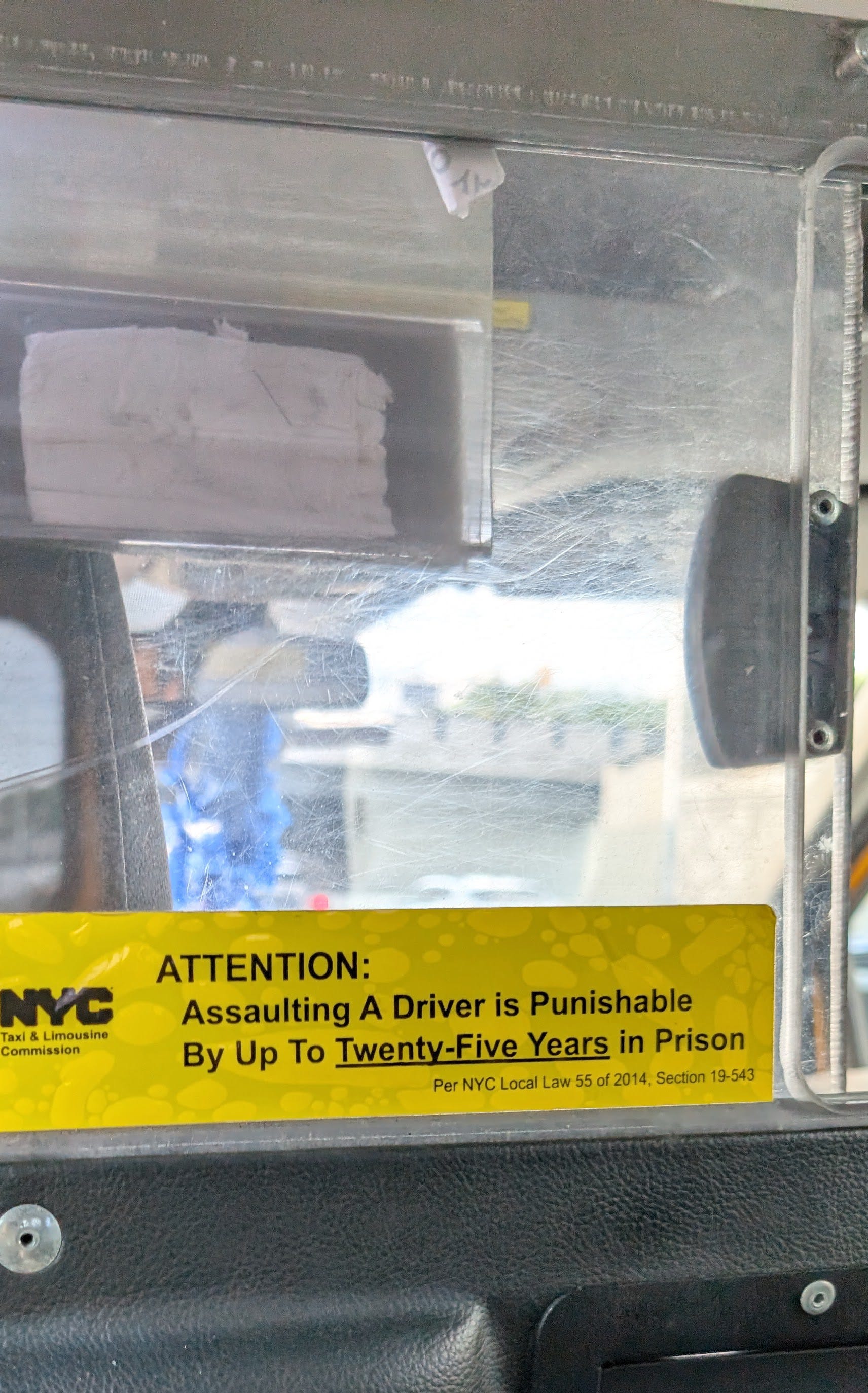
I’ll start by explaining that there are no driverless cars roaming the streets of New York City (yet). In New York, my relationship with transit is beautifully physical (I mean, let’s be real, not always “beautifully” 🐀💩😵💫, but still): I walk, I bike, I take a bus, or I hop a ferry. If I absolutely must take a vehicle, it’s a yellow cab, complete with a heavy plastic shield of separation between me and the driver, and a charming sign reading “Assaulting a Driver is Punishable By Up To Twenty-Five Years in Prison.” (read it with a thick New Yawk accent).
What is does though, it sets a clear, unspoken boundary of non-engagement, and frankly, I am quite fine with that.
But parts of California, specifically places in what we refer to as the Silicon Valley, operate under a completely different, deeply unhinged spatial logic. You simply cannot just walk places. I always try to book my lodging deceptively “close” to the office. I look at the map and think, Oh, look, a lovely 15-minute stroll!
But somehow, it is never actually possible or safe to traverse on foot. The map lies. You attempt to walk and suddenly find yourself standing on the shoulder of an eight-lane highway with no sidewalk, staring down a concrete abyss, realizing that a simple pedestrian crossing requires a death wish. It is the ultimate cosmic joke: in the name of absolute comfort and automotive supremacy, we have built cities where we are literally imprisoned by our own infrastructure. We are marooned in a suburban layout designed entirely for cars, trapped in a luxury cage, forced into the rideshare pool because walking across the street is a high-stakes extreme sport.
And that is when the universe decided to test my ethnographic tolerance.
Valerie’s Ethnography: “The Silicon Valley Uber Chronicles”
Before my mechanical sanctuary arrived, I had to survive the organic alternative. After stepping out of a series of meetings and social events that had already fried my nervous system into a data-heavy shatter, I endured a string of California ride-share trips that ranged from deeply problematic to hilariously uncomfortable.
Exhibit A: I’m Scared
Let’s call him Brian. Brian didn’t just drive; he prophesied. Within three minutes of entering his vehicle, Brian had warned me extensively against the Illuminati, laid bare the entire geopolitical framework of God and the Devil, and seamlessly pivoted to explaining how women are being abducted every single day. He paused, caught my eye dead-on in the rearview mirror, and looked over his shoulder. “But not just in Africa, sister. Right here. They’re watching.” I mean, I just wanted to get to my hotel, not audition for a psychological thriller.
Exhibit B: The Disillusioned Globetrotter
Next up was a gentleman from Turkey, who spent the entire crawl explaining the absolute supremacy of his homeland, immediately followed by a brutal review of his American driving career. He had driven Uber in five different major US cities, and according to his rigorous analysis, every single one of them was “completely shit and fucking depressing everywhere.” A beautifully uplifting narrative. Truly, thank you for that existential weight.
Exhibit C: The Rom-Com Delusion.
And finally, the guy who decided that a standard suburban traffic light was the perfect, high-stakes setting to completely hit on me. Like… what? Sir. Look at me. I am uncomfortable, overstimulated, my nervous system is shattered, and I am wearing an oversized hoodie, I’m literally hiding myself from the world.
By the time I escaped the final vehicle, my baseline of human tolerance was in the negatives. The organic world wasn't just exhausting; it felt like a psychological hazing ritual. I didn't want a human connection.
But looking back on those rides through the lens of my own autism, I realize why these interactions hit me with such a devastating impact. As an autistic person, my brain processes social information without a built-in firewall. When people tell me about the Illuminati, or complain about the depressing state of American cities, I don’t naturally push back or jump to judge. I sit there, listening and not reacting. Objectively, they are just sharing their specific side of the world with me, and in the moment, I have no objective context to dispute their reality. I treat their words with a level of earnest weight that most neurotypical passengers probably bypass with a polite laugh or a quick pivot to their phones.
Because I process everything so literally, I often don’t even know how I actually feel about an interaction while it’s happening. The emotional bill arrives later, all at once, leaving me drained.
The truth is, my absolute best, highest-effort attempt at building a defensive wall is simply putting on a pair of massive, noise-canceling headphones. But in the organic world, people just talk right over them anyway.
I didn’t just want an optimized ride. I desperately needed to protect my own un-fenced boundaries from the sheer, uncurated weight of other people.
And that’s when I climbed into a completely silent, autonomous capsule.
Enter The Viral Sanctuary
This is where the real comedy of my intellectual undoing began. I actually recorded several videos during the ride, in one of them you can see me looking at the empty driver’s seat, sighing deeply, and whispering to the camera, “This is so relaxing. I really like it.”
It felt so... nice. And clean. And completely frictionless. I even caught myself genuinely enjoying the fact that the car’s default automated voice was female: efficient, non-intrusive, and entirely devoid of opinions on global conspiracies.
As the steering wheel began turning itself through the streets, my initial intellectual skepticism collapsed into pure, visceral relief. Behind my calm expression was a massive ideological meltdown. I usually rail against the sterile, hyper-optimized bubbles of modern tech. Yet, stepping into that driverless car felt like entering a holy sanctuary. It forced me to sit with a deeply uncomfortable, personal question: Am I a hypocrite?
The Optimization of the Other
The anthropology of tech isn’t just about what we build; it’s about how our bodies react to it. What fascinated me as a researcher was watching my own biology adjust in real-time. The transition from “this is terrifying sci-fi” to “this is just Thursday” happens with terrifying speed. We accept a new baseline of predictability, and our bodies crave it because the alternative, the chaotic, unpredictable human world, requires immense energy.
This is what I call The Optimization of the Other. We are increasingly using automation not to build a better outer world, but to program away the risk of human interaction. The convenience economy promises to remove “friction,” but in doing so, it turned out to have a dark side.
As my absolute goddess of social relationship wisdom, Esther Perel, so brilliantly warns us: we are moving toward a “contactless world” where predictive technologies teach us to expect zero friction. But when you try to smooth out every rough edge, you turn intimacy into a flat, commercial process. She reminds us that people are by definition imperfect and unpredictable, and we need that exact friction to build our actual “relational skills.”
When we optimize away the discomfort of negotiating with a real, live human being, we flatten the connection entirely. We try to optimize the people around us until they match our exact specifications, forgetting that a partner who never pushes back isn’t a partner, they’re an appliance.
We see this systemic error bleeding heavily into our modern misconceptions about romantic relationships. Our world has become entirely obsessed with performance, outcome, and immediate gratification. We want transactional validation and predictable metrics of success.
But what happens when you treat romance like a delivery app? What happens when you focus so entirely on the ultimate outcome that you optimize away what actually matters?
When we engineer out the messy, uncertain path to intimacy, we destroy the very terrain where love is formed: the liminal space where we don’t have immediate answers. The spaces where we are forced to long, to hope, to wonder, and to sit in the heavy, beautiful suspense of the unknown. When you optimize all of that away, you are no longer experiencing a relationship. What you have left is the predictable, transactional commodity of an “OnlyFans” experience, intimacy stripped of its risk, simulated for consumption, and completely devoid of an actual, autonomous Other.
The Architecture of Desire: Why We Need the Slow Burn
This cultural obsession with flattening out time and optimizing away the difficult bits is exactly why, in my own creative life, I chose to write a slow-burn epic historical series. The Firebound Saga’s key relationships are a slow burn not because it’s a convenient narrative trope, but because intimacy requires a crucible.
In a hyper-optimized world where you can swipe, click, and satisfy a desire in milliseconds, we have forgotten the profound psychological utility of waiting. In historical epics, separation isn’t just an obstacle; it’s the architecture of desire. The space between characters, the accumulation of trust, is where transformation actually occurs. And yes, there is an intense, dark comedy to the stakes of that world: when your brooding male lead goes off to war, he becomes a bit of a Schrödinger husband (he is sort of there, but maybe not, or not for long). The constant undercurrent of mortal risk forces a radical clarity about what actually matters.
Compare that high-stakes, soul-forging medieval pining to the grim, unromantic reality of modern couples during the peak optimization of lockdown. When you strip away all mystery and force two people onto a living room couch 24/7, you aren’t building intimacy but testing human endurance. Without space, suddenly you are trapped in a low-stakes psychological thriller: Omg, he’s chewing his cereal so loudly. Omg, why is he breathing like that? Omg, is he still talking to me? (Pretend I’m asleep).
You cannot micro-dose or fast-forward intimacy without breaking the magic, but you also can’t over-saturate it until it smothers the flame. True connection requires boundaries to cross and distance to bridge. The transformation doesn’t happen when the path is perfectly cleared, or when you are trapped on the couch together forever, it happens entirely in the high-stakes, unpredictable friction of the journey.
The Gen A Experiment: Pings, Pups, and Soul-Searching
This desire to optimize away human messiness becomes equally dangerous, and hilarious, when we apply it to parenting. I recently discussed this concept on my podcast, Anthro AI, with Florencia Bernthal, a Lacanian psychoanalyst exploring how digital spaces reshape human subjectivity. Together, we unpacked what we call the “Gen A Experiment”. Generation Alpha represents the first population in human history where we are increasingly outsourcing the “why” of childhood to a mirror that has no soul.
But while the academic implications are weighty, the day-to-day reality of raising these tech-native humans is an absolute comedy of errors.
Take my son, Teddy (9), recently got his very first kids’ smartwatch (location tracking and messaging are the only features). The goal was pure independence, let him proudly walk the dog on his own and build some real-world confidence. It was supposed to be a milestone of growth. Instead, it turned my phone into an unending, hilarious stream of consciousness.
Now my screen lights up every forty seconds with high-stakes status updates:
“Mom, the dog smelled a leaf.”
“Mom, a lady looked at the dog.”
“Mom, I am walking faster now.”
“Mom, I see the annoying guy who always gives advice about dogs!”
It turns out that granting a child tech-enabled freedom doesn’t actually remove the friction of parenting, it just digitizes the commentary.
And when they aren’t walking the dog, the technology becomes an open pipeline for the ultimate childhood crisis: existential boredom.
Exhibit D: The Escalation Loop
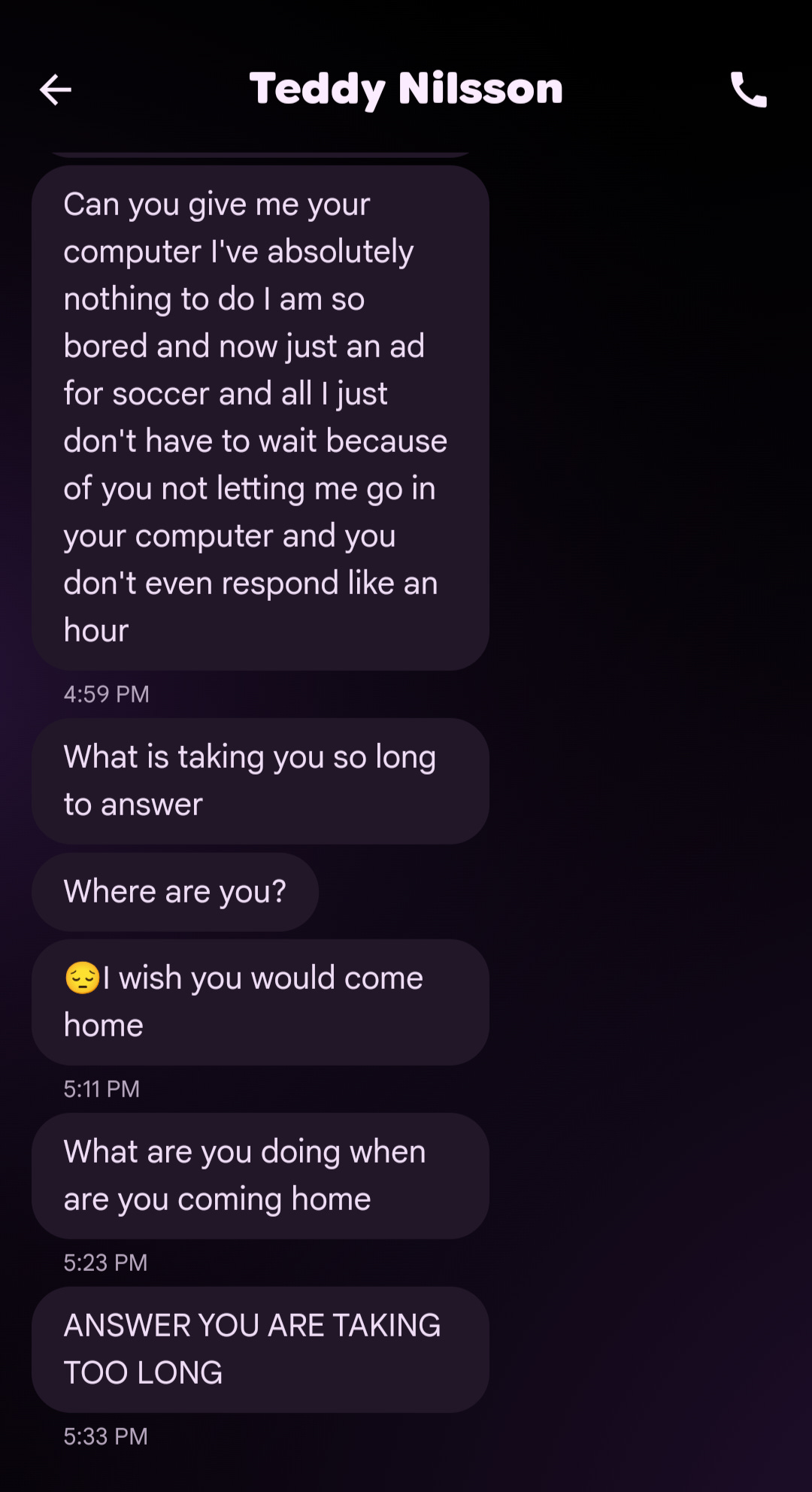
As you can see from my log of text alerts, the void of unstructured time is treated like an active emergency. Teddy hits me with a wall of text at 4:59 PM: “Can you give me your computer I’ve absolutely nothing to do I am so bored...” When the machine doesn’t offer instant satisfaction, the timeline spirals. By 5:33 PM, it hits a fever pitch: “ANSWER YOU ARE TAKING TOO LONG.”
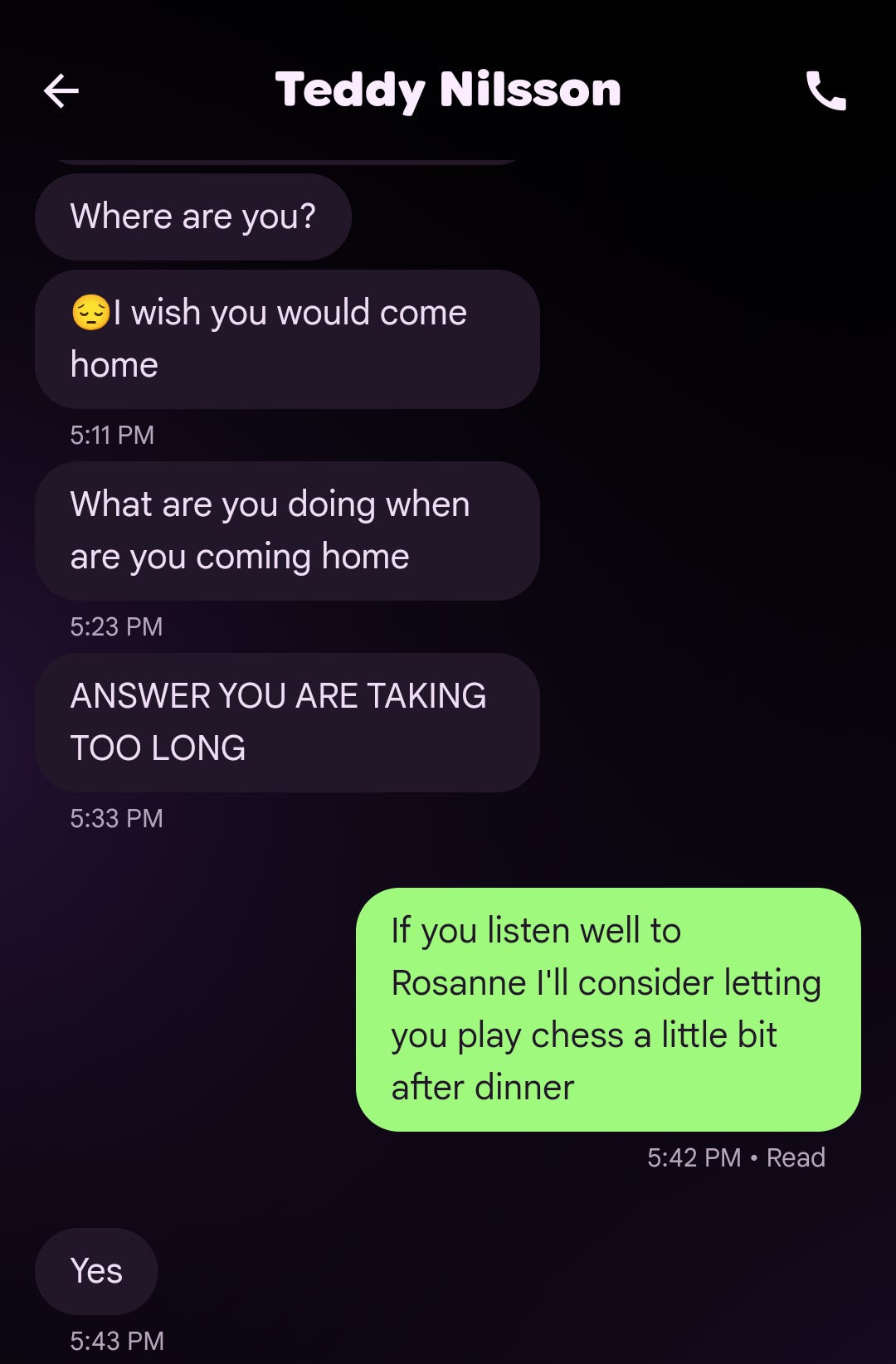
But notice what happens next when I refuse to pave over the road for him. I don’t give him the laptop. I let him stew in that uncomfortable, screen-free void for another nine minutes before laying down a high-friction, conditional boundary at 5:42 PM: “If you listen well to Rosanne I’ll consider letting you play chess a little bit after dinner.”
One minute later, the digital tantrum completely collapses into a classic, offline solution. At 5:43 PM, he replies: “Yes.”
By forcing him to sit in the boredom, he didn’t get an automated dopamine hit and then he chose a deeply strategic, centuries-old analog board game.
But when I’m running on empty, trying to balance a professional role and the children, the temptation to completely outsource life’s complexities to technology is real. When they ask deep questions, or when you are just trying to survive the evening, it’s incredibly easy to reply, “Can you just ask Google? Use the Gemini speaker.” In fact, I caught myself doing exactly that in our battle over screen time.
Exhibit E: The “Ask Google” Trap
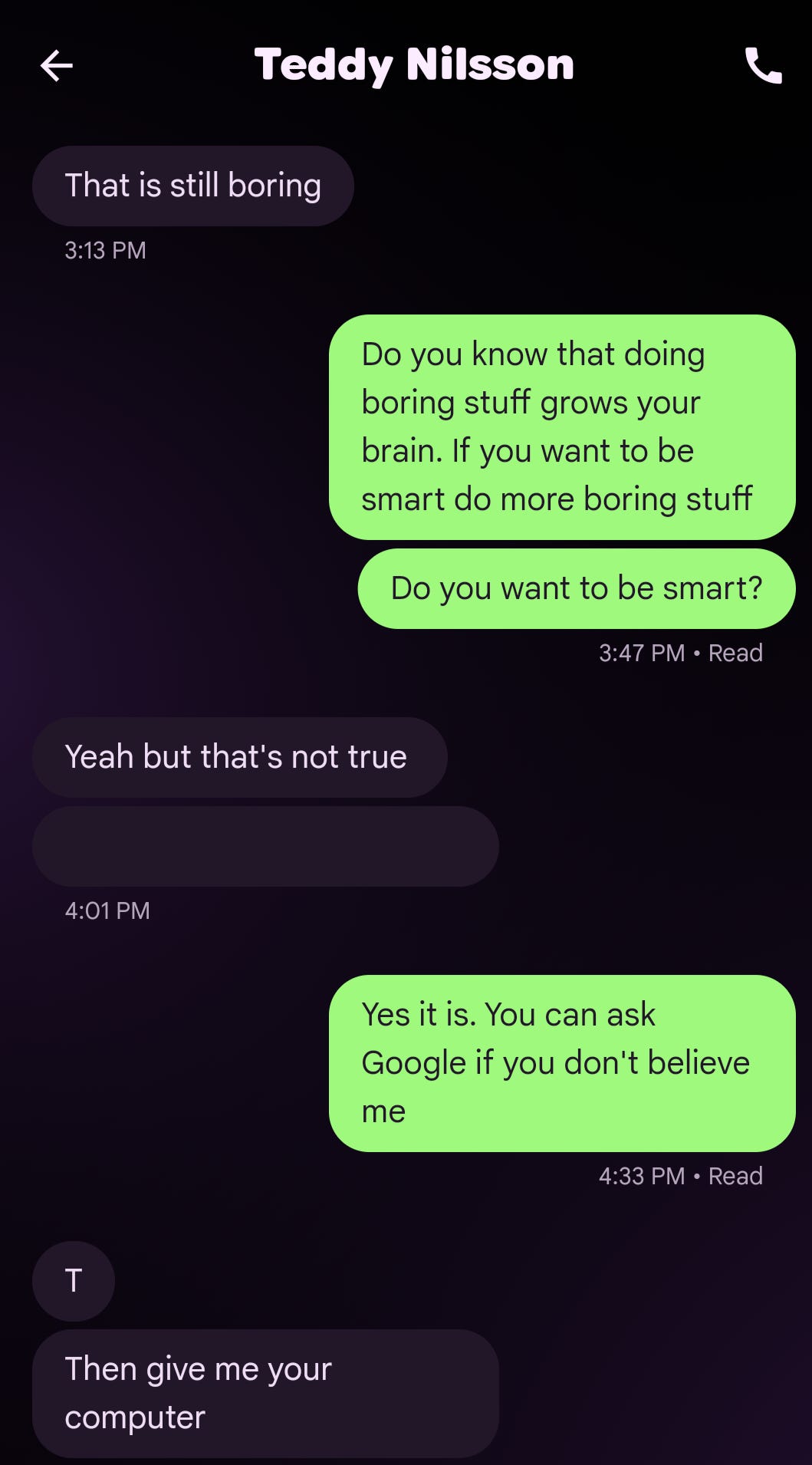
Here is another example: when Teddy tells me my thesis on boredom growing your brain is “not true,” my default defense mechanism is to point him right back to the machine: “Yes it is. You can ask Google if you don’t believe me.” To which he responds with flawless logic: “Then give me your computer.”
Touché, Teddy.
But as Florencia pointed out during our chat, if we jump to provide automated, friction-free answers to everything, or give them the devices to patch every silent pocket of the day, we slide into “plow parenting”, actively cutting off any sense of frustration before it can even begin. By trying to make their operational worlds completely perfect, we treat them like objects to be managed. Florencia raised the chilling question: are we risking raising children who are operationally flawless but psychologically empty, simply because they have never had to navigate a boundary or handle a moment of boredom?
Trusting the Friction
Thankfully, the kids themselves usually provide the antidote to our over-engineering. They aren’t nearly as fragile as our hyper-optimized tools want them to be. They are capable, curious, and profoundly competent learners. If we just step back and let them sit in the empty space of a minor frustration, or let them send fifty text messages about a dog sniffing a sidewalk, they figure it out.
Florencia reminded me of a core psychoanalytic truth: human growth requires “lack.” It is in the empty space of boredom, or a parent’s “not right now,” that a child is forced to activate their own imagination and discover who they are.
We don’t need to patch every void with a dopamine loop or an immediate, perfect answer. Sometimes, the best parenting tool is simply allowing the journey to be a little bit manual.
Technology can beautifully augment our lives, the silent, clean sanctuary of my autonomous California ride proved that to my shattered nervous system. It gave me a temporary pocket of safety to breathe when the human world became too loud. But a machine can only mirror us; it cannot teach our children how to navigate the beautiful, chaotic, high-friction labor of being human. If we give them the space to do it, they will surprise us every single time.
Thanks for reading! Subscribe for free to receive new posts and support my work.
Beautifully written. It’s fascinating how we use technology to understand ourselves, only to realize the answers we’re searching for still live in human connection.


Beautifully written. It’s fascinating how we use technology to understand ourselves, only to realize the answers we’re searching for still live in human connection.